House approves adjustments to Natural Resources Protection Act amid environmental debate
March 12, 2026 | 2026 Legislature ME, Maine
This article was created by AI summarizing key points discussed. AI makes mistakes, so for full details and context, please refer to the video of the full meeting. Please report any errors so we can fix them. Report an error »
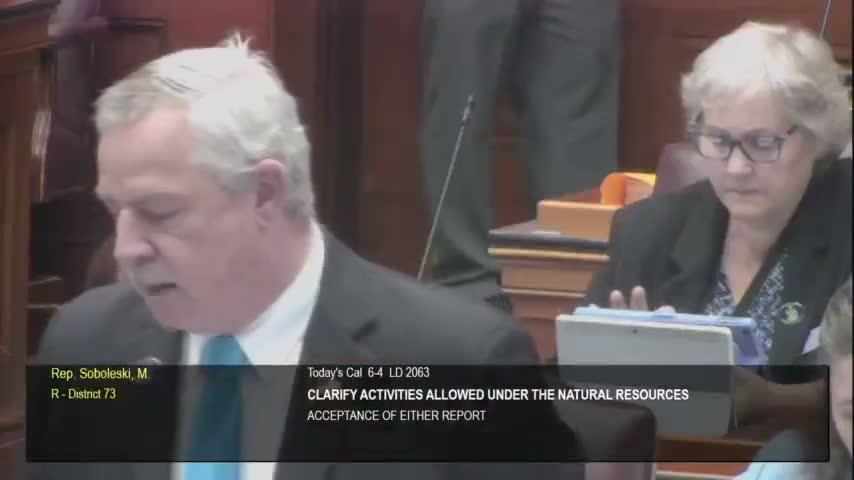
The Maine House voted to accept the majority report and pass LD 2063 as amended, a measure that modifies definitions and DEP oversight under the Natural Resources Protection Act (NRPA).
Representative Sobolewski (speaker 16) opposed the amendment on the floor, saying it ‘‘narrows the Natural Resource Protection Act in a way that reduces the DEP's ability to review work occurring directly beside streams, wetlands, and other protected resources’’ and warned that the amendment would exempt road-related activities that can ‘‘significantly increase sediment and flow, and alter water flow.’’ He argued that site-specific conditions and field review by DEP are necessary to catch cumulative harms rather than relying solely on statutory checkboxes.
Representative Duda (speaker 15) and others defended the report and amendment as science-based adjustments that equip the Department of Environmental Protection with useful tools. ‘‘Merely what it's doing is offering some very thoughtful, science-based adjustments to the Natural Resources Protection Act,’’ Duda said, adding that the majority report includes provisions addressing significant impacts to great ponds.
On the roll call, the House recorded 73 members voting in the affirmative and 68 in the negative; the motion prevailed and the measure was agreed to by the chamber and sent for the next steps in the legislative process.
Supporters framed the change as providing the DEP with additional options to protect lakes and ponds; opponents urged caution, arguing that tightening definitions and narrowing oversight could lead to incremental environmental damage not captured by statute.
Representative Sobolewski (speaker 16) opposed the amendment on the floor, saying it ‘‘narrows the Natural Resource Protection Act in a way that reduces the DEP's ability to review work occurring directly beside streams, wetlands, and other protected resources’’ and warned that the amendment would exempt road-related activities that can ‘‘significantly increase sediment and flow, and alter water flow.’’ He argued that site-specific conditions and field review by DEP are necessary to catch cumulative harms rather than relying solely on statutory checkboxes.
Representative Duda (speaker 15) and others defended the report and amendment as science-based adjustments that equip the Department of Environmental Protection with useful tools. ‘‘Merely what it's doing is offering some very thoughtful, science-based adjustments to the Natural Resources Protection Act,’’ Duda said, adding that the majority report includes provisions addressing significant impacts to great ponds.
On the roll call, the House recorded 73 members voting in the affirmative and 68 in the negative; the motion prevailed and the measure was agreed to by the chamber and sent for the next steps in the legislative process.
Supporters framed the change as providing the DEP with additional options to protect lakes and ponds; opponents urged caution, arguing that tightening definitions and narrowing oversight could lead to incremental environmental damage not captured by statute.
Don't Miss a Word: See the Full Meeting!
Go beyond summaries. Unlock every video, transcript, and key insight with a Founder Membership.
✓
Get instant access to full meeting videos
✓
Search and clip any phrase from complete transcripts
✓
Receive AI-powered summaries & custom alerts
✓
Enjoy lifetime, unrestricted access to government data
30-day money-back guarantee
