Committee hears "Kayla's Hope" bridge-safety bill, lays it over for omnibus consideration
March 13, 2026 | 2026 Legislature MN, Minnesota
This article was created by AI summarizing key points discussed. AI makes mistakes, so for full details and context, please refer to the video of the full meeting. Please report any errors so we can fix them. Report an error »
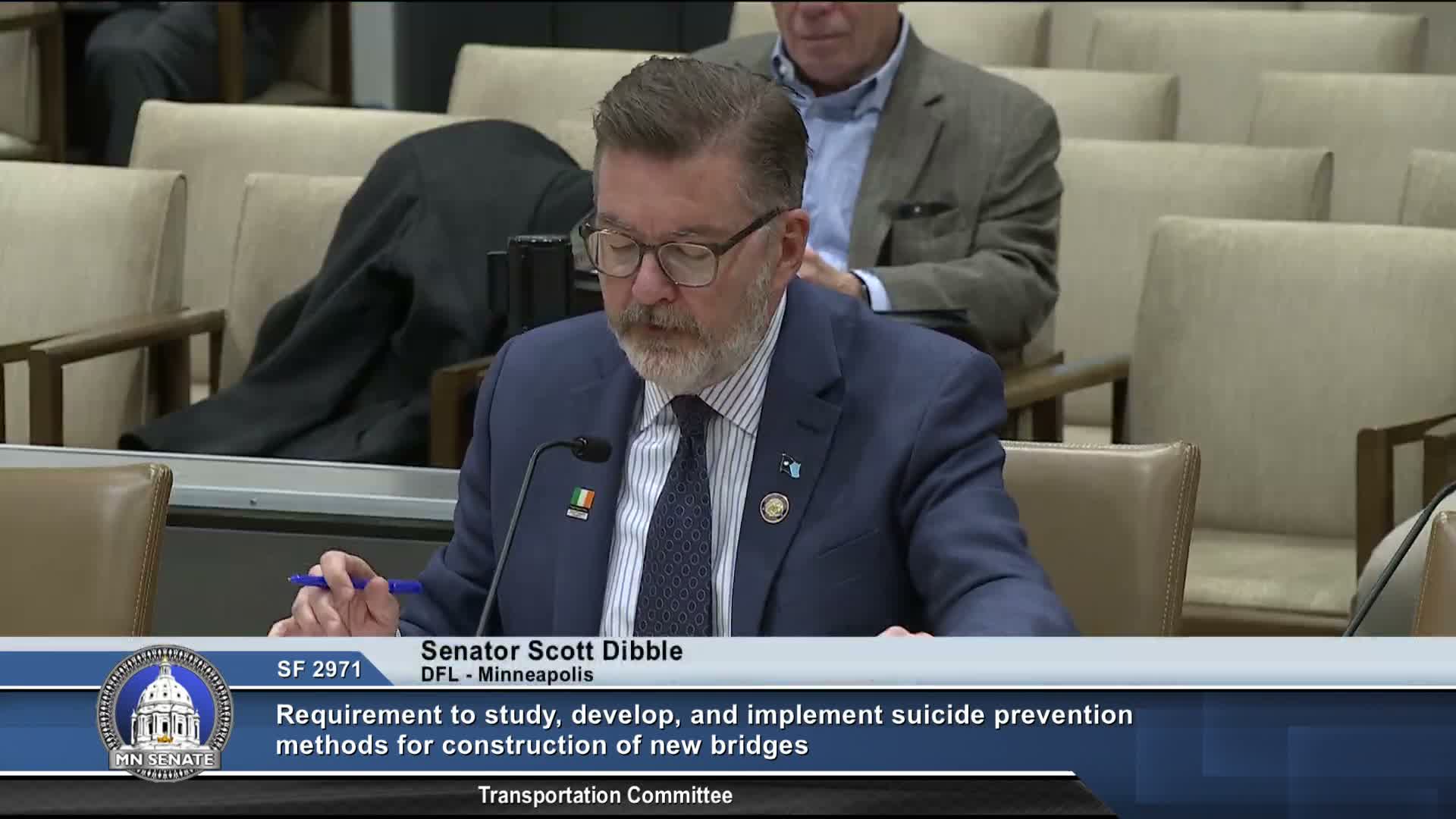
Senate File 2971, a proposal to create a statewide, data-driven framework for evaluating suicide-prevention measures on bridges, was heard Tuesday by the Minnesota Senate Transportation Committee. Sponsor Senator Dibble described a bill that would direct the commissioner of transportation, working with the Department of Health, to identify bridges with histories of suicide-related deaths, collect annual data, develop best-practice design criteria and implement suicide-reduction railings where they are determined to be appropriate and feasible.
Family members and advocacy groups urged action. "This bill gives our state the opportunity to lead the nation in preventing further heartbreak and turning grief into hope," said MJ Weisz Blair, who identified herself as the mother of Kayla and urged passage of what she called "Kayla's Hope Act." Eric Mishke, CEO of SAVE (Suicide Awareness Voices of Education), said SAVE worked with MnDOT on the language and cited recent state funding for a University of Minnesota structure, adding that barriers "interrupt suicidal impulsivity" and save lives.
Trish Morello, co-founder of the Coalition for Suicide Prevention and Public Infrastructure, put the proposal in a national context, saying other states and a pending federal bill aim to address barriers at high-risk structures. She recounted the Natchez Trace Parkway bridge case and described how short delays can create time for intervention.
Committee members asked targeted implementation questions. Senator Jaczynski raised whether the bill would affect bridges listed on state or national historic registers; Senator Dibble said he expected MnDOT and the State Historic Preservation Office (SHPO) to work through historic-preservation concerns and cited past design negotiations on the Mendota Bridge as precedent.
There was no final committee approval of the underlying bill on Tuesday. After testimony and discussion, Senator Dibble said the intend was to "lay it on the table for consideration" and the committee laid Senate File 2971 over for possible inclusion in a future omnibus bill.
What happens next: The bill remains eligible for inclusion in the upcoming omnibus process and staff indicated MnDOT and the Department of Health would be asked to provide technical input on historic-bridge impacts and the proposed methodology.
Family members and advocacy groups urged action. "This bill gives our state the opportunity to lead the nation in preventing further heartbreak and turning grief into hope," said MJ Weisz Blair, who identified herself as the mother of Kayla and urged passage of what she called "Kayla's Hope Act." Eric Mishke, CEO of SAVE (Suicide Awareness Voices of Education), said SAVE worked with MnDOT on the language and cited recent state funding for a University of Minnesota structure, adding that barriers "interrupt suicidal impulsivity" and save lives.
Trish Morello, co-founder of the Coalition for Suicide Prevention and Public Infrastructure, put the proposal in a national context, saying other states and a pending federal bill aim to address barriers at high-risk structures. She recounted the Natchez Trace Parkway bridge case and described how short delays can create time for intervention.
Committee members asked targeted implementation questions. Senator Jaczynski raised whether the bill would affect bridges listed on state or national historic registers; Senator Dibble said he expected MnDOT and the State Historic Preservation Office (SHPO) to work through historic-preservation concerns and cited past design negotiations on the Mendota Bridge as precedent.
There was no final committee approval of the underlying bill on Tuesday. After testimony and discussion, Senator Dibble said the intend was to "lay it on the table for consideration" and the committee laid Senate File 2971 over for possible inclusion in a future omnibus bill.
What happens next: The bill remains eligible for inclusion in the upcoming omnibus process and staff indicated MnDOT and the Department of Health would be asked to provide technical input on historic-bridge impacts and the proposed methodology.
Don't Miss a Word: See the Full Meeting!
Go beyond summaries. Unlock every video, transcript, and key insight with a Founder Membership.
✓
Get instant access to full meeting videos
✓
Search and clip any phrase from complete transcripts
✓
Receive AI-powered summaries & custom alerts
✓
Enjoy lifetime, unrestricted access to government data
30-day money-back guarantee
