Advisory Council on Traffic Safety presents 2025 report; committee discusses oral-fluid testing and emerging road-safety priorities
March 13, 2026 | 2026 Legislature MN, Minnesota
This article was created by AI summarizing key points discussed. AI makes mistakes, so for full details and context, please refer to the video of the full meeting. Please report any errors so we can fix them. Report an error »
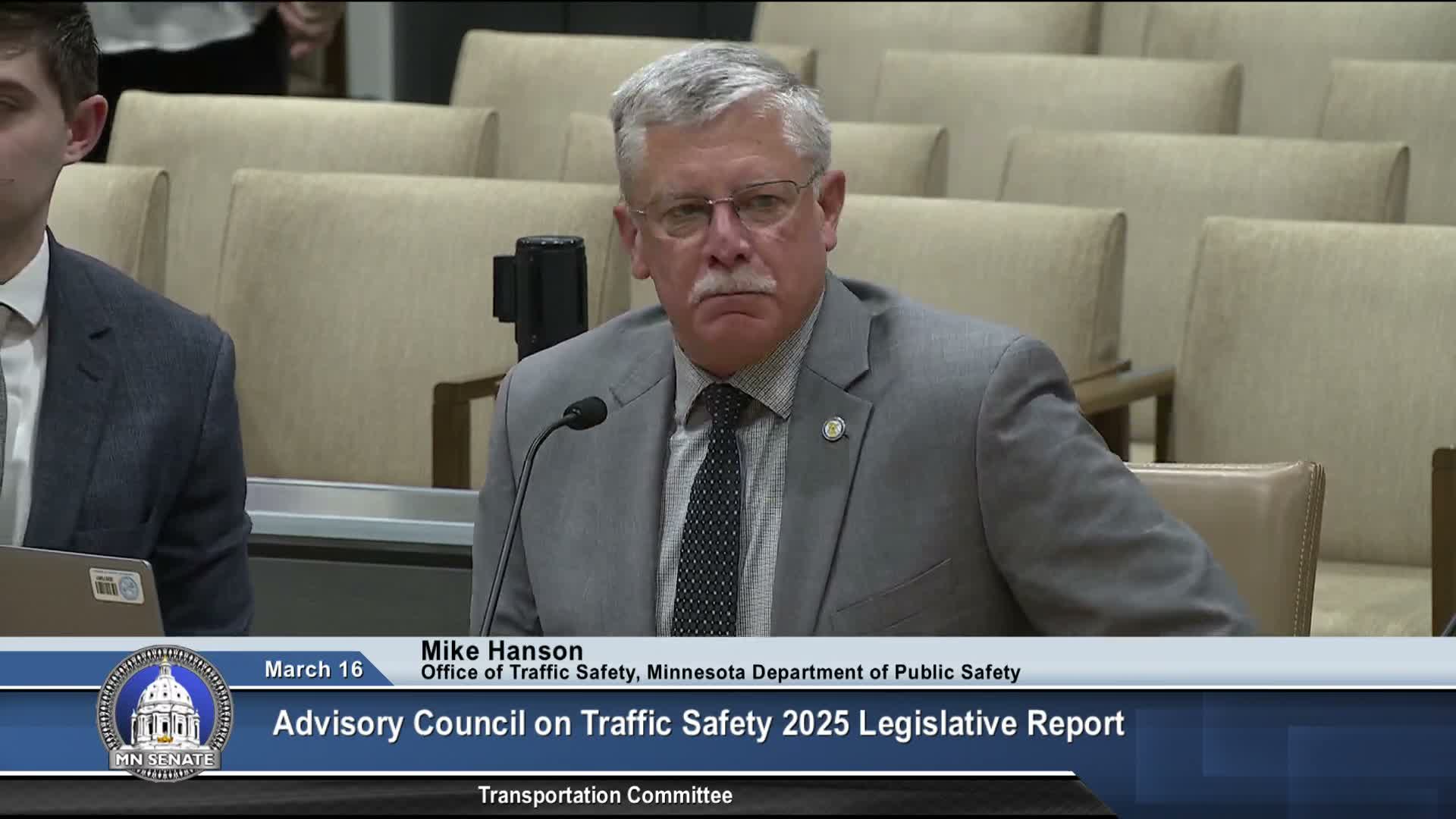
Mike Hansen, director of the Minnesota Department of Public Safety's Office of Traffic Safety and vice chair of the Advisory Council on Traffic Safety, presented the council's 2025 report to the committee, outlining the council's role in the Strategic Highway Safety Plan (SHSP) and programs that supported a drop in fatalities.
Hansen said Minnesota saw a notable reduction in traffic fatalities in 2025 but that 373 families still experienced fatal crashes; he credited one-time 2023 appropriations (about $14 million) for rural high-risk roadway improvements and the Safe Road Zones program. Hansen also highlighted emerging issues: growing drug-impaired driving trends, oral-fluid roadside testing pilots (41 agencies across 36 counties) that detect multiple substances, pilot speed-camera deployments (Highway 7), and tests of automated vehicles (Waymo testing in Minneapolis with safety drivers).
Committee members focused on data and operational constraints. Senator Jaczynski and others asked why drug impairment did not appear in top contributing-factor tables; Hansen said data-collection gaps exist because lethal alcohol readings can stop further lab testing and that oral-fluid screening and expanded lab work will be necessary to quantify drug involvement. He said the state has nearly 400 Drug Recognition Evaluators (DREs) among roughly 11,500 licensed peace officers and that training is costly (about $28,000'$30,000 per officer).
Panelists from the Minnesota Safety Council, the Department of Health and driver-education advocates supported the council's framework. Paul Austin (Minnesota Safety Council) urged continued enforcement and engineering countermeasures such as roundabouts and cable median barriers. Dr. Catherine Diamond (Minnesota Department of Health) framed the council's work as public-health prevention and urged resources to implement the SHSP. Pete Hosmer (MIDCEA) described online driver-education pilots and urged broader access.
What happens next: Committee members asked for additional data on drug impairment and for more information on program deployment and resource needs; Hansen said legislation to authorize oral-fluid screening is expected to come before the committee.
Hansen said Minnesota saw a notable reduction in traffic fatalities in 2025 but that 373 families still experienced fatal crashes; he credited one-time 2023 appropriations (about $14 million) for rural high-risk roadway improvements and the Safe Road Zones program. Hansen also highlighted emerging issues: growing drug-impaired driving trends, oral-fluid roadside testing pilots (41 agencies across 36 counties) that detect multiple substances, pilot speed-camera deployments (Highway 7), and tests of automated vehicles (Waymo testing in Minneapolis with safety drivers).
Committee members focused on data and operational constraints. Senator Jaczynski and others asked why drug impairment did not appear in top contributing-factor tables; Hansen said data-collection gaps exist because lethal alcohol readings can stop further lab testing and that oral-fluid screening and expanded lab work will be necessary to quantify drug involvement. He said the state has nearly 400 Drug Recognition Evaluators (DREs) among roughly 11,500 licensed peace officers and that training is costly (about $28,000'$30,000 per officer).
Panelists from the Minnesota Safety Council, the Department of Health and driver-education advocates supported the council's framework. Paul Austin (Minnesota Safety Council) urged continued enforcement and engineering countermeasures such as roundabouts and cable median barriers. Dr. Catherine Diamond (Minnesota Department of Health) framed the council's work as public-health prevention and urged resources to implement the SHSP. Pete Hosmer (MIDCEA) described online driver-education pilots and urged broader access.
What happens next: Committee members asked for additional data on drug impairment and for more information on program deployment and resource needs; Hansen said legislation to authorize oral-fluid screening is expected to come before the committee.
Don't Miss a Word: See the Full Meeting!
Go beyond summaries. Unlock every video, transcript, and key insight with a Founder Membership.
✓
Get instant access to full meeting videos
✓
Search and clip any phrase from complete transcripts
✓
Receive AI-powered summaries & custom alerts
✓
Enjoy lifetime, unrestricted access to government data
30-day money-back guarantee
