Snohomish County task force flags $14M–$27M structural gap; recommends mix of modest revenue, banked capacity and targeted cuts
March 11, 2026 | Snohomish County, Washington
This article was created by AI summarizing key points discussed. AI makes mistakes, so for full details and context, please refer to the video of the full meeting. Please report any errors so we can fix them. Report an error »
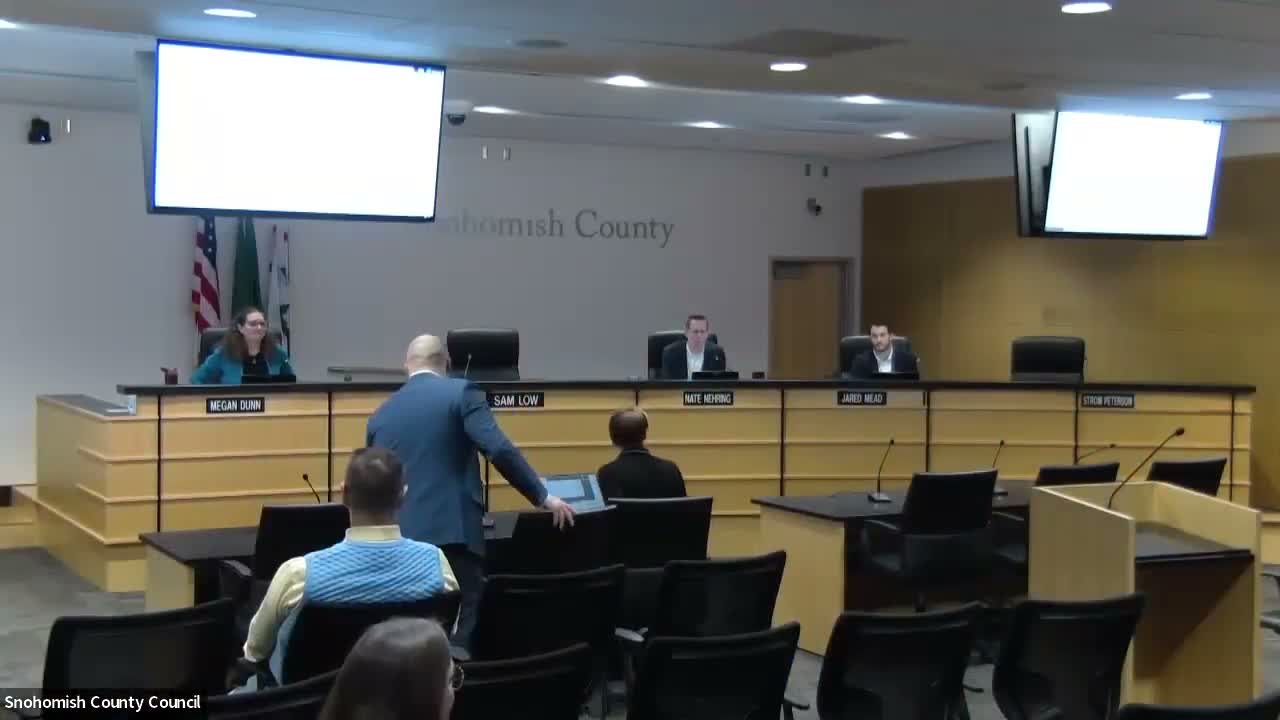
Caramine Hester, chief budget officer in the county executive's office, presented the fiscal sustainability task force advisory report during the March 11 Snohomish County Council meeting and said the county faces a structural general‑fund deficit that will widen without action. "By definition, a structural deficit," she said, presenting adopted 2026 numbers showing a $14,000,000 deficit in the near term and about $27,000,000 in each year thereafter.
Hester summarized the task force’s prioritized, near‑term recommendations: use banked property‑tax capacity (about $4,000,000 sequenced across the biennium), an annual 1% property‑tax revenue increase where available, a formal fund‑balance target policy, and fee cost‑recovery with indexing. She said those baseline actions might yield roughly $5,000,000 toward the 2027–28 biennium but would not close the structural gap on their own.
The task force also analyzed other revenue levers and trade‑offs. Hester said a $20 vehicle‑license fee for the Transportation Benefit District (TBD) would raise about $6,000,000 for the roads (Rhodes) fund but does not affect the general fund. She described a public‑safety enhancement sales tax (one‑tenth of a percent) as a significant revenue source that could provide roughly $20,000,000 depending on state action, but she noted it is regressive and politically difficult: "No one likes the concept of a point 1% sales tax," Hester said.
Ray Steffensen of the Economic Alliance said the gap is driven by state revenue constraints and mandated costs and urged a balanced approach. "If we can't get permits done, businesses will go to other counties," he said, and he recommended the council consider reassigning jail responsibility to the county executive to control jail cost overruns.
Carrie Caffrey of AFSCME Council 2, speaking from the labor perspective, warned that vacancy management and workforce reductions carry significant operational risks, including higher overtime, burnout, and loss of institutional knowledge. "Strategic vacancy management is not cost neutral," she said.
Natalie Reber of the Master Builders urged careful evaluation of vacancy and staffing options and highlighted technology, including AI tools, as a way to reduce mundane staff work and increase efficiency without immediate layoffs.
Councilmembers pressed for a deeper, department‑level review of expenditures and for executive‑legislative cooperation. Several members said they prefer to show the public that discretionary spending has been examined before asking voters for new revenue. Chair Jared Dunn proposed creating an internal ad hoc committee of council and executive members to give the council ownership of any proposal — including what a public‑safety sales tax would fund — and to provide regular updates to the council and the public.
Hester and task force members said more departmental study is necessary to validate specific cuts and that sequencing of actions (which revenues or cuts happen first) matters to reducing risk. The task force recommended a combination of revenue and expense measures rather than a single approach.
Next steps discussed at the meeting included further study, coordinated executive‑legislative review, and the potential formation of an ad hoc internal committee to refine options and public messaging.
Hester summarized the task force’s prioritized, near‑term recommendations: use banked property‑tax capacity (about $4,000,000 sequenced across the biennium), an annual 1% property‑tax revenue increase where available, a formal fund‑balance target policy, and fee cost‑recovery with indexing. She said those baseline actions might yield roughly $5,000,000 toward the 2027–28 biennium but would not close the structural gap on their own.
The task force also analyzed other revenue levers and trade‑offs. Hester said a $20 vehicle‑license fee for the Transportation Benefit District (TBD) would raise about $6,000,000 for the roads (Rhodes) fund but does not affect the general fund. She described a public‑safety enhancement sales tax (one‑tenth of a percent) as a significant revenue source that could provide roughly $20,000,000 depending on state action, but she noted it is regressive and politically difficult: "No one likes the concept of a point 1% sales tax," Hester said.
Ray Steffensen of the Economic Alliance said the gap is driven by state revenue constraints and mandated costs and urged a balanced approach. "If we can't get permits done, businesses will go to other counties," he said, and he recommended the council consider reassigning jail responsibility to the county executive to control jail cost overruns.
Carrie Caffrey of AFSCME Council 2, speaking from the labor perspective, warned that vacancy management and workforce reductions carry significant operational risks, including higher overtime, burnout, and loss of institutional knowledge. "Strategic vacancy management is not cost neutral," she said.
Natalie Reber of the Master Builders urged careful evaluation of vacancy and staffing options and highlighted technology, including AI tools, as a way to reduce mundane staff work and increase efficiency without immediate layoffs.
Councilmembers pressed for a deeper, department‑level review of expenditures and for executive‑legislative cooperation. Several members said they prefer to show the public that discretionary spending has been examined before asking voters for new revenue. Chair Jared Dunn proposed creating an internal ad hoc committee of council and executive members to give the council ownership of any proposal — including what a public‑safety sales tax would fund — and to provide regular updates to the council and the public.
Hester and task force members said more departmental study is necessary to validate specific cuts and that sequencing of actions (which revenues or cuts happen first) matters to reducing risk. The task force recommended a combination of revenue and expense measures rather than a single approach.
Next steps discussed at the meeting included further study, coordinated executive‑legislative review, and the potential formation of an ad hoc internal committee to refine options and public messaging.
Don't Miss a Word: See the Full Meeting!
Go beyond summaries. Unlock every video, transcript, and key insight with a Founder Membership.
✓
Get instant access to full meeting videos
✓
Search and clip any phrase from complete transcripts
✓
Receive AI-powered summaries & custom alerts
✓
Enjoy lifetime, unrestricted access to government data
30-day money-back guarantee
