Legislators and tribal leaders press insurers and state agencies over soaring home insurance costs on tribal lands
March 13, 2026 | California State Assembly, House, Legislative, California
This article was created by AI summarizing key points discussed. AI makes mistakes, so for full details and context, please refer to the video of the full meeting. Please report any errors so we can fix them. Report an error »
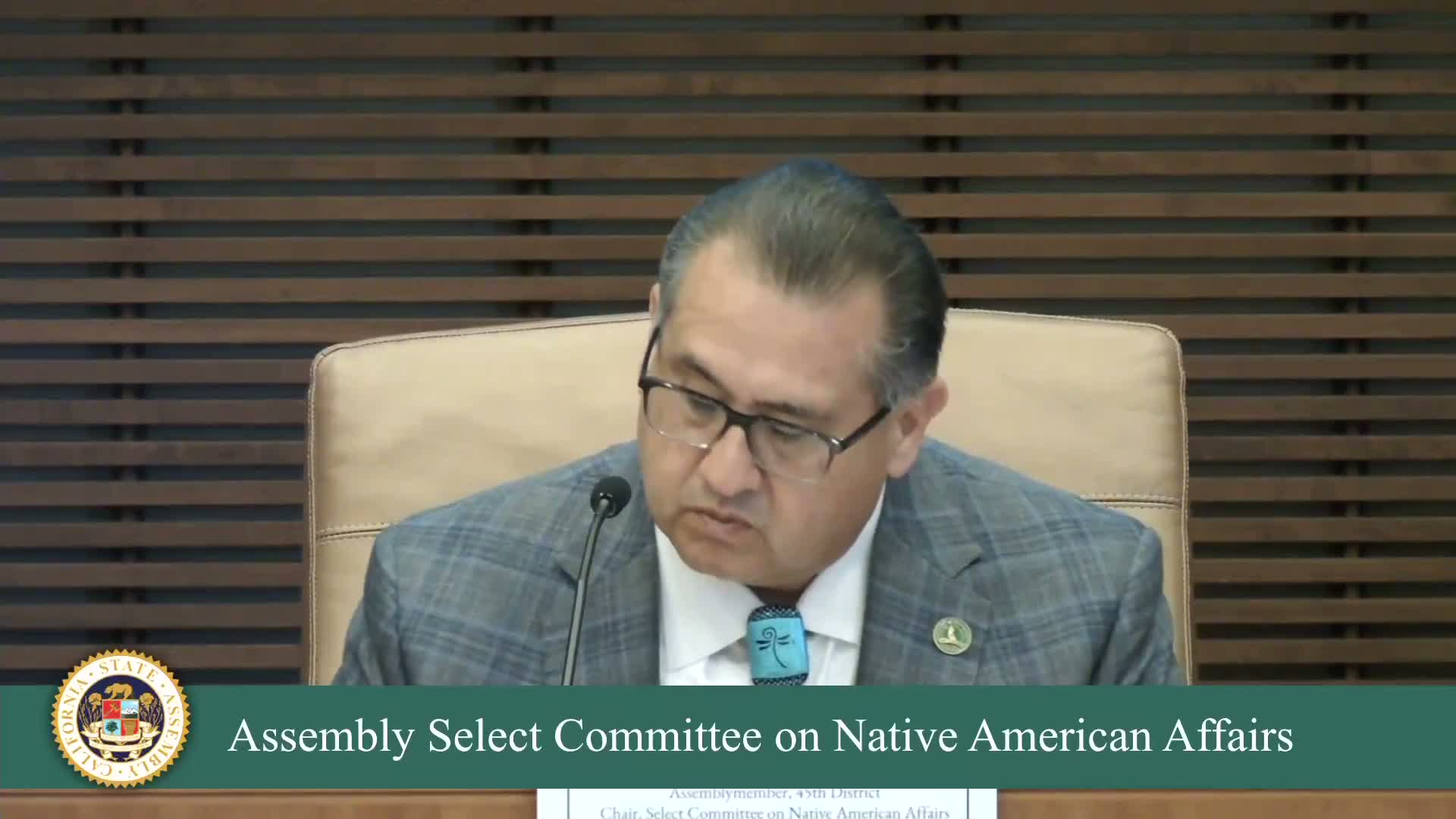
Members of the California State Assembly’s Select Committee on Native American Affairs met March 13, 2026 on Barona tribal land to examine how rising homeowners insurance costs are affecting tribal communities across the state. Tribal leaders, tribal fire chiefs and state officials described active mitigation work on reservations and said that, despite local efforts, many members face sharply higher premiums or lack of coverage altogether.
Raymond Wells, chairman of the Barona Band of Mission Indians, told the committee that his community has seen premiums “from $6,000 to $18,000 per year” on homes they track and warned that unaffordable insurance can threaten tribal housing and sovereignty. “We will fight to ensure that insurance costs never force a single member to leave their home,” Wells said.
Several tribal leaders and fire chiefs described extensive local mitigation and emergency-response capacity. Isaiah Vivanco, chairman of the Soboba Band of Luiseño Indians, said Soboba reduced its Public Protection Classification from a 3 to a 2 and that his tribe has invested in a fire department and a WUI crew. Pechanga Fire Chief Jason Keeling and Verona (Barona) Fire Chief Ken Krimsky described year-round fuels projects, prescribed burns and mutual-aid contributions that also protect neighboring communities.
Speakers faulted insurers for relying on coarse mapping or remote desktop tools rather than on-site assessments that would recognize tribal mitigation. Keeling said insurers “need to come out and personally survey” properties so homeowner investments in clearance and home hardening are reflected in rates. Tribal leaders described grants and pilot programs designed to harden homes and said tribal governments often face procedural or environmental barriers when applying for those funds.
Frank Bigelow, deputy director of CAL FIRE’s Community Wildfire Preparedness and Mitigation Division, described CAN FIRE’s tribal engagement initiatives: tribal liaisons on incident management teams, a southern-region tribal affairs deputy chief, and direct funding. Bigelow told the committee CAL FIRE has awarded more than $30,000,000 to 25 California tribes for wildfire resilience and reported that some 12,000 acres of tribal lands burned in 2023–2025 (reported to the National Fire Incident Reporting System). He acknowledged that tribal-specific grant outreach and uptake remain areas for improvement.
Insurance Commissioner Ricardo Lara framed the problem as a mix of climate-driven losses, legacy land patterns and insufficient tribal data. Lara said insurers have too often defaulted to worst-case assumptions when granular data are missing. To address market failure, Lara outlined the department’s Sustainable Insurance Strategy (SIS), including a public statewide wildfire model intended to allow tribal governments to demonstrate the effect of mitigation and cultural burning. He said the department is advancing legislation to modernize the California Fair Plan (AB 1680) and to strengthen disaster recovery and claims handling (SB 876).
Sarin (Sarin Aaron) Taylor of the Personal Insurance Federation of California discussed market pressures: catastrophic wildfire losses that erased decades of underwriting gains, and reconstruction-cost inflation that raises replacement estimates. Taylor described practical constraints on in-person home inspections in rural areas and noted the industry often relies on photo checklists, agent reports and third‑party models; she and the commissioner urged clearer, consistent communication on mitigation standards (for example, the IBHS wildfire‑prepared home standard) so homeowners and tribes can prioritize effective retrofits.
Legislators pressed both regulators and agencies on concrete next steps. Members asked the department to hold town halls and consultations with tribal governments, to ensure mitigation discounts required by regulation are operationalized for sovereign lands, and to develop granular data so insurers cannot rely on outdated or proprietary algorithms without oversight. Lara committed to expanded outreach, government‑to‑government consultation and to making the public wildfire model available to tribal governments.
Public commenters and state emergency‑management representatives urged better federal‑state‑tribal coordination for predeployment of firefighting assets, clarified mutual‑aid changes that now allow tribal signatories, and recommended investment in shared infrastructure such as helicopter tanks for early deployment.
The hearing produced no formal votes. Committee members asked staff and regulators to schedule tribal town halls and to provide data on tribal grant applications and awards. The committee adjourned with legislators saying they would carry testimony into future budget and policy discussions.
Raymond Wells, chairman of the Barona Band of Mission Indians, told the committee that his community has seen premiums “from $6,000 to $18,000 per year” on homes they track and warned that unaffordable insurance can threaten tribal housing and sovereignty. “We will fight to ensure that insurance costs never force a single member to leave their home,” Wells said.
Several tribal leaders and fire chiefs described extensive local mitigation and emergency-response capacity. Isaiah Vivanco, chairman of the Soboba Band of Luiseño Indians, said Soboba reduced its Public Protection Classification from a 3 to a 2 and that his tribe has invested in a fire department and a WUI crew. Pechanga Fire Chief Jason Keeling and Verona (Barona) Fire Chief Ken Krimsky described year-round fuels projects, prescribed burns and mutual-aid contributions that also protect neighboring communities.
Speakers faulted insurers for relying on coarse mapping or remote desktop tools rather than on-site assessments that would recognize tribal mitigation. Keeling said insurers “need to come out and personally survey” properties so homeowner investments in clearance and home hardening are reflected in rates. Tribal leaders described grants and pilot programs designed to harden homes and said tribal governments often face procedural or environmental barriers when applying for those funds.
Frank Bigelow, deputy director of CAL FIRE’s Community Wildfire Preparedness and Mitigation Division, described CAN FIRE’s tribal engagement initiatives: tribal liaisons on incident management teams, a southern-region tribal affairs deputy chief, and direct funding. Bigelow told the committee CAL FIRE has awarded more than $30,000,000 to 25 California tribes for wildfire resilience and reported that some 12,000 acres of tribal lands burned in 2023–2025 (reported to the National Fire Incident Reporting System). He acknowledged that tribal-specific grant outreach and uptake remain areas for improvement.
Insurance Commissioner Ricardo Lara framed the problem as a mix of climate-driven losses, legacy land patterns and insufficient tribal data. Lara said insurers have too often defaulted to worst-case assumptions when granular data are missing. To address market failure, Lara outlined the department’s Sustainable Insurance Strategy (SIS), including a public statewide wildfire model intended to allow tribal governments to demonstrate the effect of mitigation and cultural burning. He said the department is advancing legislation to modernize the California Fair Plan (AB 1680) and to strengthen disaster recovery and claims handling (SB 876).
Sarin (Sarin Aaron) Taylor of the Personal Insurance Federation of California discussed market pressures: catastrophic wildfire losses that erased decades of underwriting gains, and reconstruction-cost inflation that raises replacement estimates. Taylor described practical constraints on in-person home inspections in rural areas and noted the industry often relies on photo checklists, agent reports and third‑party models; she and the commissioner urged clearer, consistent communication on mitigation standards (for example, the IBHS wildfire‑prepared home standard) so homeowners and tribes can prioritize effective retrofits.
Legislators pressed both regulators and agencies on concrete next steps. Members asked the department to hold town halls and consultations with tribal governments, to ensure mitigation discounts required by regulation are operationalized for sovereign lands, and to develop granular data so insurers cannot rely on outdated or proprietary algorithms without oversight. Lara committed to expanded outreach, government‑to‑government consultation and to making the public wildfire model available to tribal governments.
Public commenters and state emergency‑management representatives urged better federal‑state‑tribal coordination for predeployment of firefighting assets, clarified mutual‑aid changes that now allow tribal signatories, and recommended investment in shared infrastructure such as helicopter tanks for early deployment.
The hearing produced no formal votes. Committee members asked staff and regulators to schedule tribal town halls and to provide data on tribal grant applications and awards. The committee adjourned with legislators saying they would carry testimony into future budget and policy discussions.
Don't Miss a Word: See the Full Meeting!
Go beyond summaries. Unlock every video, transcript, and key insight with a Founder Membership.
✓
Get instant access to full meeting videos
✓
Search and clip any phrase from complete transcripts
✓
Receive AI-powered summaries & custom alerts
✓
Enjoy lifetime, unrestricted access to government data
30-day money-back guarantee
