Bellevue planners debate 70‑foot access corridors and a no‑minimum parking approach for Wilburton TOD
March 27, 2024 | Parks and Community Services Board, Bellevue, King County, Washington
This article was created by AI summarizing key points discussed. AI makes mistakes, so for full details and context, please refer to the video of the full meeting. Please report any errors so we can fix them. Report an error »
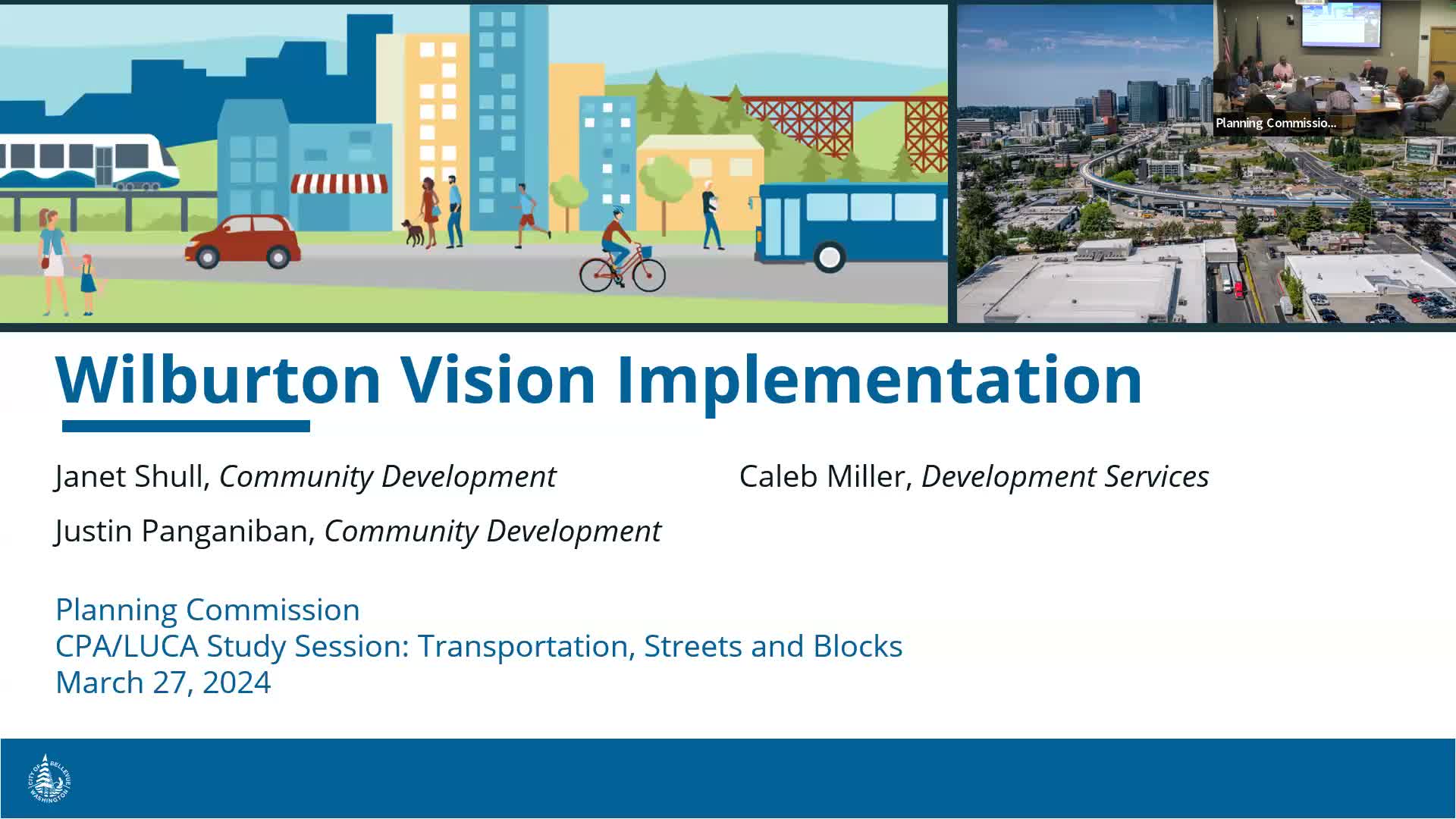
City of Bellevue planning staff presented a detailed package March 27 aimed at implementing the Wilburton transit‑oriented development vision, prompting debate over a proposed 70‑foot flexible access standard and whether the city should keep or drop minimum parking requirements.
Staff framed the proposal as a package of complementary changes: a maximum block perimeter of 1,200 feet; vehicular access roughly every 500 feet and non‑motorized access every 250 feet; four access types (local streets, flexible access corridors, active‑transportation corridors and internal block access); and a recommendation to set maximum parking ratios while eliminating citywide minimum parking mandates in Wilburton. Justin Panganiban, the city’s urban designer, described the access concept as a toolkit to create greater permeability and pedestrian connections to Eastrail and light‑rail stations.
"The 70 feet is measured from the building faces on each side of it," said Caleb Miller, senior planner, explaining the width is not all pavement but includes room for vehicular movement, sidewalks, planting strips and bike lanes. "It will account for space for landscaping, sidewalks, bike lanes, parking lanes, and other needs that the developer can choose from." Miller said a 20‑foot minimum for two‑way traffic would typically be part of that width and that the design goal includes space for tree canopy.
Public commenters representing property owners and developers generally supported removing minimum parking requirements as appropriate for a high‑capacity transit area but urged more flexible, project‑by‑project design standards rather than prescriptive dimensional minimums. "We are very supportive of the no minimum parking requirement in Wilburton," said Jackie Caray, a land‑use attorney representing an auto‑center property, while also warning that a blanket 70‑foot requirement and rigid access grids could limit density and workable site design.
Commissioners reacted with a mix of support for the street‑grid and permeability goals and concern about losing parking protections and the practical effects of the 70‑foot standard. Several commissioners asked staff to provide diagrams and comparative case studies showing how the 70‑foot corridor behaves in cross‑section and how block proportions translate into building typologies. One commissioner described removing parking minimums as a risky step without supporting market and access analysis.
The commission did not take a final vote on code language at the meeting. Staff clarified the near‑term schedule: next week’s meeting (April 3) will focus on the future land‑use map and the commission will consider a comprehensive plan amendment hearing on May 1; the LUCA (land‑use code amendment) implementing Wilburton’s detailed standards will return later in the year after consultants finalize design guidance and transportation analysis.
What happens next: staff committed to return with diagrams that show how the 70‑foot flexible access dimension is allocated (pavement, planting, sidewalks, etc.), comparative examples of block sizes, and parking best‑practice analysis (including the potential of fee‑in‑lieu or perimeter parking strategies). The Planning Commission asked staff to bring those materials before making final LUCA recommendations.
Staff framed the proposal as a package of complementary changes: a maximum block perimeter of 1,200 feet; vehicular access roughly every 500 feet and non‑motorized access every 250 feet; four access types (local streets, flexible access corridors, active‑transportation corridors and internal block access); and a recommendation to set maximum parking ratios while eliminating citywide minimum parking mandates in Wilburton. Justin Panganiban, the city’s urban designer, described the access concept as a toolkit to create greater permeability and pedestrian connections to Eastrail and light‑rail stations.
"The 70 feet is measured from the building faces on each side of it," said Caleb Miller, senior planner, explaining the width is not all pavement but includes room for vehicular movement, sidewalks, planting strips and bike lanes. "It will account for space for landscaping, sidewalks, bike lanes, parking lanes, and other needs that the developer can choose from." Miller said a 20‑foot minimum for two‑way traffic would typically be part of that width and that the design goal includes space for tree canopy.
Public commenters representing property owners and developers generally supported removing minimum parking requirements as appropriate for a high‑capacity transit area but urged more flexible, project‑by‑project design standards rather than prescriptive dimensional minimums. "We are very supportive of the no minimum parking requirement in Wilburton," said Jackie Caray, a land‑use attorney representing an auto‑center property, while also warning that a blanket 70‑foot requirement and rigid access grids could limit density and workable site design.
Commissioners reacted with a mix of support for the street‑grid and permeability goals and concern about losing parking protections and the practical effects of the 70‑foot standard. Several commissioners asked staff to provide diagrams and comparative case studies showing how the 70‑foot corridor behaves in cross‑section and how block proportions translate into building typologies. One commissioner described removing parking minimums as a risky step without supporting market and access analysis.
The commission did not take a final vote on code language at the meeting. Staff clarified the near‑term schedule: next week’s meeting (April 3) will focus on the future land‑use map and the commission will consider a comprehensive plan amendment hearing on May 1; the LUCA (land‑use code amendment) implementing Wilburton’s detailed standards will return later in the year after consultants finalize design guidance and transportation analysis.
What happens next: staff committed to return with diagrams that show how the 70‑foot flexible access dimension is allocated (pavement, planting, sidewalks, etc.), comparative examples of block sizes, and parking best‑practice analysis (including the potential of fee‑in‑lieu or perimeter parking strategies). The Planning Commission asked staff to bring those materials before making final LUCA recommendations.
Don't Miss a Word: See the Full Meeting!
Go beyond summaries. Unlock every video, transcript, and key insight with a Founder Membership.
✓
Get instant access to full meeting videos
✓
Search and clip any phrase from complete transcripts
✓
Receive AI-powered summaries & custom alerts
✓
Enjoy lifetime, unrestricted access to government data
30-day money-back guarantee
