Senate adopts amended E-Verify 'safe harbor' framework after extended debate
March 14, 2026 | 2026 Legislature WV, West Virginia
This article was created by AI summarizing key points discussed. AI makes mistakes, so for full details and context, please refer to the video of the full meeting. Please report any errors so we can fix them. Report an error »
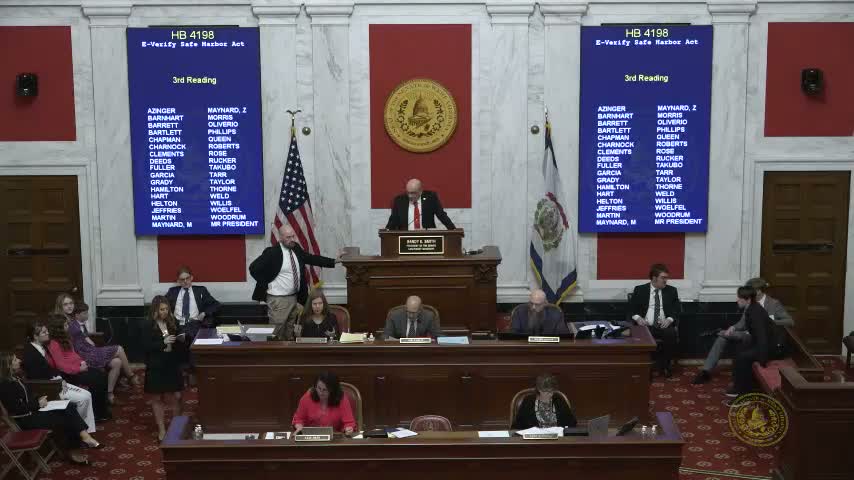
The West Virginia Senate on the final night of the session adopted an amended version of the E‑Verify Safe Harbor Act (House Bill 41‑98) after extended floor debate over small‑business exemptions, enforcement timelines and federal‑state interactions.
Senators debated several competing amendments before adopting a compromise offered by the senator from Randolph, which makes E‑Verify mandatory for state public employers and permissive for private employers while creating an incentive structure: employers that use E‑Verify receive immunity from certain state civil or criminal penalties tied to hiring unauthorized workers, while employers who do not use E‑Verify remain subject to the state's existing I‑9 documentation and a graduated penalty scheme if violations are found. "This is a compromise with the business community while also ensuring ... employers are doing what they need to do to ensure they are not employing unauthorized workers," the senator from Randolph said in floor remarks.
Opponents warned that state mandates stricter than federal practice could invite federal scrutiny of small employers. The senior senator from the fourth cautioned that differences between state rules and federal practice "invite the federal government into every business in West Virginia," arguing that a lower exemption threshold could create confusion and regulatory burdens for small businesses. The senator from Jefferson, who spoke in favor of retaining stronger mandatory language in earlier committee form, said E‑Verify is a free tool that can quickly confirm employment authorization and that existing law already requires employers to verify employees' work status.
Under the adopted amendment, the first offense for failing to maintain required records triggers a written warning after notice and an opportunity to be heard; subsequent violations carry escalating administrative sanctions, including public posting, temporary bid ineligibility on state contracts and, for third or further offenses tied to knowing, willful violations, potential revocation of a business license. The amendment also sets fines for false records and clarifies procedures for notice and hearings.
The Senate adopted an amendment to that amendment and ultimately approved the amended bill on a recorded vote (31 yays, 3 nays). The bill was declared passed and the clerk was instructed to communicate the action to the House.
The floor debate produced lengthy exchanges between members about enforcement timelines, whether E‑Verify outages or federal shutdowns could affect compliance, and whether the measure properly balances business protections and immigration enforcement. The Senate record shows multiple procedural motions during the debate as members sought to end debate and move to final action.
Next steps: the clerk will transmit the Senate's action to the House.
Senators debated several competing amendments before adopting a compromise offered by the senator from Randolph, which makes E‑Verify mandatory for state public employers and permissive for private employers while creating an incentive structure: employers that use E‑Verify receive immunity from certain state civil or criminal penalties tied to hiring unauthorized workers, while employers who do not use E‑Verify remain subject to the state's existing I‑9 documentation and a graduated penalty scheme if violations are found. "This is a compromise with the business community while also ensuring ... employers are doing what they need to do to ensure they are not employing unauthorized workers," the senator from Randolph said in floor remarks.
Opponents warned that state mandates stricter than federal practice could invite federal scrutiny of small employers. The senior senator from the fourth cautioned that differences between state rules and federal practice "invite the federal government into every business in West Virginia," arguing that a lower exemption threshold could create confusion and regulatory burdens for small businesses. The senator from Jefferson, who spoke in favor of retaining stronger mandatory language in earlier committee form, said E‑Verify is a free tool that can quickly confirm employment authorization and that existing law already requires employers to verify employees' work status.
Under the adopted amendment, the first offense for failing to maintain required records triggers a written warning after notice and an opportunity to be heard; subsequent violations carry escalating administrative sanctions, including public posting, temporary bid ineligibility on state contracts and, for third or further offenses tied to knowing, willful violations, potential revocation of a business license. The amendment also sets fines for false records and clarifies procedures for notice and hearings.
The Senate adopted an amendment to that amendment and ultimately approved the amended bill on a recorded vote (31 yays, 3 nays). The bill was declared passed and the clerk was instructed to communicate the action to the House.
The floor debate produced lengthy exchanges between members about enforcement timelines, whether E‑Verify outages or federal shutdowns could affect compliance, and whether the measure properly balances business protections and immigration enforcement. The Senate record shows multiple procedural motions during the debate as members sought to end debate and move to final action.
Next steps: the clerk will transmit the Senate's action to the House.
Don't Miss a Word: See the Full Meeting!
Go beyond summaries. Unlock every video, transcript, and key insight with a Founder Membership.
✓
Get instant access to full meeting videos
✓
Search and clip any phrase from complete transcripts
✓
Receive AI-powered summaries & custom alerts
✓
Enjoy lifetime, unrestricted access to government data
30-day money-back guarantee
