Bellevue Planning Commission sets June public hearings on comp‑plan and BelRed after long debate over lane repurposing, parking and housing
May 22, 2024 | Parks and Community Services Board, Bellevue, King County, Washington
This article was created by AI summarizing key points discussed. AI makes mistakes, so for full details and context, please refer to the video of the full meeting. Please report any errors so we can fix them. Report an error »
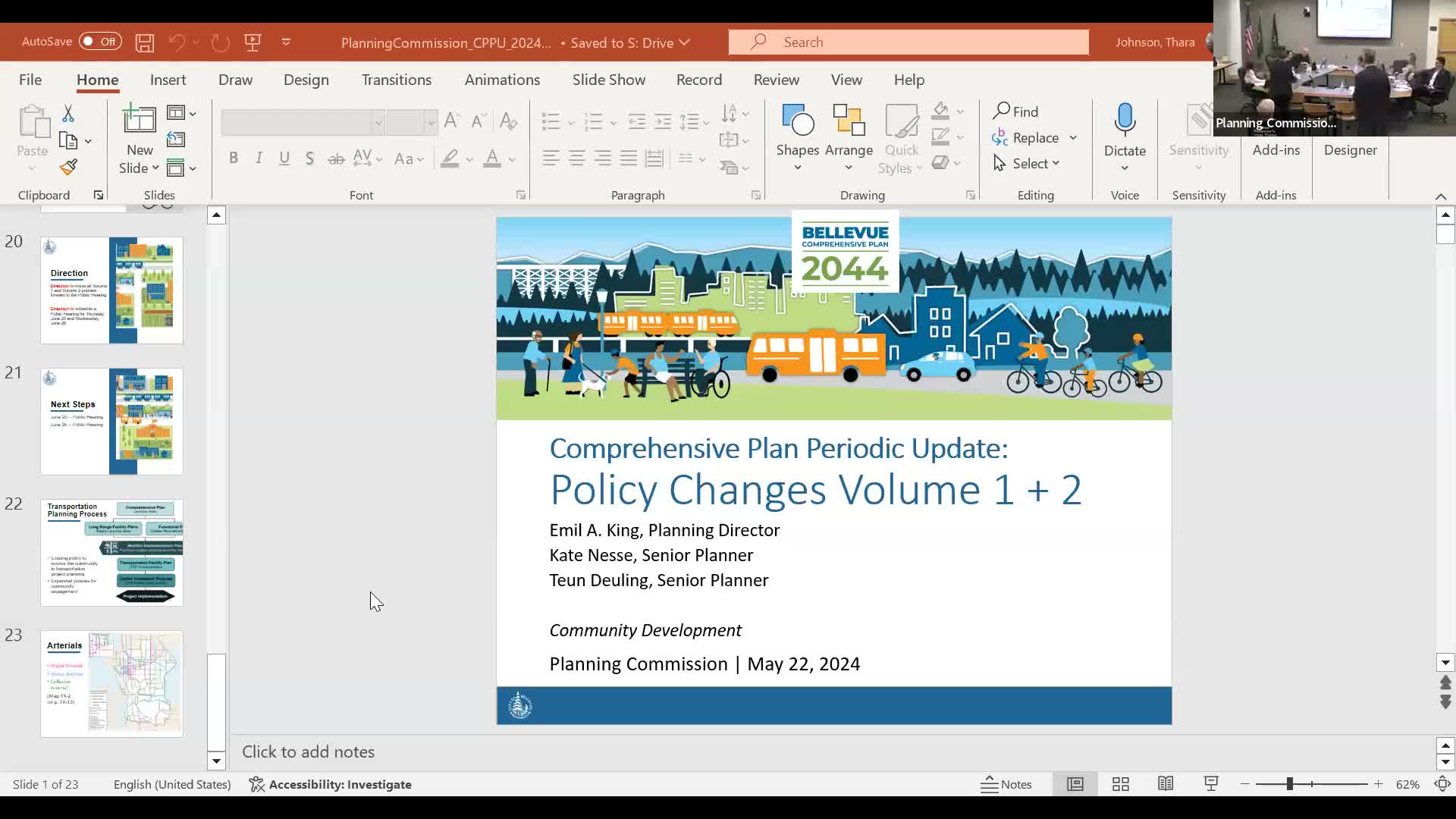
The Bellevue Planning Commission on May 22 directed staff to take revised policy language to public hearing for the Comprehensive Plan periodic update (Volumes 1 and 2) and the BelRed Subarea Plan, after a night of public testimony and a multi‑hour debate over transportation and housing policy.
Commissioners voted to schedule hearings for June 20 (BelRed first) and to continue the comprehensive plan hearing to June 26. The vote moves staff recommendations — with commission direction on specific language changes — into the public‑hearing packet.
Why it matters: the periodic update adjusts citywide policy and neighborhood subarea plans to comply with recent state housing bills and to align neighborhood policies with a single citywide future land‑use map. The decisions set the schedule for formal public testimony and give staff guidance on how to revise draft policies that could affect traffic patterns, parking requirements, housing capacity and implementation details in growth areas such as BelRed and Wilburton.
Public comment and stakes
Developers and property owners urged limits on rules that would inhibit vehicle capacity and redevelopment. "Please amend TR56 so that it reads allow for repurposing of travel lanes for other uses ... where excess vehicular capacity exists at peak periods and where no other practical alternatives are available," said Maria Frost, director of transportation for Kemper Development Company, asking the commission to retain SBR 54 (the BelRed arterial‑capacity policy) or apply its direction citywide.
Several neighborhood residents and long‑time professionals warned of traffic impacts if lanes are removed. Victor Bishop, a traffic engineer and former Transportation Commission chair, pointed to projected person‑trip growth and said that light rail alone "will not solve our transportation problem." Residents from Newport Hills urged caution about rezoning sites with limited ingress and egress.
A disruptive, partisan outburst by a public commenter (identified in the record as Alex Zimmerman, president of Stand Up America) drew an immediate ruling from the chair that the remarks were a campaign speech and not relevant to the commission’s duties; the chair cited the city decorum ordinance and moved on to the scheduled agenda.
The TR56 debate: demonstration, analysis and limits
A central focus of the commission's policy-level debate was TR56 — the draft policy that allows the city to repurpose vehicle travel lanes for transit, parking, or pedestrian and bicycle facilities under certain conditions. Transportation staff recommended splitting TR56 into two parts: one focused on frequent‑transit corridors where repurposing would increase person‑throughput for transit, and a second addressing off‑peak lane use, curbside parking and active‑transportation facilities.
Commissioners expressed a mix of views about how prescriptive the policy should be. Several members said repurposing should be rare and supported language requiring a demonstration, study or other technical analysis that shows a clear public benefit. Commissioner comments that staff should use "best available technical evidence" and that any reconfiguration be piloted as a demonstration project drew broad support; staff agreed to recraft TR56 to reflect those directions before the hearing.
Parking and state law
Staff reminded the commission that recent state housing legislation requires the city to allow reductions in minimum parking in certain contexts (for example, near high‑capacity transit). The proposed LU 32 language would align the city with state law while emphasizing transportation and land‑use objectives and protections for people with special needs. Commissioners differed on how forcefully the plan should "encourage" reduced minimums versus merely provide guidance on complying with state requirements; staff will carry forward the commission’s direction and present revised language at the hearing.
Jubilee Reach and affordable housing contingency
Commissioners discussed a staff suggestion about a single Jubilee Reach parcel: upzoning the site could speed development but would, staff warned, remove a guarantee that units built there would remain affordable under the formal C‑1 affordable‑housing upzone process. Staff urged caution about setting a precedent that would bypass the C‑1 process; commissioners asked staff to continue negotiating with the Jubilee Reach owner and to explain tradeoffs in the public‑hearing materials.
BelRed, mass timber and plazas
On BelRed policy, commissioners asked staff to preserve flexibility for green construction techniques such as mass timber — notably easing some stepback and floor‑height constraints that can make mass‑timber projects economically infeasible — and to ensure the policy language still allows for civic plazas or large urban parks near the light‑rail station. Staff said detailed implementation and code changes would be addressed in the upcoming land‑use code amendment (LUCA) process.
What the commission decided and next steps
- The commission voted to schedule public hearings on the Comprehensive Plan volumes and the BelRed Subarea Plan for June 20 and June 26. Staff will revise TR56 and other flagged policies to reflect the commission’s directions (require demonstration/analysis, rely on best-available technical evidence, clarify objectives for repurposing lanes and parking near transit) and include those revisions in the hearing packet.
- Staff noted that Volume 2 edits mainly implement state housing bills (HB 1110 and HB 1337) and update neighborhood area plans to reference the citywide future land‑use map; the commission found Volume 2 suitable to advance to the hearings.
- The meeting record includes a mix of public comment in favor of retaining SBR 54 and protecting vehicular capacity, neighborhood concerns about traffic impacts, developer requests for greater zoning capacity to finance affordable housing, and technical requests about policy implementation.
The commission will hear formal public testimony at the scheduled hearings; after public testimony and any further amendments the commission will forward recommendations to the City Council, which has final authority to adopt the comprehensive plan changes.
Quotes
"Please amend TR56 so that it reads, allow for repurposing of travel lanes for other uses ... where excess vehicular capacity exists at peak periods and where no other practical alternatives are available," said Maria Frost of Kemper Development Company.
"Light rail will not solve our transportation problem," said traffic engineer Victor Bishop, citing city long‑range person‑trip forecasts.
"That appeared to me to be just a campaign speech, and it wasn't relevant," the chair said after a public commenter launched a partisan rant; the chair cited ordinance 67 52 and asked the speaker to leave.
Ending
The commission's direction to staff — and the decision to send the revised policies to public hearing — sets a timetable for June public testimony and gives staff specific technical guidance on how to frame policy language for transportation analysis, parking, housing commitments and BelRed implementation. The hearings will be the formal opportunity for public testimony before the commission forwards its recommendations to the City Council.
Commissioners voted to schedule hearings for June 20 (BelRed first) and to continue the comprehensive plan hearing to June 26. The vote moves staff recommendations — with commission direction on specific language changes — into the public‑hearing packet.
Why it matters: the periodic update adjusts citywide policy and neighborhood subarea plans to comply with recent state housing bills and to align neighborhood policies with a single citywide future land‑use map. The decisions set the schedule for formal public testimony and give staff guidance on how to revise draft policies that could affect traffic patterns, parking requirements, housing capacity and implementation details in growth areas such as BelRed and Wilburton.
Public comment and stakes
Developers and property owners urged limits on rules that would inhibit vehicle capacity and redevelopment. "Please amend TR56 so that it reads allow for repurposing of travel lanes for other uses ... where excess vehicular capacity exists at peak periods and where no other practical alternatives are available," said Maria Frost, director of transportation for Kemper Development Company, asking the commission to retain SBR 54 (the BelRed arterial‑capacity policy) or apply its direction citywide.
Several neighborhood residents and long‑time professionals warned of traffic impacts if lanes are removed. Victor Bishop, a traffic engineer and former Transportation Commission chair, pointed to projected person‑trip growth and said that light rail alone "will not solve our transportation problem." Residents from Newport Hills urged caution about rezoning sites with limited ingress and egress.
A disruptive, partisan outburst by a public commenter (identified in the record as Alex Zimmerman, president of Stand Up America) drew an immediate ruling from the chair that the remarks were a campaign speech and not relevant to the commission’s duties; the chair cited the city decorum ordinance and moved on to the scheduled agenda.
The TR56 debate: demonstration, analysis and limits
A central focus of the commission's policy-level debate was TR56 — the draft policy that allows the city to repurpose vehicle travel lanes for transit, parking, or pedestrian and bicycle facilities under certain conditions. Transportation staff recommended splitting TR56 into two parts: one focused on frequent‑transit corridors where repurposing would increase person‑throughput for transit, and a second addressing off‑peak lane use, curbside parking and active‑transportation facilities.
Commissioners expressed a mix of views about how prescriptive the policy should be. Several members said repurposing should be rare and supported language requiring a demonstration, study or other technical analysis that shows a clear public benefit. Commissioner comments that staff should use "best available technical evidence" and that any reconfiguration be piloted as a demonstration project drew broad support; staff agreed to recraft TR56 to reflect those directions before the hearing.
Parking and state law
Staff reminded the commission that recent state housing legislation requires the city to allow reductions in minimum parking in certain contexts (for example, near high‑capacity transit). The proposed LU 32 language would align the city with state law while emphasizing transportation and land‑use objectives and protections for people with special needs. Commissioners differed on how forcefully the plan should "encourage" reduced minimums versus merely provide guidance on complying with state requirements; staff will carry forward the commission’s direction and present revised language at the hearing.
Jubilee Reach and affordable housing contingency
Commissioners discussed a staff suggestion about a single Jubilee Reach parcel: upzoning the site could speed development but would, staff warned, remove a guarantee that units built there would remain affordable under the formal C‑1 affordable‑housing upzone process. Staff urged caution about setting a precedent that would bypass the C‑1 process; commissioners asked staff to continue negotiating with the Jubilee Reach owner and to explain tradeoffs in the public‑hearing materials.
BelRed, mass timber and plazas
On BelRed policy, commissioners asked staff to preserve flexibility for green construction techniques such as mass timber — notably easing some stepback and floor‑height constraints that can make mass‑timber projects economically infeasible — and to ensure the policy language still allows for civic plazas or large urban parks near the light‑rail station. Staff said detailed implementation and code changes would be addressed in the upcoming land‑use code amendment (LUCA) process.
What the commission decided and next steps
- The commission voted to schedule public hearings on the Comprehensive Plan volumes and the BelRed Subarea Plan for June 20 and June 26. Staff will revise TR56 and other flagged policies to reflect the commission’s directions (require demonstration/analysis, rely on best-available technical evidence, clarify objectives for repurposing lanes and parking near transit) and include those revisions in the hearing packet.
- Staff noted that Volume 2 edits mainly implement state housing bills (HB 1110 and HB 1337) and update neighborhood area plans to reference the citywide future land‑use map; the commission found Volume 2 suitable to advance to the hearings.
- The meeting record includes a mix of public comment in favor of retaining SBR 54 and protecting vehicular capacity, neighborhood concerns about traffic impacts, developer requests for greater zoning capacity to finance affordable housing, and technical requests about policy implementation.
The commission will hear formal public testimony at the scheduled hearings; after public testimony and any further amendments the commission will forward recommendations to the City Council, which has final authority to adopt the comprehensive plan changes.
Quotes
"Please amend TR56 so that it reads, allow for repurposing of travel lanes for other uses ... where excess vehicular capacity exists at peak periods and where no other practical alternatives are available," said Maria Frost of Kemper Development Company.
"Light rail will not solve our transportation problem," said traffic engineer Victor Bishop, citing city long‑range person‑trip forecasts.
"That appeared to me to be just a campaign speech, and it wasn't relevant," the chair said after a public commenter launched a partisan rant; the chair cited ordinance 67 52 and asked the speaker to leave.
Ending
The commission's direction to staff — and the decision to send the revised policies to public hearing — sets a timetable for June public testimony and gives staff specific technical guidance on how to frame policy language for transportation analysis, parking, housing commitments and BelRed implementation. The hearings will be the formal opportunity for public testimony before the commission forwards its recommendations to the City Council.
View the Full Meeting & All Its Details
This article offers just a summary. Unlock complete video, transcripts, and insights as a Founder Member.
✓
Watch full, unedited meeting videos
✓
Search every word spoken in unlimited transcripts
✓
AI summaries & real-time alerts (all government levels)
✓
Permanent access to expanding government content
30-day money-back guarantee
