Senate approves load‑forecasting bill after tense debate over coal‑plant provisions
March 12, 2026 | 2026 Legislature WV, West Virginia
This article was created by AI summarizing key points discussed. AI makes mistakes, so for full details and context, please refer to the video of the full meeting. Please report any errors so we can fix them. Report an error »
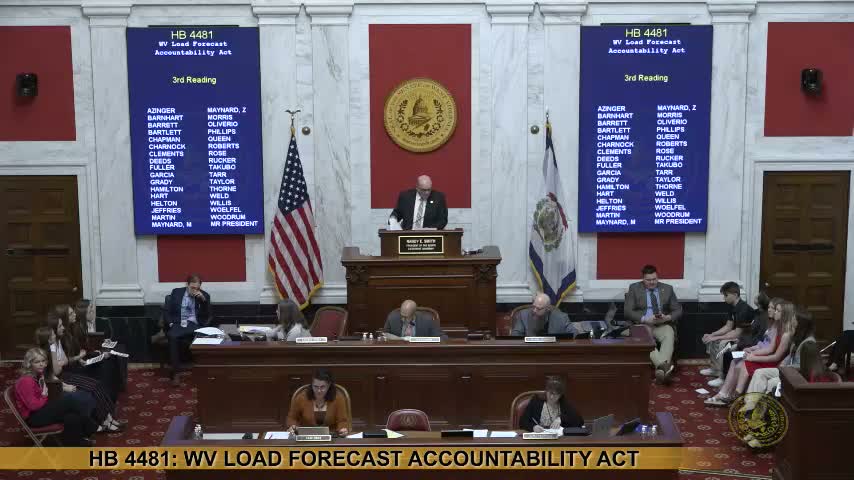
The West Virginia Senate passed the West Virginia Load Forecast Accountability Act, an engrossed version of House Bill 44‑81 that includes provisions drawn from Senate Bill 420, after a contested floor debate and a roll‑call vote of 26 yeas to 8 nays.
Sen. (Junior senator from the second) defended the measure on the Senate floor, saying the package is intended to "enhance transparency and accuracy in electric load forecasting" and to protect West Virginia's coal industry and ratepayers. He argued the bill requires the Public Service Commission to review forecasting assumptions and "ensure that only projects with the high likelihood of development are to be included in the forecast," and that state forecasts coordinate with PJM and other jurisdictions. In a forceful passage on the floor he said the provisions were necessary "for West Virginia rate payers. We need this for West Virginia's coal industry and quite frankly, we need it for West Virginia's power utilities." He added, in an exchange that drew attention, that if coal plants disappear "when those subsidies are gone... then you ain't gonna have no power left at all."
Sen. (Senator from Brooke) questioned that approach, citing a prior House rejection of similar language and asking why the Senate should expect a different outcome. He pressed whether the bill preserves the "initial intent" of other energy measures and whether inserting the provisions would change outcomes when a companion House bill had performed poorly in that chamber.
Sen. (Senator from Monongalia) and other supporters said the measure is intended to improve forecasting accuracy and protect in‑state generation and jobs. Supporters emphasized the bill tasks the Public Service Commission with validating assumptions used in forecasts and coordinating with regional planners to avoid duplicate counting of large new loads.
After debate the Senate recorded 26 yeas and 8 nays and declared the bill passed; the body then adopted a committee title amendment and directed the clerk to communicate the action to the House.
Why it matters: The change adds statutory direction to how electric load forecasts are developed and validated in West Virginia and inserts language supporters say prevents double‑counting and protects local generation. Critics on the floor warned the inserted language goes further than prior House measures and may lock forecasting policy toward preserving incumbent generation types rather than reflecting market or technological change.
What happens next: The clerk will transmit the engrossed and amended bill to the House of Delegates. If the House accepts the amendment and the versions reconcile, the measure moves toward enrollment and presentation to the governor.
Sen. (Junior senator from the second) defended the measure on the Senate floor, saying the package is intended to "enhance transparency and accuracy in electric load forecasting" and to protect West Virginia's coal industry and ratepayers. He argued the bill requires the Public Service Commission to review forecasting assumptions and "ensure that only projects with the high likelihood of development are to be included in the forecast," and that state forecasts coordinate with PJM and other jurisdictions. In a forceful passage on the floor he said the provisions were necessary "for West Virginia rate payers. We need this for West Virginia's coal industry and quite frankly, we need it for West Virginia's power utilities." He added, in an exchange that drew attention, that if coal plants disappear "when those subsidies are gone... then you ain't gonna have no power left at all."
Sen. (Senator from Brooke) questioned that approach, citing a prior House rejection of similar language and asking why the Senate should expect a different outcome. He pressed whether the bill preserves the "initial intent" of other energy measures and whether inserting the provisions would change outcomes when a companion House bill had performed poorly in that chamber.
Sen. (Senator from Monongalia) and other supporters said the measure is intended to improve forecasting accuracy and protect in‑state generation and jobs. Supporters emphasized the bill tasks the Public Service Commission with validating assumptions used in forecasts and coordinating with regional planners to avoid duplicate counting of large new loads.
After debate the Senate recorded 26 yeas and 8 nays and declared the bill passed; the body then adopted a committee title amendment and directed the clerk to communicate the action to the House.
Why it matters: The change adds statutory direction to how electric load forecasts are developed and validated in West Virginia and inserts language supporters say prevents double‑counting and protects local generation. Critics on the floor warned the inserted language goes further than prior House measures and may lock forecasting policy toward preserving incumbent generation types rather than reflecting market or technological change.
What happens next: The clerk will transmit the engrossed and amended bill to the House of Delegates. If the House accepts the amendment and the versions reconcile, the measure moves toward enrollment and presentation to the governor.
Don't Miss a Word: See the Full Meeting!
Go beyond summaries. Unlock every video, transcript, and key insight with a Founder Membership.
✓
Get instant access to full meeting videos
✓
Search and clip any phrase from complete transcripts
✓
Receive AI-powered summaries & custom alerts
✓
Enjoy lifetime, unrestricted access to government data
30-day money-back guarantee
