Commissioners push for stronger affordable‑housing, land‑bank and youth‑shelter commitments during housing and human‑services study session
April 03, 2024 | Parks and Community Services Board, Bellevue, King County, Washington
This article was created by AI summarizing key points discussed. AI makes mistakes, so for full details and context, please refer to the video of the full meeting. Please report any errors so we can fix them. Report an error »
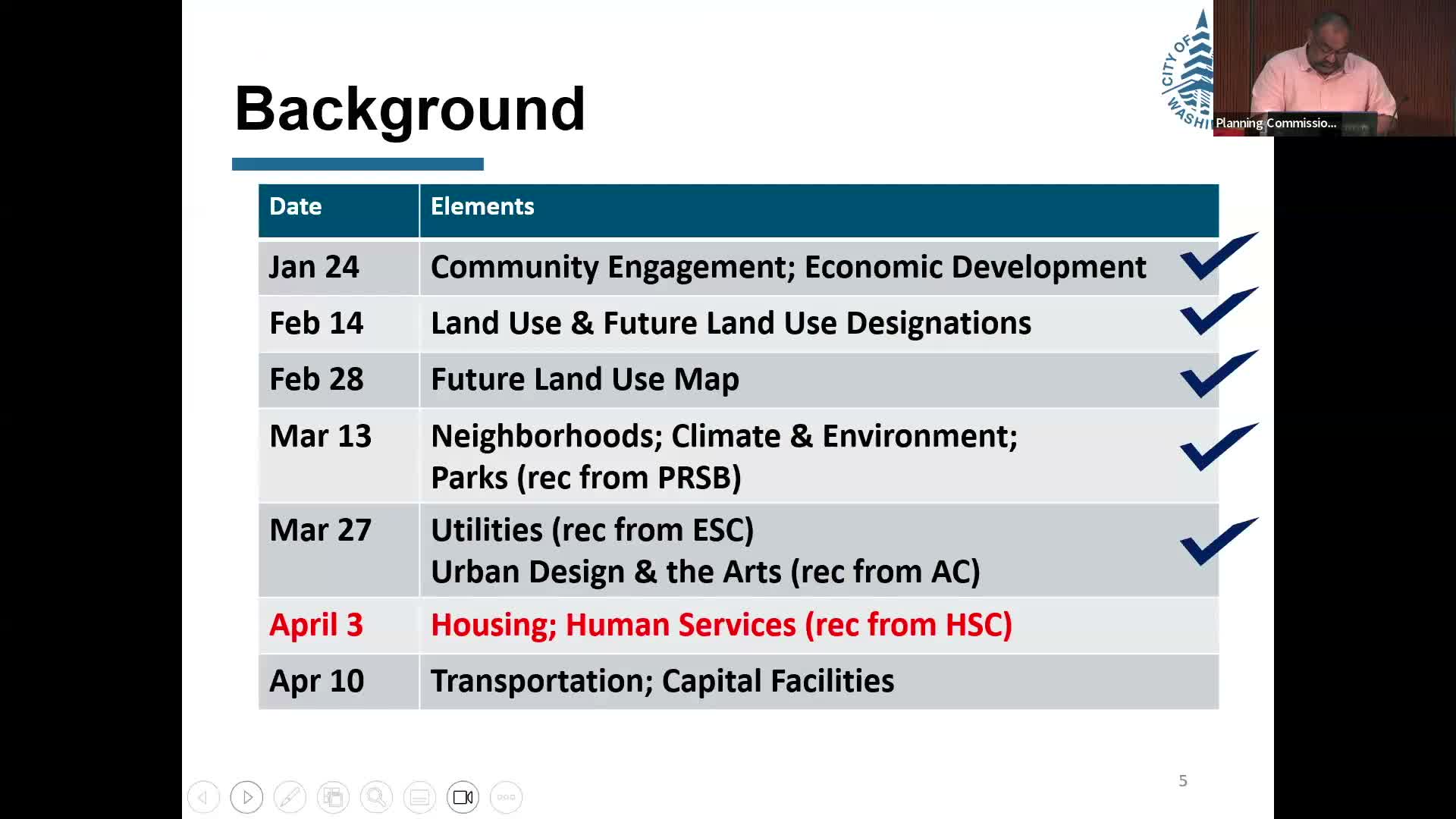
Commissioners spent the latter part of the April 3 meeting reviewing staff‑recommended updates to the housing and human‑services elements of Bellevue’s comprehensive plan, pressing staff to make several changes to policy language and to identify concrete implementation tools.
Hannah Von Miller, senior planner, summarized the housing element revisions — increasing policies from 42 to 74 to comply with state and county requirements (including HB 1220 and countywide planning policies), to address racial disparate impacts, middle housing and a stronger focus on affordability, and to align with the city’s climate vulnerability work. She said the staff recommendation includes new policies for housing equity, supply and diversity, and homelessness prevention.
Commissioners’ feedback emphasized action‑oriented language and implementation clarity. Multiple commissioners asked staff to replace passive verbs such as “explore” or “promote” with stronger directives (for example, “implement,” “incentivize,” or “establish”), and several urged explicit consideration of mandatory affordability when the city grants substantial additional development capacity through up‑zoning. Commissioner Farris said incentives alone “aren’t enough to really make a dent in the production of affordable housing,” and urged that mandatory tools be considered for large‑scale upzoning.
Other recurring requests included creating a land bank to acquire and hold property for permanently affordable housing, establishing stable funding mechanisms for very‑low and extremely‑low income units, and clarifying how incentives will be made financially attractive enough to be used by developers. Commissioners also asked staff to examine building typologies and code options—such as single‑stair mid‑rise designs and adjustments to dimensional standards—that can reduce construction costs and enable more family‑sized units.
Human‑services discussion covered improved coordination among providers, stronger linkage to youth services and shelters, and expanded language on marginalized populations. Several commissioners asked staff to add explicit youth‑shelter policies; multiple public commenters had urged a teen shelter during the oral‑comment period. Commissioners also called for clearer performance monitoring (production and cost baselines) so staff and elected officials can measure whether policies deliver intended housing outcomes.
What happens next: staff will return to the commission with edits and additional analysis, including clarifying where policy language implies programmatic commitments and where analysis of mandatory affordability or incentive design is needed for decision‑making.
At the April 3 meeting, speakers from housing providers and nonprofits reinforced the policy direction: Dan Landis of King County Housing Authority warned “we need more housing and especially we need more affordable housing,” while several commissioners asked staff for quantitative baselines and incentive designs that “pencil up” for developers.
Hannah Von Miller, senior planner, summarized the housing element revisions — increasing policies from 42 to 74 to comply with state and county requirements (including HB 1220 and countywide planning policies), to address racial disparate impacts, middle housing and a stronger focus on affordability, and to align with the city’s climate vulnerability work. She said the staff recommendation includes new policies for housing equity, supply and diversity, and homelessness prevention.
Commissioners’ feedback emphasized action‑oriented language and implementation clarity. Multiple commissioners asked staff to replace passive verbs such as “explore” or “promote” with stronger directives (for example, “implement,” “incentivize,” or “establish”), and several urged explicit consideration of mandatory affordability when the city grants substantial additional development capacity through up‑zoning. Commissioner Farris said incentives alone “aren’t enough to really make a dent in the production of affordable housing,” and urged that mandatory tools be considered for large‑scale upzoning.
Other recurring requests included creating a land bank to acquire and hold property for permanently affordable housing, establishing stable funding mechanisms for very‑low and extremely‑low income units, and clarifying how incentives will be made financially attractive enough to be used by developers. Commissioners also asked staff to examine building typologies and code options—such as single‑stair mid‑rise designs and adjustments to dimensional standards—that can reduce construction costs and enable more family‑sized units.
Human‑services discussion covered improved coordination among providers, stronger linkage to youth services and shelters, and expanded language on marginalized populations. Several commissioners asked staff to add explicit youth‑shelter policies; multiple public commenters had urged a teen shelter during the oral‑comment period. Commissioners also called for clearer performance monitoring (production and cost baselines) so staff and elected officials can measure whether policies deliver intended housing outcomes.
What happens next: staff will return to the commission with edits and additional analysis, including clarifying where policy language implies programmatic commitments and where analysis of mandatory affordability or incentive design is needed for decision‑making.
At the April 3 meeting, speakers from housing providers and nonprofits reinforced the policy direction: Dan Landis of King County Housing Authority warned “we need more housing and especially we need more affordable housing,” while several commissioners asked staff for quantitative baselines and incentive designs that “pencil up” for developers.
Don't Miss a Word: See the Full Meeting!
Go beyond summaries. Unlock every video, transcript, and key insight with a Founder Membership.
✓
Get instant access to full meeting videos
✓
Search and clip any phrase from complete transcripts
✓
Receive AI-powered summaries & custom alerts
✓
Enjoy lifetime, unrestricted access to government data
30-day money-back guarantee
