Consultants tell Bellevue Planning Commission of large affordable-housing funding gap; Phase 2 to test three policy paths
January 10, 2024 | Parks and Community Services Board, Bellevue, King County, Washington
This article was created by AI summarizing key points discussed. AI makes mistakes, so for full details and context, please refer to the video of the full meeting. Please report any errors so we can fix them. Report an error »
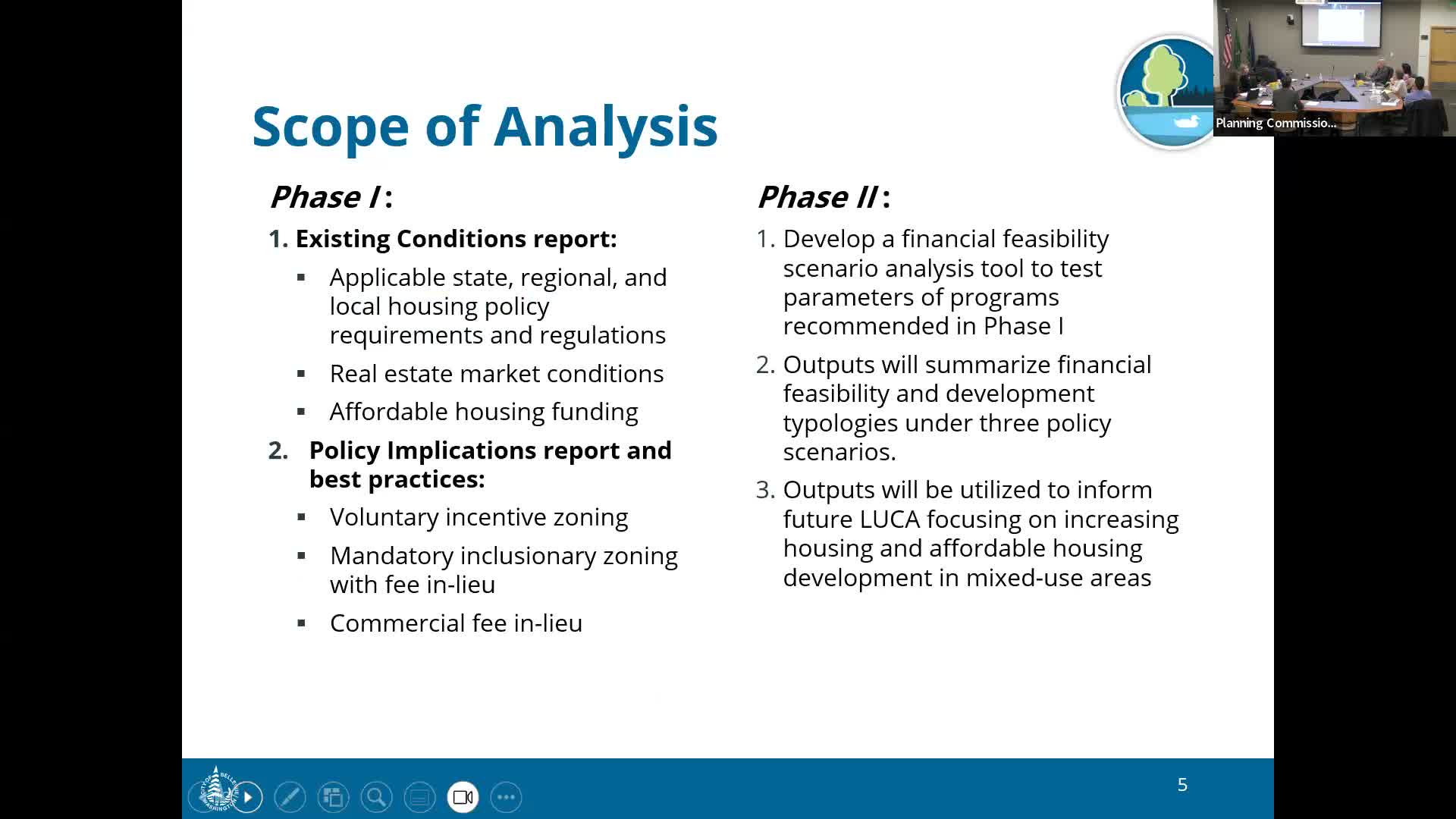
Madalena, a senior economist with Community Attributes, told the Bellevue Planning Commission that Phase 1 of a housing economic policy analysis is qualitative background meant to shape a more detailed Phase 2 feasibility model.
"This is all information only tonight," Emil, a city staff presenter, said as he opened the study session. Madalena described Phase 1 scope, case-study interviews with municipal staff in five jurisdictions and work that will feed into a financial-feasibility tool in Phase 2.
The firm reported Bellevue currently has more than 5,000 income-restricted affordable units in service and said 39% of the city’s affordable stock entered service in the past five years. The consultants summarized existing local tools—citywide density bonuses, location‑specific incentives in BelRed, Downtown, Eastgate and East Main, and a voluntary Multifamily Tax Exemption (MFTE) program that provides a 12‑year tax exemption for projects that set aside 20% of units for income‑eligible households.
On funding, the consultants presented a range of estimated annual subsidy needs that varied with cost assumptions and methodology. Using lower subsidy assumptions, they described a low-range estimate in the hundreds of millions per year; using full project cost assumptions provided by ARCH, they described a much larger upper bound, up to several billion dollars per year. Madalena said the modeling choices—what costs are counted and which AMI bands are prioritized—drive very different gap estimates.
From Phase 1 the consultants recommended three policy scenarios for Phase 2 analysis: (1) incentive zoning (voluntary programs/design incentives), (2) mandatory residential inclusionary zoning with a fee‑in‑lieu option, and (3) a commercial fee‑in‑lieu (linkage fee) program. Phase 2 will define specific program parameters, test up to four development typologies, and model impacts on development feasibility across AMI levels.
Commissioners pressed the team for more detail. One asked why the five case-study cities were chosen; Madalena said the selection prioritized representation of three policy types, similar housing-market conditions, and jurisdictions that agreed to be interviewed. Commissioners also asked for clarity on the per‑unit cost assumptions used in the high‑end gap figure; Madalena said ARCH provided project cost inputs and that staff would provide more granularity in Phase 2.
Several commissioners emphasized the need to engage developers in Phase 2, track MFTE expirations and the preservation of existing below‑market units, and consider differentiated approaches by AMI level and unit size (family‑sized units). Staff and the consultants committed to additional stakeholder outreach and more detailed quantitative work in Phase 2. The commissioners were told the final EIS appendix will include the Phase 1 report and that further touch points are expected before Council decisions.
The presentation closed with staff noting Phase 2 will include targeted stakeholder engagement, development of a financial‑feasibility tool, and a March deliverable summarizing methods and results, followed by additional Commission briefings.
"This is all information only tonight," Emil, a city staff presenter, said as he opened the study session. Madalena described Phase 1 scope, case-study interviews with municipal staff in five jurisdictions and work that will feed into a financial-feasibility tool in Phase 2.
The firm reported Bellevue currently has more than 5,000 income-restricted affordable units in service and said 39% of the city’s affordable stock entered service in the past five years. The consultants summarized existing local tools—citywide density bonuses, location‑specific incentives in BelRed, Downtown, Eastgate and East Main, and a voluntary Multifamily Tax Exemption (MFTE) program that provides a 12‑year tax exemption for projects that set aside 20% of units for income‑eligible households.
On funding, the consultants presented a range of estimated annual subsidy needs that varied with cost assumptions and methodology. Using lower subsidy assumptions, they described a low-range estimate in the hundreds of millions per year; using full project cost assumptions provided by ARCH, they described a much larger upper bound, up to several billion dollars per year. Madalena said the modeling choices—what costs are counted and which AMI bands are prioritized—drive very different gap estimates.
From Phase 1 the consultants recommended three policy scenarios for Phase 2 analysis: (1) incentive zoning (voluntary programs/design incentives), (2) mandatory residential inclusionary zoning with a fee‑in‑lieu option, and (3) a commercial fee‑in‑lieu (linkage fee) program. Phase 2 will define specific program parameters, test up to four development typologies, and model impacts on development feasibility across AMI levels.
Commissioners pressed the team for more detail. One asked why the five case-study cities were chosen; Madalena said the selection prioritized representation of three policy types, similar housing-market conditions, and jurisdictions that agreed to be interviewed. Commissioners also asked for clarity on the per‑unit cost assumptions used in the high‑end gap figure; Madalena said ARCH provided project cost inputs and that staff would provide more granularity in Phase 2.
Several commissioners emphasized the need to engage developers in Phase 2, track MFTE expirations and the preservation of existing below‑market units, and consider differentiated approaches by AMI level and unit size (family‑sized units). Staff and the consultants committed to additional stakeholder outreach and more detailed quantitative work in Phase 2. The commissioners were told the final EIS appendix will include the Phase 1 report and that further touch points are expected before Council decisions.
The presentation closed with staff noting Phase 2 will include targeted stakeholder engagement, development of a financial‑feasibility tool, and a March deliverable summarizing methods and results, followed by additional Commission briefings.
View the Full Meeting & All Its Details
This article offers just a summary. Unlock complete video, transcripts, and insights as a Founder Member.
✓
Watch full, unedited meeting videos
✓
Search every word spoken in unlimited transcripts
✓
AI summaries & real-time alerts (all government levels)
✓
Permanent access to expanding government content
30-day money-back guarantee
