Parks board urges clearer park-acquisition goals, cultural programming and safety language in Bellevue plan
March 13, 2024 | Parks and Community Services Board, Bellevue, King County, Washington
This article was created by AI summarizing key points discussed. AI makes mistakes, so for full details and context, please refer to the video of the full meeting. Please report any errors so we can fix them. Report an error »
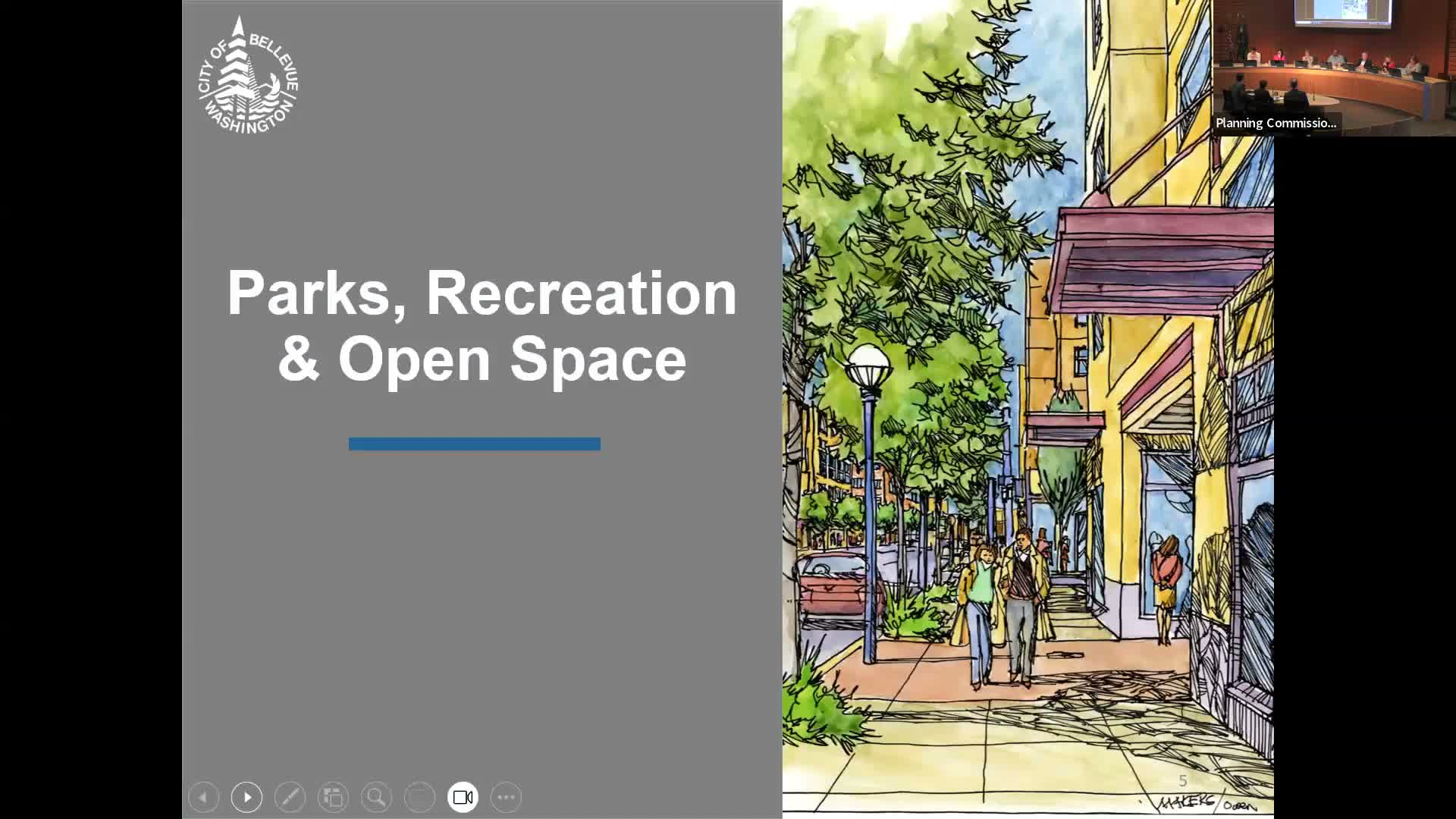
Paul Clark, chair of the Parks and Community Services Board, told the Bellevue Planning Commission on March 13 that the board met four times during the comp-plan periodic update and approved (6–0) a set of refinements to the parks, recreation and open-space policies. "We began to work on this section in April 2022," Clark said, noting the board’s priorities included expanding park acreage to keep pace with growth (PA‑2), focusing park signage on Bellevue’s local history (PA‑25) and broadening outreach and programming to support intercultural exchange (PA‑31/32).
The Planning Commission and staff framed the discussion around three persistent policy challenges: how the city will acquire parkland as neighborhoods densify, how to prevent loss or conversion of parkland without excluding reasonable, compatible uses, and how to strengthen protections for urban forest and ecological functions. "PA‑2 speaks to the need for expansion of our park system to keep pace with growth," Clark said, adding the board sought language that calls attention to downtown and other growth quarters where park space per resident is lowest.
Planning staff presented community feedback that strongly supported policies emphasizing ecological function and equitable access. Staff said safety-related policies (PA‑5, PA‑14, PA‑41) were reinforced after public and board comments. Commissioners asked staff for concrete examples of how the city would meet park needs in high-density areas — land dedication, targeted acquisitions, partnerships with private landowners, and creative approaches such as on-site multifunctional plazas or off-site fee‑in‑lieu arrangements were discussed as options.
Several commissioners pressed staff to revise PA‑45, a policy intended to "eliminate and prevent" uses that conflict with park purposes. One commissioner said the current text could be read as removing public review from conversions of parkland; staff replied the intent is to prevent inappropriate conversions but agreed language should be clarified to preserve public involvement. On tree and habitat protections, public commenters and commissioners urged stronger, more action‑oriented verbs ("seek" or "require" rather than "promote" or "encourage") and for more explicit cross‑references to the parks and open‑space system plan for implementation detail.
Public testimony during the meeting reinforced those themes. Lee Sergeant of Trees for Livability said significant trees "are more than a tree" and urged a definition and stronger protections in the comprehensive plan. Developer and project managers urged incentives for green building so private development can help meet canopy and sustainability goals.
Staff committed to: returning with clarified glossary definitions (for terms such as "scenic character" and geologic hazard thresholds), tightening PA‑45 language to make public review and protections explicit, and adding examples of creative park acquisition and programming approaches for densifying areas. The Commission did not take any formal votes on policy text at this meeting; staff will bring amended language back for further review.
The study session moved next to the neighborhoods element after a short break. The Commission did, earlier in the evening, approve the meeting agenda and later accepted the February 14 minutes with a minor correction.
The Planning Commission and staff framed the discussion around three persistent policy challenges: how the city will acquire parkland as neighborhoods densify, how to prevent loss or conversion of parkland without excluding reasonable, compatible uses, and how to strengthen protections for urban forest and ecological functions. "PA‑2 speaks to the need for expansion of our park system to keep pace with growth," Clark said, adding the board sought language that calls attention to downtown and other growth quarters where park space per resident is lowest.
Planning staff presented community feedback that strongly supported policies emphasizing ecological function and equitable access. Staff said safety-related policies (PA‑5, PA‑14, PA‑41) were reinforced after public and board comments. Commissioners asked staff for concrete examples of how the city would meet park needs in high-density areas — land dedication, targeted acquisitions, partnerships with private landowners, and creative approaches such as on-site multifunctional plazas or off-site fee‑in‑lieu arrangements were discussed as options.
Several commissioners pressed staff to revise PA‑45, a policy intended to "eliminate and prevent" uses that conflict with park purposes. One commissioner said the current text could be read as removing public review from conversions of parkland; staff replied the intent is to prevent inappropriate conversions but agreed language should be clarified to preserve public involvement. On tree and habitat protections, public commenters and commissioners urged stronger, more action‑oriented verbs ("seek" or "require" rather than "promote" or "encourage") and for more explicit cross‑references to the parks and open‑space system plan for implementation detail.
Public testimony during the meeting reinforced those themes. Lee Sergeant of Trees for Livability said significant trees "are more than a tree" and urged a definition and stronger protections in the comprehensive plan. Developer and project managers urged incentives for green building so private development can help meet canopy and sustainability goals.
Staff committed to: returning with clarified glossary definitions (for terms such as "scenic character" and geologic hazard thresholds), tightening PA‑45 language to make public review and protections explicit, and adding examples of creative park acquisition and programming approaches for densifying areas. The Commission did not take any formal votes on policy text at this meeting; staff will bring amended language back for further review.
The study session moved next to the neighborhoods element after a short break. The Commission did, earlier in the evening, approve the meeting agenda and later accepted the February 14 minutes with a minor correction.
Don't Miss a Word: See the Full Meeting!
Go beyond summaries. Unlock every video, transcript, and key insight with a Founder Membership.
✓
Get instant access to full meeting videos
✓
Search and clip any phrase from complete transcripts
✓
Receive AI-powered summaries & custom alerts
✓
Enjoy lifetime, unrestricted access to government data
30-day money-back guarantee
