Bellevue planning staff seek calibration on sweeping tree-canopy code changes, commissioners press for clarity on enforcement and housing impacts
January 24, 2024 | Parks and Community Services Board, Bellevue, King County, Washington
This article was created by AI summarizing key points discussed. AI makes mistakes, so for full details and context, please refer to the video of the full meeting. Please report any errors so we can fix them. Report an error »
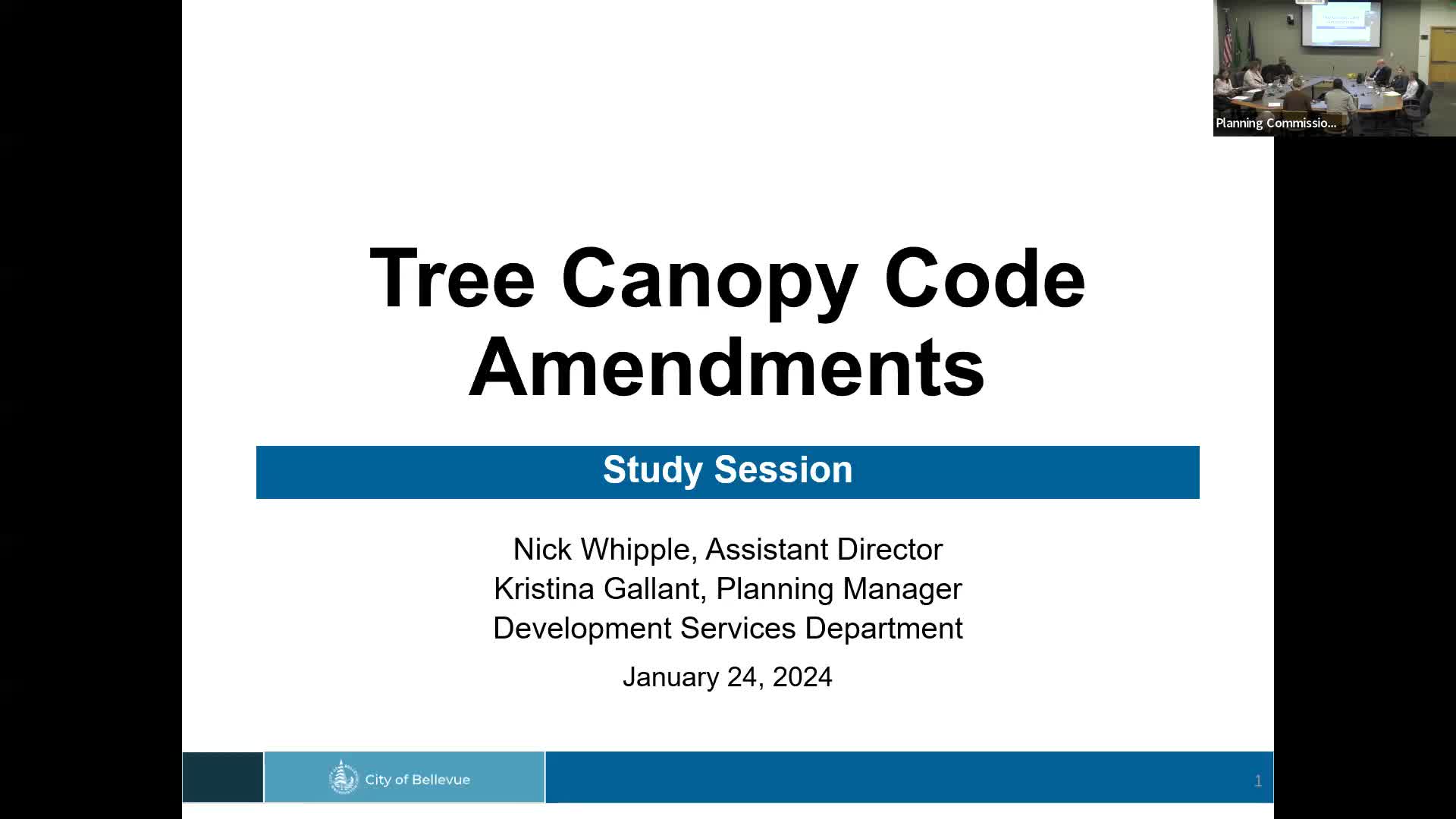
Bellevue planning staff on Jan. 24 outlined a proposed rewrite of the city's tree retention code that would replace the existing approach with a tree-credit system, formalize landmark-tree definitions and expand enforcement tools while seeking a commission'level calibration between incentives and requirements.
"We're proposing a full rewrite of section 20.2900 — tree retention and replacement — to prevent citywide net loss of canopy and address local canopy gaps," Christina Gallant, a city planner leading the LUCA presentation, told the commission. She said staff are recommending a minimum required tree density scaled to development type, a permanent landmark-tree definition and a possible change in the significant-tree diameter threshold from 8 inches to 6 inches to expand coverage.
Why it matters: Bellevue's overall tree canopy is near 40%, staff said, but single-family neighborhoods have experienced net canopy loss in recent canopy analyses. Staff described the LUCA (land use code amendment) as an opportunity to modernize regulations last substantially updated decades ago and to balance preservation goals against development capacity and housing needs.
Staff outlined three calibration approaches: a market-based credit system (maximum development flexibility but less certainty for large-tree retention); a strict-retention approach (strong certainty for large trees but less flexibility); or a hybrid that combines incentives and targeted requirements. Potential incentives discussed included extra credits for retaining landmark trees and tree groves, native-species planting bonuses, and maintaining an existing parking reduction incentive for projects that exceed retention targets.
On enforcement, Gallant described the current complaint-driven sequence: a reported violation triggers a code-enforcement investigation, voluntary compliance and replanting attempts, and—if necessary—a notice of civil violation and a hearing before the hearing examiner with monetary penalties tied to the assessed value of trees. "Often we don't have enough evidence to move to a civil hearing," she said, noting reliance on aerial imagery and Google Street View to establish baselines.
Commissioners pressed staff for implementation details. "If there was a landmark tree in the middle of a lot where somebody wanted to build a house, what would happen?" one commissioner asked; staff responded that calibration guidance is needed and that options could include replanting multiple trees, fees or limited flexibility for locating development.
Commissioners also asked about homeowner costs for routine permits and the city's approach to monitoring compliance. Christina Gallant said basic permits to remove a landmark or significant tree without other land-use decisions are currently priced "under $400," adding that more extensive reviews (for example, in Bridal Trails where removing multiple trees triggers land-use review) can carry higher fees. Commissioners suggested tools such as maintenance agreements, a registry of tree service providers, required signage and markers during construction, a staff arborist or subsidies for arborist costs, and proactive baseline imagery (for example, transactional drone photos) to reduce "he said, she said" enforcement gaps.
Public commenters included residents who urged protection of large, 40-to-90-year-old trees and developers who urged clear, predictable rules so permitting is not a barrier. Veronica Shekotko of the Master Builders Association said her members favor a "right tree in the right place" approach and predictability in permitting to avoid added costs and delays.
Next steps: Staff told commissioners they plan at least one more study session on the LUCA, followed by a public hearing and a recommendation to the council. Commissioners gave staff direction to return with refined calibration options (incentives vs. requirements), clearer enforcement baselines and specific language on implementation and impacts to housing production. The commission did not take a final vote on the LUCA at the Jan. 24 meeting.
Ending: Staff will incorporate commissioner feedback and public input into the next LUCA packet and return for further direction and a public hearing in the coming months.
"We're proposing a full rewrite of section 20.2900 — tree retention and replacement — to prevent citywide net loss of canopy and address local canopy gaps," Christina Gallant, a city planner leading the LUCA presentation, told the commission. She said staff are recommending a minimum required tree density scaled to development type, a permanent landmark-tree definition and a possible change in the significant-tree diameter threshold from 8 inches to 6 inches to expand coverage.
Why it matters: Bellevue's overall tree canopy is near 40%, staff said, but single-family neighborhoods have experienced net canopy loss in recent canopy analyses. Staff described the LUCA (land use code amendment) as an opportunity to modernize regulations last substantially updated decades ago and to balance preservation goals against development capacity and housing needs.
Staff outlined three calibration approaches: a market-based credit system (maximum development flexibility but less certainty for large-tree retention); a strict-retention approach (strong certainty for large trees but less flexibility); or a hybrid that combines incentives and targeted requirements. Potential incentives discussed included extra credits for retaining landmark trees and tree groves, native-species planting bonuses, and maintaining an existing parking reduction incentive for projects that exceed retention targets.
On enforcement, Gallant described the current complaint-driven sequence: a reported violation triggers a code-enforcement investigation, voluntary compliance and replanting attempts, and—if necessary—a notice of civil violation and a hearing before the hearing examiner with monetary penalties tied to the assessed value of trees. "Often we don't have enough evidence to move to a civil hearing," she said, noting reliance on aerial imagery and Google Street View to establish baselines.
Commissioners pressed staff for implementation details. "If there was a landmark tree in the middle of a lot where somebody wanted to build a house, what would happen?" one commissioner asked; staff responded that calibration guidance is needed and that options could include replanting multiple trees, fees or limited flexibility for locating development.
Commissioners also asked about homeowner costs for routine permits and the city's approach to monitoring compliance. Christina Gallant said basic permits to remove a landmark or significant tree without other land-use decisions are currently priced "under $400," adding that more extensive reviews (for example, in Bridal Trails where removing multiple trees triggers land-use review) can carry higher fees. Commissioners suggested tools such as maintenance agreements, a registry of tree service providers, required signage and markers during construction, a staff arborist or subsidies for arborist costs, and proactive baseline imagery (for example, transactional drone photos) to reduce "he said, she said" enforcement gaps.
Public commenters included residents who urged protection of large, 40-to-90-year-old trees and developers who urged clear, predictable rules so permitting is not a barrier. Veronica Shekotko of the Master Builders Association said her members favor a "right tree in the right place" approach and predictability in permitting to avoid added costs and delays.
Next steps: Staff told commissioners they plan at least one more study session on the LUCA, followed by a public hearing and a recommendation to the council. Commissioners gave staff direction to return with refined calibration options (incentives vs. requirements), clearer enforcement baselines and specific language on implementation and impacts to housing production. The commission did not take a final vote on the LUCA at the Jan. 24 meeting.
Ending: Staff will incorporate commissioner feedback and public input into the next LUCA packet and return for further direction and a public hearing in the coming months.
View the Full Meeting & All Its Details
This article offers just a summary. Unlock complete video, transcripts, and insights as a Founder Member.
✓
Watch full, unedited meeting videos
✓
Search every word spoken in unlimited transcripts
✓
AI summaries & real-time alerts (all government levels)
✓
Permanent access to expanding government content
30-day money-back guarantee
