Commissioners press staff to clarify neighborhood 'character', parking and air‑quality language in proposed land‑use policies
February 14, 2024 | Parks and Community Services Board, Bellevue, King County, Washington
This article was created by AI summarizing key points discussed. AI makes mistakes, so for full details and context, please refer to the video of the full meeting. Please report any errors so we can fix them. Report an error »
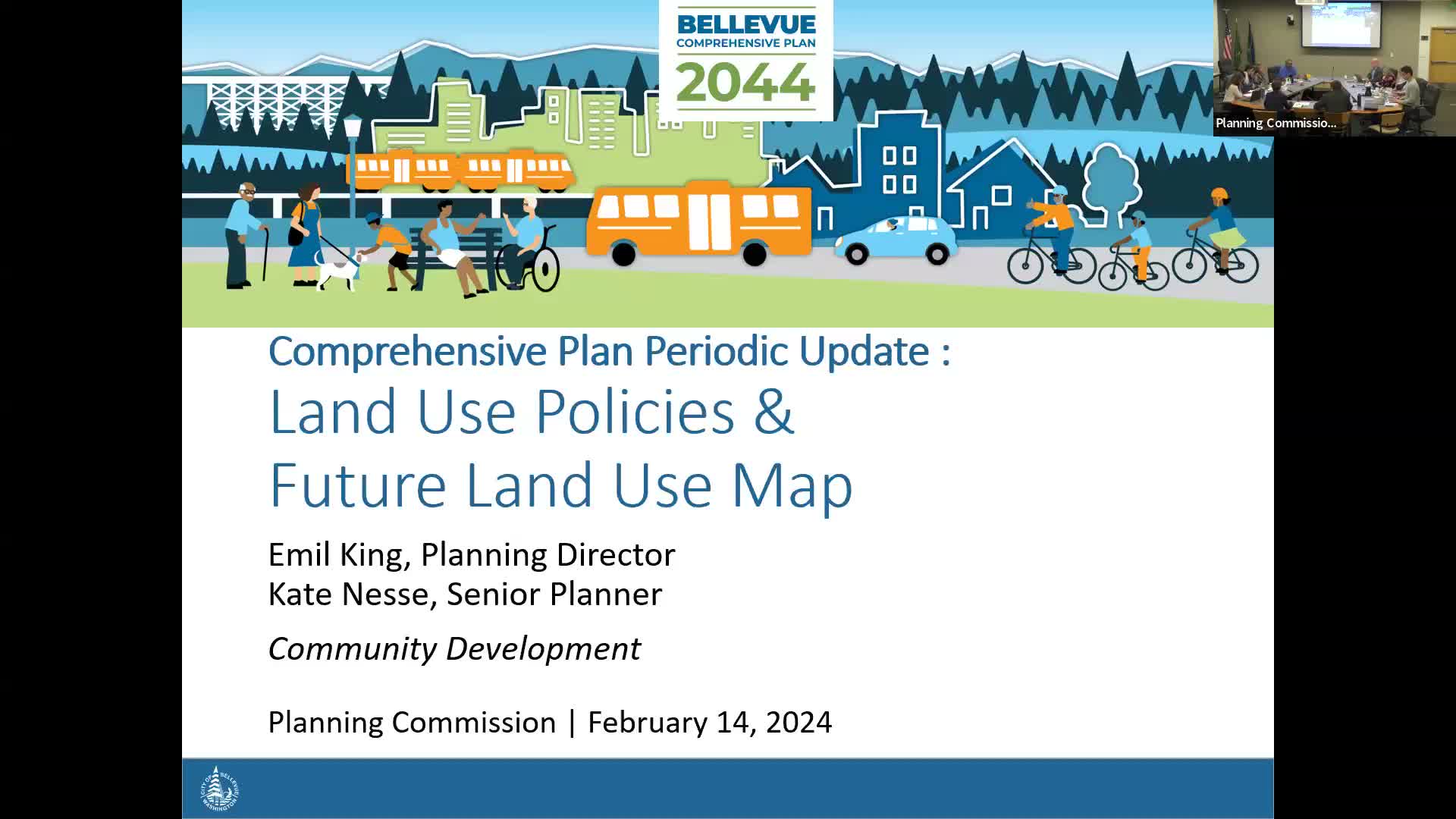
City planning staff presented major updates to the draft land‑use element and a new, consolidated future land‑use map key and asked the Planning Commission for direction on several policy areas.
Emil (planning staff) and Kate (planning staff) walked commissioners through substantive changes: stronger emphasis on expanding parks and open space (LU‑2/LU‑3), reorganized residential policies (LU‑12/13/15), and a new approach to grouping multiple existing map categories into broader mixed‑use and residential bands to simplify the plan and reduce the need for frequent plan amendments.
Kate highlighted that countywide centers (for example, BelRed and Wilburton) serve a transportation focus and must meet size and jobs/housing thresholds, while the city wishes to retain greater flexibility for mixed‑use centers beyond county designations. The staff proposal showed illustrative building types and stressed that the EIS studied separate land‑use categories even if the plan groups them under a single future‑land‑use umbrella.
Commissioners raised several framing and clarity issues. Several members asked staff to rework language that references "neighborhood character" because, while the phrase is widely used, it can be ambiguous or be interpreted in ways that exclude change. Vice chair and other commissioners urged staff either to retain a clear, non‑exclusionary form of neighborhood recognition or to show where neighborhood‑focused policy objectives remain in the element.
Commissioner Farris pressed staff on whether the commission could see letters earlier in the process so that staff could respond before recommendations are finalized; staff said the EIS and outreach (about 5,000 participants reported) provide a large evidence base and agreed to return with a clearer summary of comment origins (residents vs. non‑residents) and sample maps. Commissioners also asked for examples showing how shared or excess parking might be used in redevelopment scenarios; staff flagged the policy as existing and said they would bring illustrative examples.
Air‑quality language pulled from EIS analysis also drew attention. One commissioner suggested consolidating overlapping air‑quality policies so the element's emphasis matches local trends and is proportionate to other priorities. Staff agreed to bring the EIS air‑quality findings and maps back to the commission for review.
Commissioners asked staff to tidy ambiguous terms across the element ("health and vitality," "substantial portion") and to add clarifying examples and a glossary crosswalk where helpful. Staff said they will revise draft policies and return with maps, examples, and proposed wording refinements before public hearings.
Emil (planning staff) and Kate (planning staff) walked commissioners through substantive changes: stronger emphasis on expanding parks and open space (LU‑2/LU‑3), reorganized residential policies (LU‑12/13/15), and a new approach to grouping multiple existing map categories into broader mixed‑use and residential bands to simplify the plan and reduce the need for frequent plan amendments.
Kate highlighted that countywide centers (for example, BelRed and Wilburton) serve a transportation focus and must meet size and jobs/housing thresholds, while the city wishes to retain greater flexibility for mixed‑use centers beyond county designations. The staff proposal showed illustrative building types and stressed that the EIS studied separate land‑use categories even if the plan groups them under a single future‑land‑use umbrella.
Commissioners raised several framing and clarity issues. Several members asked staff to rework language that references "neighborhood character" because, while the phrase is widely used, it can be ambiguous or be interpreted in ways that exclude change. Vice chair and other commissioners urged staff either to retain a clear, non‑exclusionary form of neighborhood recognition or to show where neighborhood‑focused policy objectives remain in the element.
Commissioner Farris pressed staff on whether the commission could see letters earlier in the process so that staff could respond before recommendations are finalized; staff said the EIS and outreach (about 5,000 participants reported) provide a large evidence base and agreed to return with a clearer summary of comment origins (residents vs. non‑residents) and sample maps. Commissioners also asked for examples showing how shared or excess parking might be used in redevelopment scenarios; staff flagged the policy as existing and said they would bring illustrative examples.
Air‑quality language pulled from EIS analysis also drew attention. One commissioner suggested consolidating overlapping air‑quality policies so the element's emphasis matches local trends and is proportionate to other priorities. Staff agreed to bring the EIS air‑quality findings and maps back to the commission for review.
Commissioners asked staff to tidy ambiguous terms across the element ("health and vitality," "substantial portion") and to add clarifying examples and a glossary crosswalk where helpful. Staff said they will revise draft policies and return with maps, examples, and proposed wording refinements before public hearings.
View the Full Meeting & All Its Details
This article offers just a summary. Unlock complete video, transcripts, and insights as a Founder Member.
✓
Watch full, unedited meeting videos
✓
Search every word spoken in unlimited transcripts
✓
AI summaries & real-time alerts (all government levels)
✓
Permanent access to expanding government content
30-day money-back guarantee
