Bellevue Planning Commission asks for more analysis on Wilburton, BelRed land‑use recommendations
February 28, 2024 | Parks and Community Services Board, Bellevue, King County, Washington
This article was created by AI summarizing key points discussed. AI makes mistakes, so for full details and context, please refer to the video of the full meeting. Please report any errors so we can fix them. Report an error »
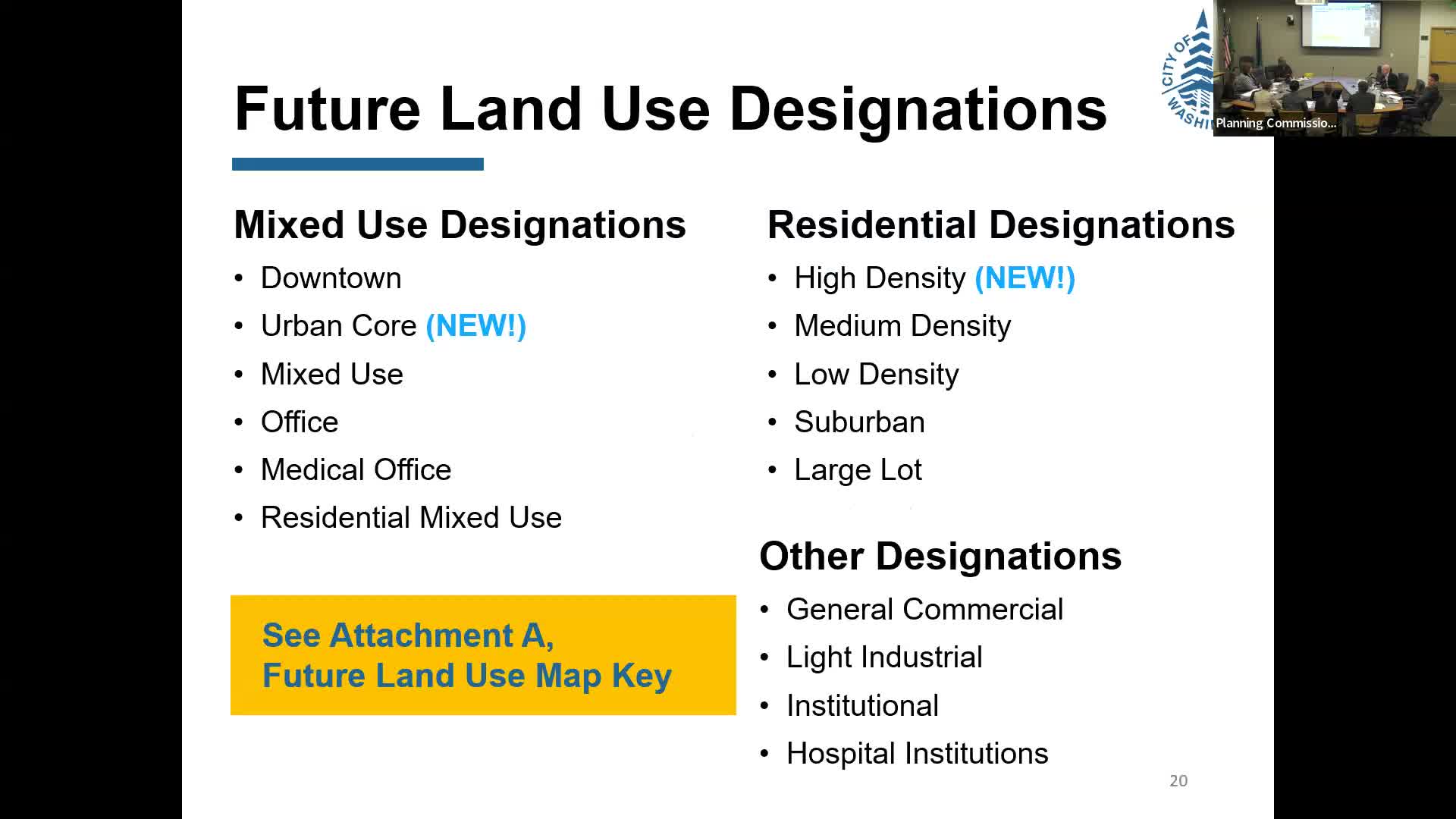
City of Bellevue — The Planning Commission continued its periodic comprehensive‑plan update on Feb. 28, focusing on proposed changes to the future land‑use map for the Wilburton and BelRed neighborhoods. Staff presented a set of refinements to the preferred alternative studied in the environmental impact statement and asked commissioners for direction on several targeted changes.
Senior planners told the commission staff is recommending higher intensity near transit: high‑rise mixed‑use designations along the Grand Connection and 120th corridor in Wilburton, mid‑rise transitions adjacent to wetlands and parks, and a proposed high‑rise medical‑office designation for the Overlake garage parcel to align with existing ownership and nearby medical uses. For BelRed, staff recommended concentrating high‑rise residential and office close to the 130th and 120th stations and keeping mid‑rise and low‑rise transitions between nodes.
Commissioners broadly supported the objective of concentrating growth near light‑rail stations and preserving nodal character, but they flagged several issues staff must address before the commission forwards formal recommendations. Multiple members asked staff to overlay transit walk‑sheds, Eastrail and the Grand Connection, and park/trail systems on the proposed map so commissioners can assess whether the highest intensities fall inside realistic pedestrian catchments. Chair Bhargava and others requested three‑dimensional or axonometric visualizations and EIS shade/shadow graphics so the panel can evaluate pedestrian experience, potential 'walling' effects along corridors, and the implications for the Bellevue Botanical Garden and other sensitive sites.
Several commissioners questioned the scope of the proposed medical‑office designation along 116th, asking staff for evidence about market demand, buildability, how medical‑office uses would interact with residential goals, and whether a more flexible high‑rise mixed‑use label would better protect opportunities for housing close to transit. Commissioner comments noted tradeoffs between preserving parcels for specialized institutional uses and maximizing residential capacity near stations.
Staff said they would return with the requested materials — including unit‑capacity estimates, EIS shadow exhibits, summary outreach data, and a refined rationale for medical‑office mapping — and expected Wilburton follow‑up in April, with BelRed and citywide materials to follow. No final map votes were taken at the meeting.
“Bring us the walk‑shed overlays and the shade analysis,” one commissioner said. “We need to see how the choices line up with the transit and park system so we can judge whether the map will deliver the outcomes we want.”
The commission also asked staff to provide build‑out numbers by area so members can evaluate how proposed changes contribute to Bellevue’s housing targets. Staff cited an approximate Bell‑Red build‑out capacity under the preferred alternative of about 27,800 units as an initial benchmark and agreed to provide more detailed, area‑specific counts.
Next steps: staff will produce the requested overlays and visualizations and return with refined map alternatives and policy edits; the Wilburton implementing code (LUCA) work is scheduled for late March and April, while broader plan adoption is targeted later in the year.
Senior planners told the commission staff is recommending higher intensity near transit: high‑rise mixed‑use designations along the Grand Connection and 120th corridor in Wilburton, mid‑rise transitions adjacent to wetlands and parks, and a proposed high‑rise medical‑office designation for the Overlake garage parcel to align with existing ownership and nearby medical uses. For BelRed, staff recommended concentrating high‑rise residential and office close to the 130th and 120th stations and keeping mid‑rise and low‑rise transitions between nodes.
Commissioners broadly supported the objective of concentrating growth near light‑rail stations and preserving nodal character, but they flagged several issues staff must address before the commission forwards formal recommendations. Multiple members asked staff to overlay transit walk‑sheds, Eastrail and the Grand Connection, and park/trail systems on the proposed map so commissioners can assess whether the highest intensities fall inside realistic pedestrian catchments. Chair Bhargava and others requested three‑dimensional or axonometric visualizations and EIS shade/shadow graphics so the panel can evaluate pedestrian experience, potential 'walling' effects along corridors, and the implications for the Bellevue Botanical Garden and other sensitive sites.
Several commissioners questioned the scope of the proposed medical‑office designation along 116th, asking staff for evidence about market demand, buildability, how medical‑office uses would interact with residential goals, and whether a more flexible high‑rise mixed‑use label would better protect opportunities for housing close to transit. Commissioner comments noted tradeoffs between preserving parcels for specialized institutional uses and maximizing residential capacity near stations.
Staff said they would return with the requested materials — including unit‑capacity estimates, EIS shadow exhibits, summary outreach data, and a refined rationale for medical‑office mapping — and expected Wilburton follow‑up in April, with BelRed and citywide materials to follow. No final map votes were taken at the meeting.
“Bring us the walk‑shed overlays and the shade analysis,” one commissioner said. “We need to see how the choices line up with the transit and park system so we can judge whether the map will deliver the outcomes we want.”
The commission also asked staff to provide build‑out numbers by area so members can evaluate how proposed changes contribute to Bellevue’s housing targets. Staff cited an approximate Bell‑Red build‑out capacity under the preferred alternative of about 27,800 units as an initial benchmark and agreed to provide more detailed, area‑specific counts.
Next steps: staff will produce the requested overlays and visualizations and return with refined map alternatives and policy edits; the Wilburton implementing code (LUCA) work is scheduled for late March and April, while broader plan adoption is targeted later in the year.
View the Full Meeting & All Its Details
This article offers just a summary. Unlock complete video, transcripts, and insights as a Founder Member.
✓
Watch full, unedited meeting videos
✓
Search every word spoken in unlimited transcripts
✓
AI summaries & real-time alerts (all government levels)
✓
Permanent access to expanding government content
30-day money-back guarantee
