Walla Walla plan: Oregon‑Washington laws allow cross‑border protection of newly developed water supplies
March 10, 2026 | Board Council Commission Agencies , Executive, Washington
This article was created by AI summarizing key points discussed. AI makes mistakes, so for full details and context, please refer to the video of the full meeting. Please report any errors so we can fix them. Report an error »
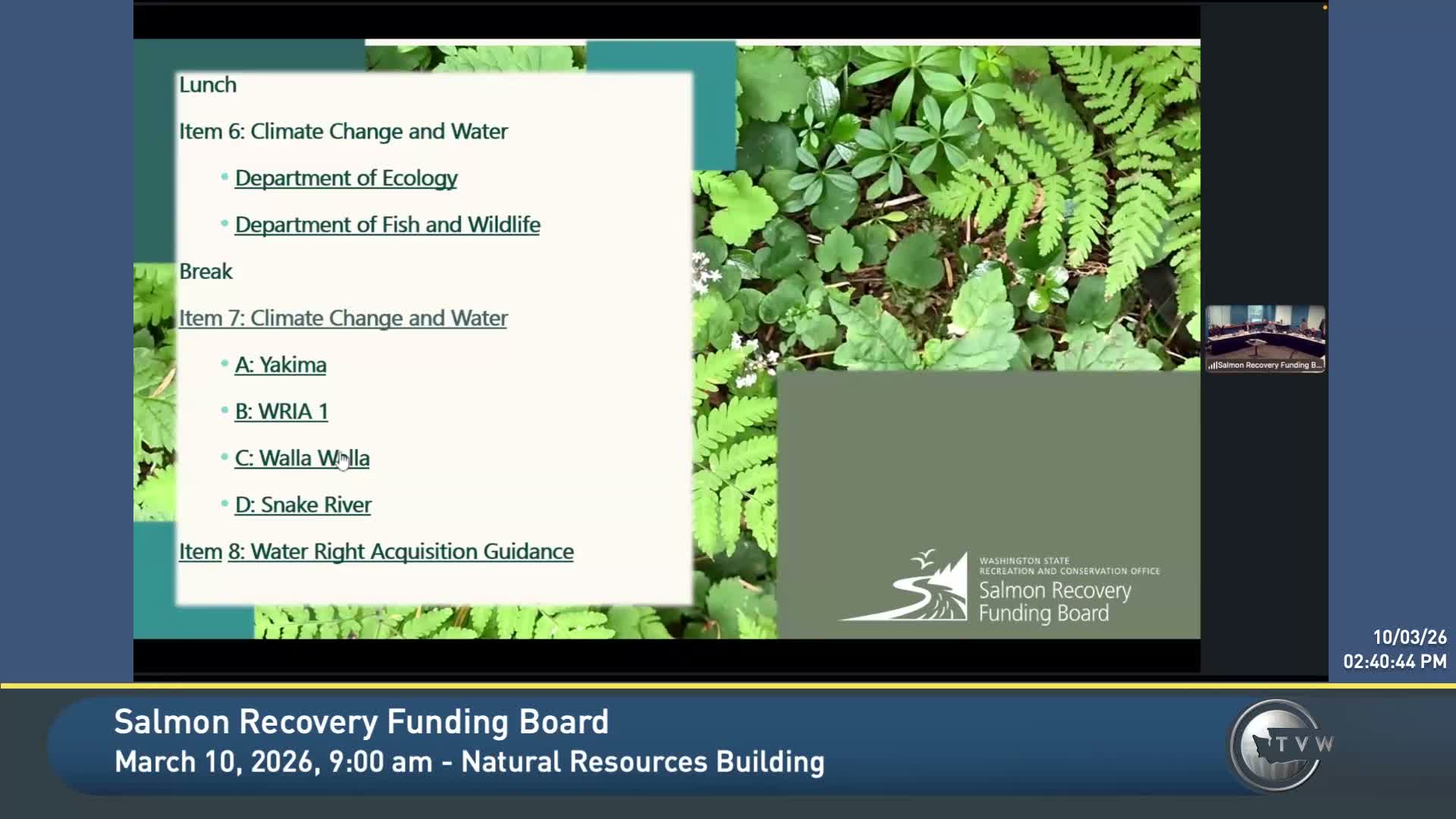
Steve Martin (Snake River Salmon Recovery Board) and Chris Coits (Oregon Water Resources Department) briefed the board on an evolving Walla Walla Basin effort that combines local planning with new state laws to protect water supplies across the Oregon–Washington border.
Coits explained that House Bill 1322 (Washington, 2023) and companion Oregon legislation provide a legal pathway to protect newly developed or reallocated supplies in one state and have those protections honored and given priority in the downstream state. “If we do an action or build a project that develops a new water supply, we can now protect that water to the state line,” Coits said, describing the 2023–2025 package of bills that enabled the approach and established program authority and legislative direction.
The Walla Walla group has used the new authorities to enroll proposed supplies in trust; Coits said the city of Walla Walla and the local irrigation district filed applications this cycle that together could protect about 20 cubic feet per second down to the Columbia River for part of the year. The agencies described a phased implementation: locally‑led feasibility studies and groundwater analyses feeding into Bureau of Reclamation and federal feasibility steps where required, plus smaller pilot protections using in‑stream leases or trust enrollment.
Board members asked how the approach resolves seniority and adjudication questions; staff said the bills provide a mechanism that, in practice, gives protected new supplies a form of super‑priority date for downstream protection and recommended continued technical study and intergovernmental agreements before broad replication.
The presenters urged the board to monitor bi‑state pilots and noted that the Walla Walla strategy combines floodplain reconnection, managed aquifer recharge and targeted flow‑augmentation approaches rather than relying on a single tool.
Coits explained that House Bill 1322 (Washington, 2023) and companion Oregon legislation provide a legal pathway to protect newly developed or reallocated supplies in one state and have those protections honored and given priority in the downstream state. “If we do an action or build a project that develops a new water supply, we can now protect that water to the state line,” Coits said, describing the 2023–2025 package of bills that enabled the approach and established program authority and legislative direction.
The Walla Walla group has used the new authorities to enroll proposed supplies in trust; Coits said the city of Walla Walla and the local irrigation district filed applications this cycle that together could protect about 20 cubic feet per second down to the Columbia River for part of the year. The agencies described a phased implementation: locally‑led feasibility studies and groundwater analyses feeding into Bureau of Reclamation and federal feasibility steps where required, plus smaller pilot protections using in‑stream leases or trust enrollment.
Board members asked how the approach resolves seniority and adjudication questions; staff said the bills provide a mechanism that, in practice, gives protected new supplies a form of super‑priority date for downstream protection and recommended continued technical study and intergovernmental agreements before broad replication.
The presenters urged the board to monitor bi‑state pilots and noted that the Walla Walla strategy combines floodplain reconnection, managed aquifer recharge and targeted flow‑augmentation approaches rather than relying on a single tool.
Don't Miss a Word: See the Full Meeting!
Go beyond summaries. Unlock every video, transcript, and key insight with a Founder Membership.
✓
Get instant access to full meeting videos
✓
Search and clip any phrase from complete transcripts
✓
Receive AI-powered summaries & custom alerts
✓
Enjoy lifetime, unrestricted access to government data
30-day money-back guarantee
