Panelists urge youth‑centered prevention, multidisciplinary threat assessments to curb online radicalization
March 13, 2026 | Board Council Commission Agencies , Executive, Washington
This article was created by AI summarizing key points discussed. AI makes mistakes, so for full details and context, please refer to the video of the full meeting. Please report any errors so we can fix them. Report an error »
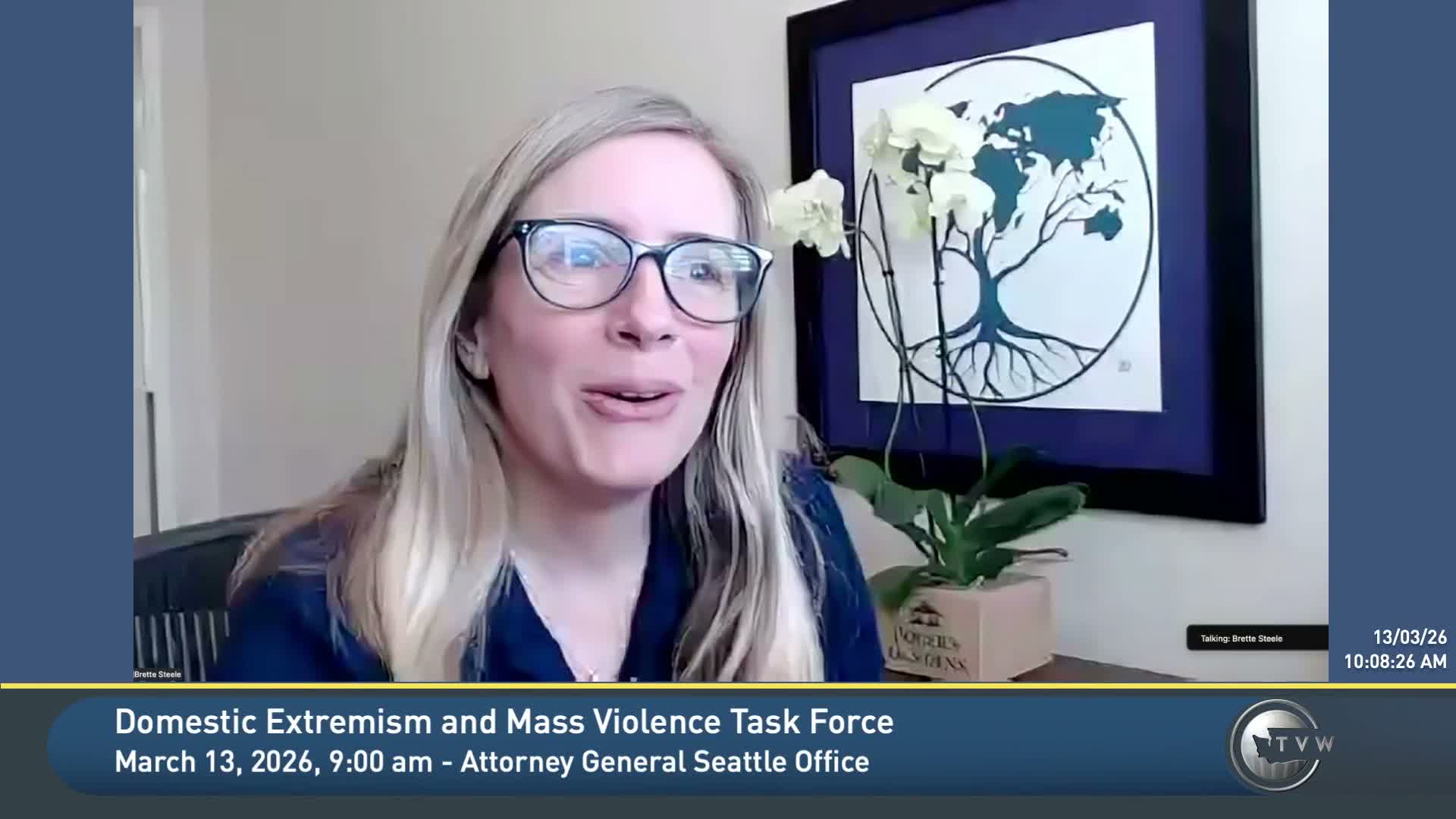
A panel of prevention and clinical experts told the task force that youth‑centered, multidisciplinary approaches can reduce the risk that vulnerable children are recruited into online communities that promote violence.
Brett Steele, president of Eradicate Hate, described the organization's Upend Hate campaign for ages 12–22 and said in one year his group trained 300 students at 10 schools in concrete intervention steps; "Those 300 youth took documented over 100 actions ... including 2 of those 300 students reported weapons on campus and averted planned school shootings," he said.
Heidi Ellis, a clinical child psychologist who directs the Trauma and Community Resilience Center at Boston Children's Hospital, said primary prevention should promote five core protective tasks — reducing problematic internet use, promoting emotional wellness, encouraging flexible thinking, promoting fairness and justice, and fostering belonging without othering. Ellis described the MAP (Massachusetts Area Prevention) program as a multidisciplinary secondary‑prevention clinic that accepts referrals from schools, families and law enforcement and performs comprehensive strengths, risks and needs assessments.
Amber Winn of the Office of Superintendent of Public Instruction outlined OSPI's tiered school‑based behavioral threat assessment model that emphasizes behavior‑focused, bias‑aware practices. Winn said Level 1 interventions stay within a school team and focus on supports; Level 2 is a multidisciplinary team (which "may consist of law enforcement, special education representatives, mental‑health providers, community‑based organizations") that evaluates whether more intensive interventions are needed while keeping prevention and services front and center.
Panelists cautioned against over‑reliance on policing as the default response. Ellis said the clinical goal is to divert children from criminal processing when possible and to work collaboratively with families and schools. Task force members raised liability concerns that can push schools to notify law enforcement; panelists acknowledged the tension, saying law enforcement has a role when threats are credible but should not be the only channel for prevention.
Panelists and members emphasized the importance of trusted adults — coaches, mentors, school staff or community leaders — and urged programs that create accessible pathways to belonging so youth do not turn to low‑friction online forums for connection.
The panel's practical examples and discussions fed into later task‑force work on prevention recommendations and subcommittee drafting.
Brett Steele, president of Eradicate Hate, described the organization's Upend Hate campaign for ages 12–22 and said in one year his group trained 300 students at 10 schools in concrete intervention steps; "Those 300 youth took documented over 100 actions ... including 2 of those 300 students reported weapons on campus and averted planned school shootings," he said.
Heidi Ellis, a clinical child psychologist who directs the Trauma and Community Resilience Center at Boston Children's Hospital, said primary prevention should promote five core protective tasks — reducing problematic internet use, promoting emotional wellness, encouraging flexible thinking, promoting fairness and justice, and fostering belonging without othering. Ellis described the MAP (Massachusetts Area Prevention) program as a multidisciplinary secondary‑prevention clinic that accepts referrals from schools, families and law enforcement and performs comprehensive strengths, risks and needs assessments.
Amber Winn of the Office of Superintendent of Public Instruction outlined OSPI's tiered school‑based behavioral threat assessment model that emphasizes behavior‑focused, bias‑aware practices. Winn said Level 1 interventions stay within a school team and focus on supports; Level 2 is a multidisciplinary team (which "may consist of law enforcement, special education representatives, mental‑health providers, community‑based organizations") that evaluates whether more intensive interventions are needed while keeping prevention and services front and center.
Panelists cautioned against over‑reliance on policing as the default response. Ellis said the clinical goal is to divert children from criminal processing when possible and to work collaboratively with families and schools. Task force members raised liability concerns that can push schools to notify law enforcement; panelists acknowledged the tension, saying law enforcement has a role when threats are credible but should not be the only channel for prevention.
Panelists and members emphasized the importance of trusted adults — coaches, mentors, school staff or community leaders — and urged programs that create accessible pathways to belonging so youth do not turn to low‑friction online forums for connection.
The panel's practical examples and discussions fed into later task‑force work on prevention recommendations and subcommittee drafting.
View the Full Meeting & All Its Details
This article offers just a summary. Unlock complete video, transcripts, and insights as a Founder Member.
✓
Watch full, unedited meeting videos
✓
Search every word spoken in unlimited transcripts
✓
AI summaries & real-time alerts (all government levels)
✓
Permanent access to expanding government content
30-day money-back guarantee
