WDFW outlines nonlethal wolf‑livestock measures, flags budget and data gaps
March 12, 2026 | Board Council Commission Agencies , Executive, Washington
This article was created by AI summarizing key points discussed. AI makes mistakes, so for full details and context, please refer to the video of the full meeting. Please report any errors so we can fix them. Report an error »
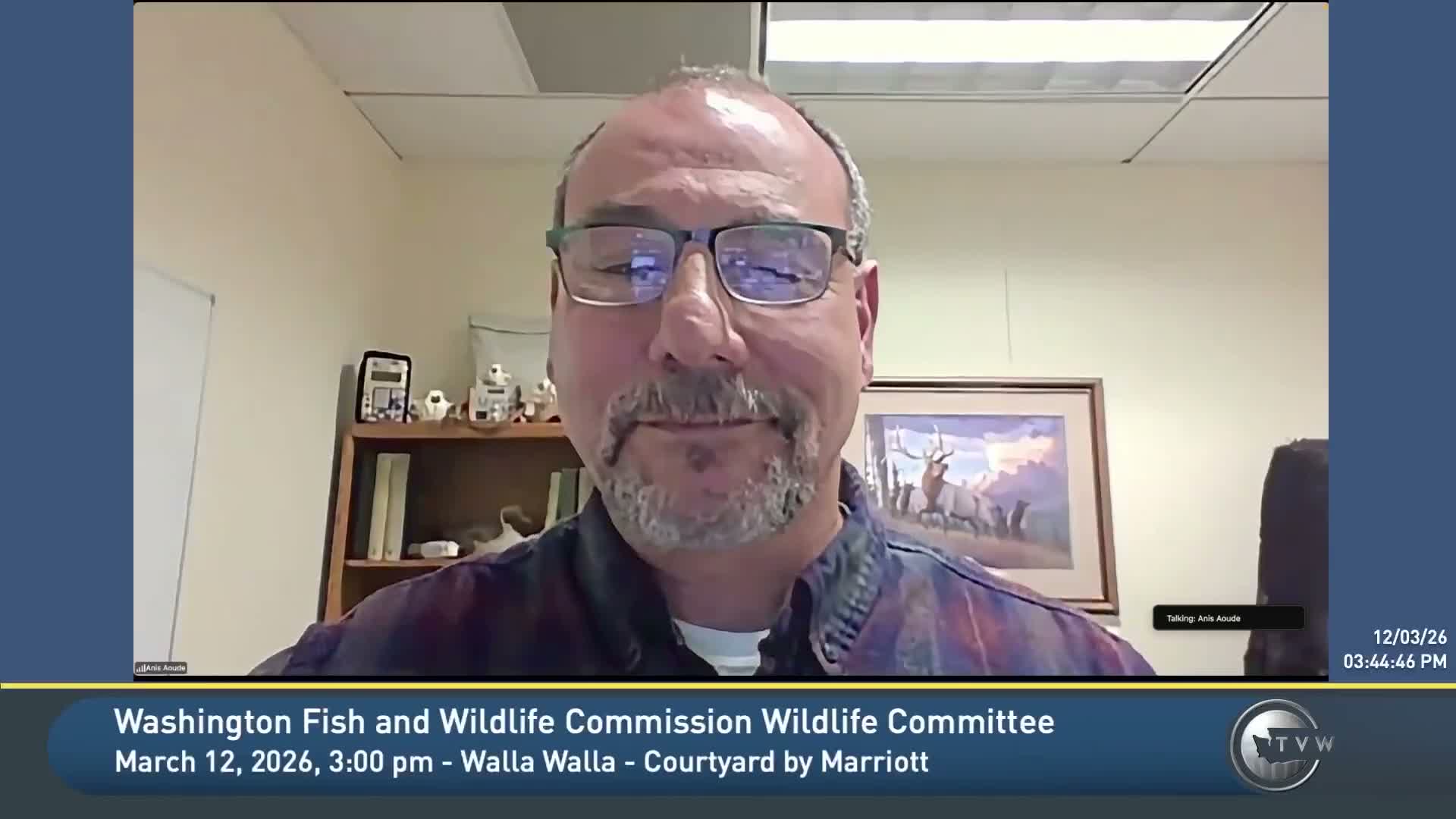
Department staff gave the wildlife committee an overview of nonlethal wolf‑management measures used to reduce livestock depredation and described funding, staffing and research needs.
Fenner Yarborough, landowner services division manager, and conflict‑specialist staff described a suite of nonlethal deterrents and programs: damage prevention cooperative agreements (DPCALs), contracted range riders, carcass sanitation, radio‑activated guard devices (RagBox), foxlights and turbo fladry. "We had $105,000 for damage prevention cooperative agreements," a presenter said, and staff described other funding lines and partnerships including personalized license‑plate revenue, state general funds, the state wildlife fund and periodic federal grants (including a USFWS livestock prevention 'Tester' grant).
Presenters said the tools’ effectiveness varies by context. Staff described upgrades to the RagBox (a smaller Pelican‑case unit replacing larger equipment), said some foxlight deployments have deterred wolves for months while others failed quickly, and noted that fladry effectiveness ranges widely. "There's no single deterrent measure or combination of measures that can guarantee everything; it's a constant moving and shaking on our part," conflict staff said.
The agency also explained program delivery: three routes for range riding (WDFW‑contracted riders, DPCAL cost‑share riders, and Department of Agriculture grant‑funded riders), plus contributions from NGOs and counties. Staff said funding and staffing constraints — about two dozen conflict staff statewide and limited range riders — limit program coverage.
Commissioners pressed for more quantitative reporting. Several asked for clearer metrics on how many producers the agency works with, how many deterrents are deployed at specific sites, and whether those deployments correlate with reduced depredations. Staff said measurement is difficult because reporting of depredations depends on local reporting behavior and case complexity, but noted ongoing research partnerships with Utah State University and Washington State University to evaluate efficacy.
The committee thanked staff for a condensed overview and asked for follow‑up data on program metrics and outcomes.
Fenner Yarborough, landowner services division manager, and conflict‑specialist staff described a suite of nonlethal deterrents and programs: damage prevention cooperative agreements (DPCALs), contracted range riders, carcass sanitation, radio‑activated guard devices (RagBox), foxlights and turbo fladry. "We had $105,000 for damage prevention cooperative agreements," a presenter said, and staff described other funding lines and partnerships including personalized license‑plate revenue, state general funds, the state wildlife fund and periodic federal grants (including a USFWS livestock prevention 'Tester' grant).
Presenters said the tools’ effectiveness varies by context. Staff described upgrades to the RagBox (a smaller Pelican‑case unit replacing larger equipment), said some foxlight deployments have deterred wolves for months while others failed quickly, and noted that fladry effectiveness ranges widely. "There's no single deterrent measure or combination of measures that can guarantee everything; it's a constant moving and shaking on our part," conflict staff said.
The agency also explained program delivery: three routes for range riding (WDFW‑contracted riders, DPCAL cost‑share riders, and Department of Agriculture grant‑funded riders), plus contributions from NGOs and counties. Staff said funding and staffing constraints — about two dozen conflict staff statewide and limited range riders — limit program coverage.
Commissioners pressed for more quantitative reporting. Several asked for clearer metrics on how many producers the agency works with, how many deterrents are deployed at specific sites, and whether those deployments correlate with reduced depredations. Staff said measurement is difficult because reporting of depredations depends on local reporting behavior and case complexity, but noted ongoing research partnerships with Utah State University and Washington State University to evaluate efficacy.
The committee thanked staff for a condensed overview and asked for follow‑up data on program metrics and outcomes.
View the Full Meeting & All Its Details
This article offers just a summary. Unlock complete video, transcripts, and insights as a Founder Member.
✓
Watch full, unedited meeting videos
✓
Search every word spoken in unlimited transcripts
✓
AI summaries & real-time alerts (all government levels)
✓
Permanent access to expanding government content
30-day money-back guarantee
