FISH Committee reviews draft technical procedures to guide hatchery management plans
March 12, 2026 | Board Council Commission Agencies , Executive, Washington
This article was created by AI summarizing key points discussed. AI makes mistakes, so for full details and context, please refer to the video of the full meeting. Please report any errors so we can fix them. Report an error »
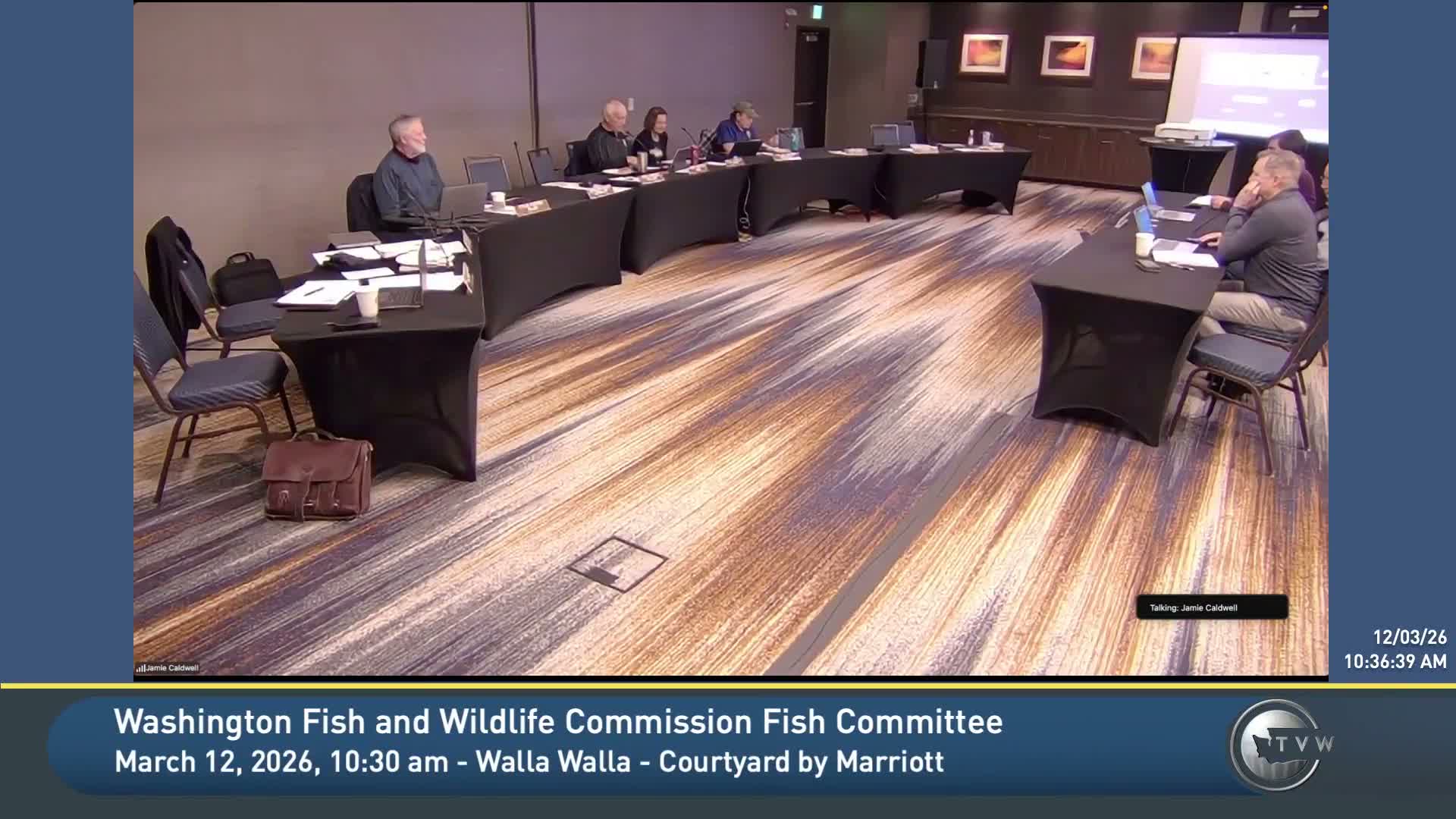
At a FISH Committee meeting in Walla Walla, agency staff presented a draft technical procedures document intended to guide hatchery management plans required under Commission policy C3624.
"The purpose of the technical procedures document was to help decision makers, weigh risks and benefits when making decisions about those hatchery management plans," Kelly Cunningham said, introducing the panel of agency scientists and managers.
Why it matters: The document translates policy direction into a process that staff say will make trade-offs explicit and measurable. Presenters said the framework will apply structured decision making to ensure decisions about hatchery production weigh conservation, harvest and legal obligations.
Mara Zimmerman, the agency's science-division manager, described how the document uses a step-by-step decision framework and a hypothetical Chinook program to show how trade-offs and outcomes would be evaluated. "We boiled down" policy-derived values into three fundamental, measurable objectives, she said: "sustain viable natural origin populations that are demographically, genetically, ecologically diverse; maintain or increase current levels of commercial and recreational harvest opportunity; [and] follow all relevant laws, policies, and agreements." Zimmerman said those objectives require specific performance attributes and indicators — for example, trends in commercial and recreational harvest, the proportion of hatchery-origin spawners on spawning grounds, and spawner-to-spawner population ratios.
Staff emphasized the role of multiple participants in planning. Zimmerman said decision-makers should include program managers or directors and may include tribal co-managers and federal managers as appropriate; technical teams should include genetics, fish health, population modeling and budget expertise.
The presenters framed alternatives as specific management actions and strategies — such as broodstock composition, within-hatchery practices to preserve genetic diversity, and targeted harvest measures — and said those alternatives would be evaluated using attributes tied to the stated objectives.
Cunningham noted the agency completed a joint co-manager hatchery policy in October 2023 and that staff are seeking additional input from tribal co-managers before finalizing the technical procedures document. The presenters also said the document contains an appendix on the State Environmental Policy Act and explains why the technical procedures document itself would not be processed through SEPA.
No formal votes or motions were recorded during the presentation. Staff said the document is in final draft form but remains open for tribal co-manager review and input; they signaled plans to bring a revised version back after that engagement. The committee discussed scheduling and future meeting planning but did not take a formal action at this session.
"The purpose of the technical procedures document was to help decision makers, weigh risks and benefits when making decisions about those hatchery management plans," Kelly Cunningham said, introducing the panel of agency scientists and managers.
Why it matters: The document translates policy direction into a process that staff say will make trade-offs explicit and measurable. Presenters said the framework will apply structured decision making to ensure decisions about hatchery production weigh conservation, harvest and legal obligations.
Mara Zimmerman, the agency's science-division manager, described how the document uses a step-by-step decision framework and a hypothetical Chinook program to show how trade-offs and outcomes would be evaluated. "We boiled down" policy-derived values into three fundamental, measurable objectives, she said: "sustain viable natural origin populations that are demographically, genetically, ecologically diverse; maintain or increase current levels of commercial and recreational harvest opportunity; [and] follow all relevant laws, policies, and agreements." Zimmerman said those objectives require specific performance attributes and indicators — for example, trends in commercial and recreational harvest, the proportion of hatchery-origin spawners on spawning grounds, and spawner-to-spawner population ratios.
Staff emphasized the role of multiple participants in planning. Zimmerman said decision-makers should include program managers or directors and may include tribal co-managers and federal managers as appropriate; technical teams should include genetics, fish health, population modeling and budget expertise.
The presenters framed alternatives as specific management actions and strategies — such as broodstock composition, within-hatchery practices to preserve genetic diversity, and targeted harvest measures — and said those alternatives would be evaluated using attributes tied to the stated objectives.
Cunningham noted the agency completed a joint co-manager hatchery policy in October 2023 and that staff are seeking additional input from tribal co-managers before finalizing the technical procedures document. The presenters also said the document contains an appendix on the State Environmental Policy Act and explains why the technical procedures document itself would not be processed through SEPA.
No formal votes or motions were recorded during the presentation. Staff said the document is in final draft form but remains open for tribal co-manager review and input; they signaled plans to bring a revised version back after that engagement. The committee discussed scheduling and future meeting planning but did not take a formal action at this session.
View the Full Meeting & All Its Details
This article offers just a summary. Unlock complete video, transcripts, and insights as a Founder Member.
✓
Watch full, unedited meeting videos
✓
Search every word spoken in unlimited transcripts
✓
AI summaries & real-time alerts (all government levels)
✓
Permanent access to expanding government content
30-day money-back guarantee
