Appellate court hears dispute over whether lopsided screws, boot mark create triable issue in Thomas v. Astera Commons Venture
March 11, 2026 | Other Court, Judicial , Washington
This article was created by AI summarizing key points discussed. AI makes mistakes, so for full details and context, please refer to the video of the full meeting. Please report any errors so we can fix them. Report an error »
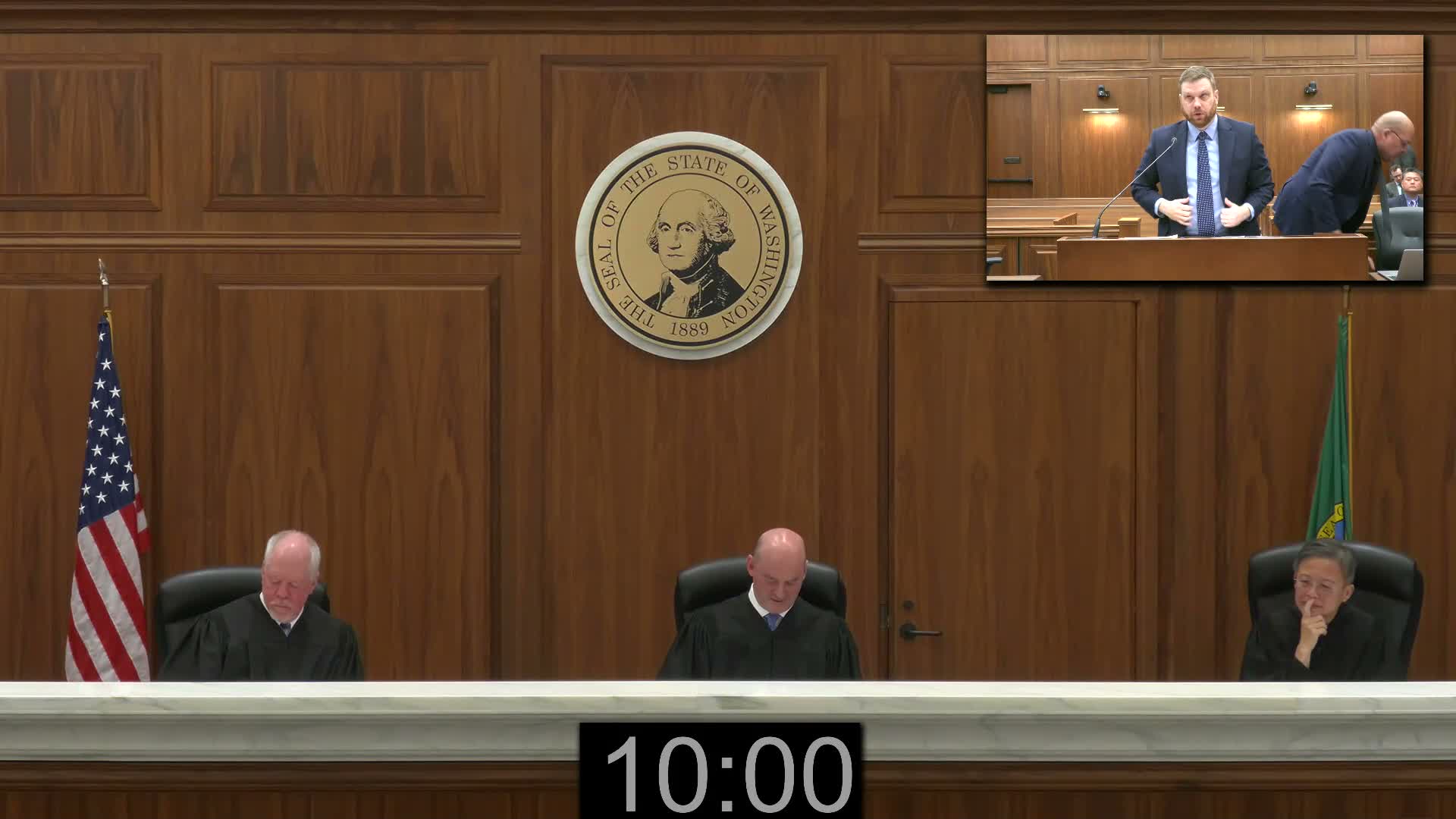
At oral argument in Thomas v. Astera Commons Venture, appellate counsel for the appellant said circumstantial evidence—protruding screws on an interior common-area staircase and an indentation on the claimant’s boot—was enough to create a fact question on causation in a trip-and-fall claim and to defeat summary judgment.
Thaddeus Martin, counsel for the appellant, told the court that the plaintiff fell down approximately 13 stairs and that the trial judge dismissed the case as speculative. “I would submit that no person that falls down the stairs, especially after hitting their head, . . . knows exactly how they fell,” Martin said, arguing that reasonable factfinders could draw inferences from the post‑fall inspection and the footwear mark.
Martin pointed to an inspection by an expert (Mark Lawless) who identified several screws that were “lopsided” or protruding instead of being flush, and he said witnesses reported the claimant told first responders that “something caught her foot” and she then “tumbled down the 13 stairs.” He cited appellate authorities such as Bella v. Junk and Miller v. Seattle to argue that circumstantial evidence and expert opinion can support causation when direct observation of the moment of injury is unavailable.
Respondent counsel Aaron Orheim countered that Washington premises‑liability law requires notice to the landlord of an unreasonable hazard and warned against collapsing notice and causation into a single analysis. “Appellant is trying to collapse these,” Orheim said, framing the dispute as one that requires an identifiable, preexisting hazard of which the owner had notice.
The panel asked several questions about the sufficiency and timing of evidence. A judge observed that direct evidence would be a statement such as, “I looked down and I saw my foot hit the screw,” and pressed whether the record shows the condition existed before the fall. Orheim emphasized that inspections documented after the incident may not prove the condition preexisted the accident and noted the absence of evidence about the stairs’ condition immediately before the fall.
Martin advanced the Pimentel exception, arguing that where a landowner or its agents created the hazardous condition on a new, common‑area staircase and conditions did not change in the short interval, a jury could reasonably infer causation without a precise identification of a single screw. The judges and counsel debated whether the inspection that found protruding screws, the boot indentation, and the claimant’s statements together suffice to raise a triable issue or whether expert testimony specifically linking the protruding screws to the fall is required.
No decision was announced in the transcript. Appellant counsel asked the court to allow the claim to proceed to a jury, acknowledging the plaintiff might not prevail at trial but arguing there is sufficient evidence to survive summary judgment; counsel then concluded argument and thanked the court.
Thaddeus Martin, counsel for the appellant, told the court that the plaintiff fell down approximately 13 stairs and that the trial judge dismissed the case as speculative. “I would submit that no person that falls down the stairs, especially after hitting their head, . . . knows exactly how they fell,” Martin said, arguing that reasonable factfinders could draw inferences from the post‑fall inspection and the footwear mark.
Martin pointed to an inspection by an expert (Mark Lawless) who identified several screws that were “lopsided” or protruding instead of being flush, and he said witnesses reported the claimant told first responders that “something caught her foot” and she then “tumbled down the 13 stairs.” He cited appellate authorities such as Bella v. Junk and Miller v. Seattle to argue that circumstantial evidence and expert opinion can support causation when direct observation of the moment of injury is unavailable.
Respondent counsel Aaron Orheim countered that Washington premises‑liability law requires notice to the landlord of an unreasonable hazard and warned against collapsing notice and causation into a single analysis. “Appellant is trying to collapse these,” Orheim said, framing the dispute as one that requires an identifiable, preexisting hazard of which the owner had notice.
The panel asked several questions about the sufficiency and timing of evidence. A judge observed that direct evidence would be a statement such as, “I looked down and I saw my foot hit the screw,” and pressed whether the record shows the condition existed before the fall. Orheim emphasized that inspections documented after the incident may not prove the condition preexisted the accident and noted the absence of evidence about the stairs’ condition immediately before the fall.
Martin advanced the Pimentel exception, arguing that where a landowner or its agents created the hazardous condition on a new, common‑area staircase and conditions did not change in the short interval, a jury could reasonably infer causation without a precise identification of a single screw. The judges and counsel debated whether the inspection that found protruding screws, the boot indentation, and the claimant’s statements together suffice to raise a triable issue or whether expert testimony specifically linking the protruding screws to the fall is required.
No decision was announced in the transcript. Appellant counsel asked the court to allow the claim to proceed to a jury, acknowledging the plaintiff might not prevail at trial but arguing there is sufficient evidence to survive summary judgment; counsel then concluded argument and thanked the court.
Don't Miss a Word: See the Full Meeting!
Go beyond summaries. Unlock every video, transcript, and key insight with a Founder Membership.
✓
Get instant access to full meeting videos
✓
Search and clip any phrase from complete transcripts
✓
Receive AI-powered summaries & custom alerts
✓
Enjoy lifetime, unrestricted access to government data
30-day money-back guarantee
