Court of Appeals hears accelerated review of guardianship order amid dispute over services for mother with disabilities
March 11, 2026 | Other Court, Judicial , Washington
This article was created by AI summarizing key points discussed. AI makes mistakes, so for full details and context, please refer to the video of the full meeting. Please report any errors so we can fix them. Report an error »
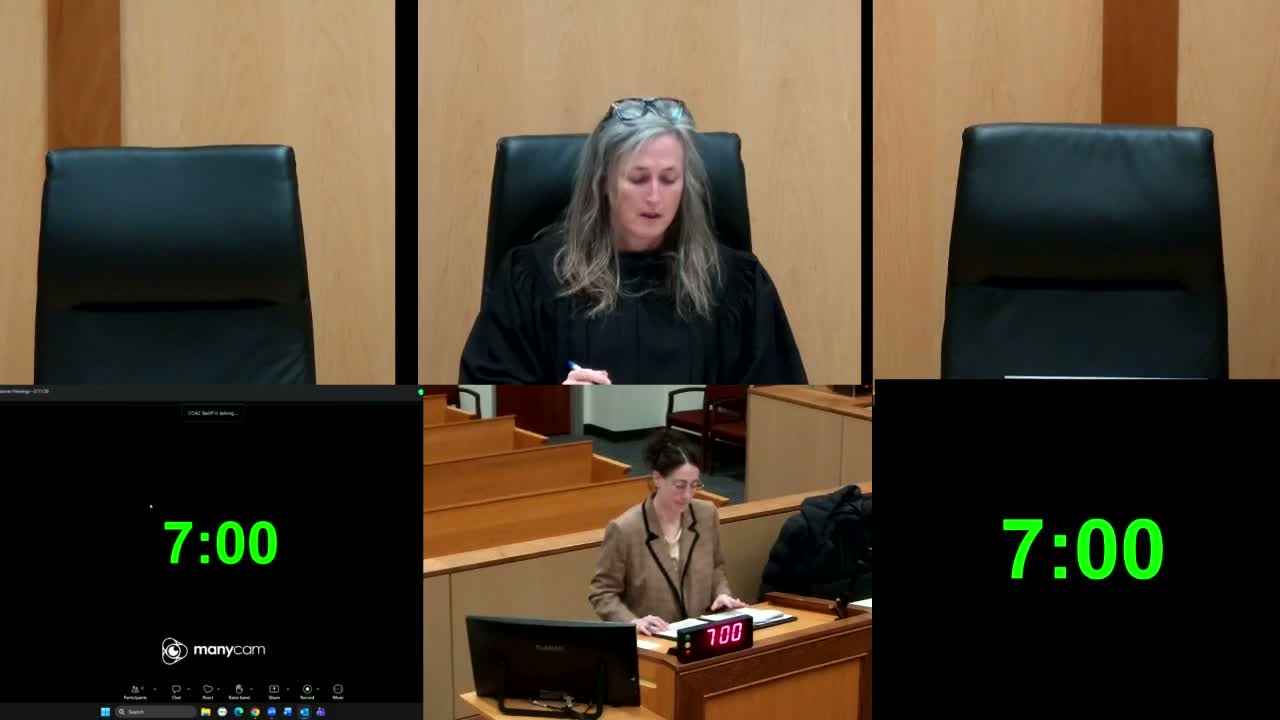
The Washington Court of Appeals, Division 2, heard oral argument March 11 in an accelerated review of guardianship case no. 61386-7 involving a three-year-old child identified as MS and challenges to a juvenile-court guardianship order.
Emily Thomason, attorney for petitioner LH, told the court the Department of Children, Youth, and Families failed to "understandably tailor" its offer of services to LH’s disabilities, which Thomason described as severe generalized anxiety disorder, an expressive language disorder and an intellectual/cognitive disability. "Doctor Ferguson's testimony very clearly shows how the department failed to understandably tailor its offer of services to accommodate LH," Thomason said, arguing the department did not provide the repetitive explanation, in-person accompaniment for transportation and test administration, or the research-based counseling the mother needed to engage with required services.
The department’s lawyer, Kristen Bellori, representing the Department of Children, Youth, and Families, urged the court to affirm the guardianship order for three reasons: the juvenile court properly denied the mother’s counsel’s motion to withdraw, substantial evidence shows the department offered or provided court-ordered services, and there is little likelihood the mother would remedy the conditions in the near future. Bellori said the department consulted ADA coordinators and concluded LH was not eligible for DDA services under the developmental-disability standard and that it had offered multiple options — including in-home oral swabs, hair-follicle testing (which requires transportation), virtual substance-use treatment, parenting education, referrals to the Center for Independence and concrete transportation supports such as Visa gift cards and gas cards.
Steve Galai of the Washington Appellate Project, representing the father, argued the record lacks direct evidence of a drug dependency or an ongoing parental deficiency and cautioned the court against relying on conjecture or association (such as nonengagement) alone to justify guardianship. Galai also pressed a legal argument that the services ordered must remain necessary to remedy an existing deficiency and that courts should not rest an extreme interference with parental rights on stale or speculative evidence.
The panel asked detailed questions about statutory duties and record evidence. The judges queried whether the record contained a DDA consultation or explicit finding of intellectual disability; counsel cited portions of the record, including testimony from Dr. Cheryl Ferguson and the mother's mental-health provider, Beatrice Abbott, which variously described the mother's anxiety and the extent of her comprehension. Counsel also discussed the juvenile court’s findings that MS had been in out-of-home care for about two and a half years and that the guardianship trial had been pending approximately nine months.
On procedural issues, Bellori told the court the juvenile court did not err in denying the mother’s counsel’s motion to withdraw because the mother had not made a proper, explicit motion to substitute counsel or to proceed pro se, and the record did not show ineffective assistance sufficient to warrant withdrawal at that stage. Thomason countered in rebuttal that the mother’s declaration (not in the record) and other facts reflected breakdowns in communication that the juvenile court failed to inquire into.
Both sides acknowledged some services had been offered but disputed whether those offers were meaningfully explained and tailored. Thomason emphasized that the department’s referral to Family Preservation Services in one instance was for the mother's oldest child, not for MS, and argued that deeper, repeated accommodation measures (such as accompaniment for transportation) were not provided. Bellori pointed to repeated contacts by social workers, offers to call the testing lab with the mother, and efforts to implement several of Dr. Ferguson’s recommendations.
The court did not announce a decision at the hearing. Commissioner Aurora Burse said the arguments would assist the panel in resolving this fact-intensive accelerated review and that the court would issue a written ruling as quickly as possible before adjourning.
The accelerated-review hearing focused on legal questions about the standard of proof and the continued necessity of ordered services, factual disputes over what supports were offered and provided, and procedural questions about counsel withdrawal and the juvenile court’s factfindings. No formal ruling was issued at the hearing.
Emily Thomason, attorney for petitioner LH, told the court the Department of Children, Youth, and Families failed to "understandably tailor" its offer of services to LH’s disabilities, which Thomason described as severe generalized anxiety disorder, an expressive language disorder and an intellectual/cognitive disability. "Doctor Ferguson's testimony very clearly shows how the department failed to understandably tailor its offer of services to accommodate LH," Thomason said, arguing the department did not provide the repetitive explanation, in-person accompaniment for transportation and test administration, or the research-based counseling the mother needed to engage with required services.
The department’s lawyer, Kristen Bellori, representing the Department of Children, Youth, and Families, urged the court to affirm the guardianship order for three reasons: the juvenile court properly denied the mother’s counsel’s motion to withdraw, substantial evidence shows the department offered or provided court-ordered services, and there is little likelihood the mother would remedy the conditions in the near future. Bellori said the department consulted ADA coordinators and concluded LH was not eligible for DDA services under the developmental-disability standard and that it had offered multiple options — including in-home oral swabs, hair-follicle testing (which requires transportation), virtual substance-use treatment, parenting education, referrals to the Center for Independence and concrete transportation supports such as Visa gift cards and gas cards.
Steve Galai of the Washington Appellate Project, representing the father, argued the record lacks direct evidence of a drug dependency or an ongoing parental deficiency and cautioned the court against relying on conjecture or association (such as nonengagement) alone to justify guardianship. Galai also pressed a legal argument that the services ordered must remain necessary to remedy an existing deficiency and that courts should not rest an extreme interference with parental rights on stale or speculative evidence.
The panel asked detailed questions about statutory duties and record evidence. The judges queried whether the record contained a DDA consultation or explicit finding of intellectual disability; counsel cited portions of the record, including testimony from Dr. Cheryl Ferguson and the mother's mental-health provider, Beatrice Abbott, which variously described the mother's anxiety and the extent of her comprehension. Counsel also discussed the juvenile court’s findings that MS had been in out-of-home care for about two and a half years and that the guardianship trial had been pending approximately nine months.
On procedural issues, Bellori told the court the juvenile court did not err in denying the mother’s counsel’s motion to withdraw because the mother had not made a proper, explicit motion to substitute counsel or to proceed pro se, and the record did not show ineffective assistance sufficient to warrant withdrawal at that stage. Thomason countered in rebuttal that the mother’s declaration (not in the record) and other facts reflected breakdowns in communication that the juvenile court failed to inquire into.
Both sides acknowledged some services had been offered but disputed whether those offers were meaningfully explained and tailored. Thomason emphasized that the department’s referral to Family Preservation Services in one instance was for the mother's oldest child, not for MS, and argued that deeper, repeated accommodation measures (such as accompaniment for transportation) were not provided. Bellori pointed to repeated contacts by social workers, offers to call the testing lab with the mother, and efforts to implement several of Dr. Ferguson’s recommendations.
The court did not announce a decision at the hearing. Commissioner Aurora Burse said the arguments would assist the panel in resolving this fact-intensive accelerated review and that the court would issue a written ruling as quickly as possible before adjourning.
The accelerated-review hearing focused on legal questions about the standard of proof and the continued necessity of ordered services, factual disputes over what supports were offered and provided, and procedural questions about counsel withdrawal and the juvenile court’s factfindings. No formal ruling was issued at the hearing.
Don't Miss a Word: See the Full Meeting!
Go beyond summaries. Unlock every video, transcript, and key insight with a Founder Membership.
✓
Get instant access to full meeting videos
✓
Search and clip any phrase from complete transcripts
✓
Receive AI-powered summaries & custom alerts
✓
Enjoy lifetime, unrestricted access to government data
30-day money-back guarantee
