Defense urges Washington Supreme Court to recognize broader state protection when suspects ambiguously ask to stop questioning
March 10, 2026 | Other Court, Judicial , Washington
This article was created by AI summarizing key points discussed. AI makes mistakes, so for full details and context, please refer to the video of the full meeting. Please report any errors so we can fix them. Report an error »
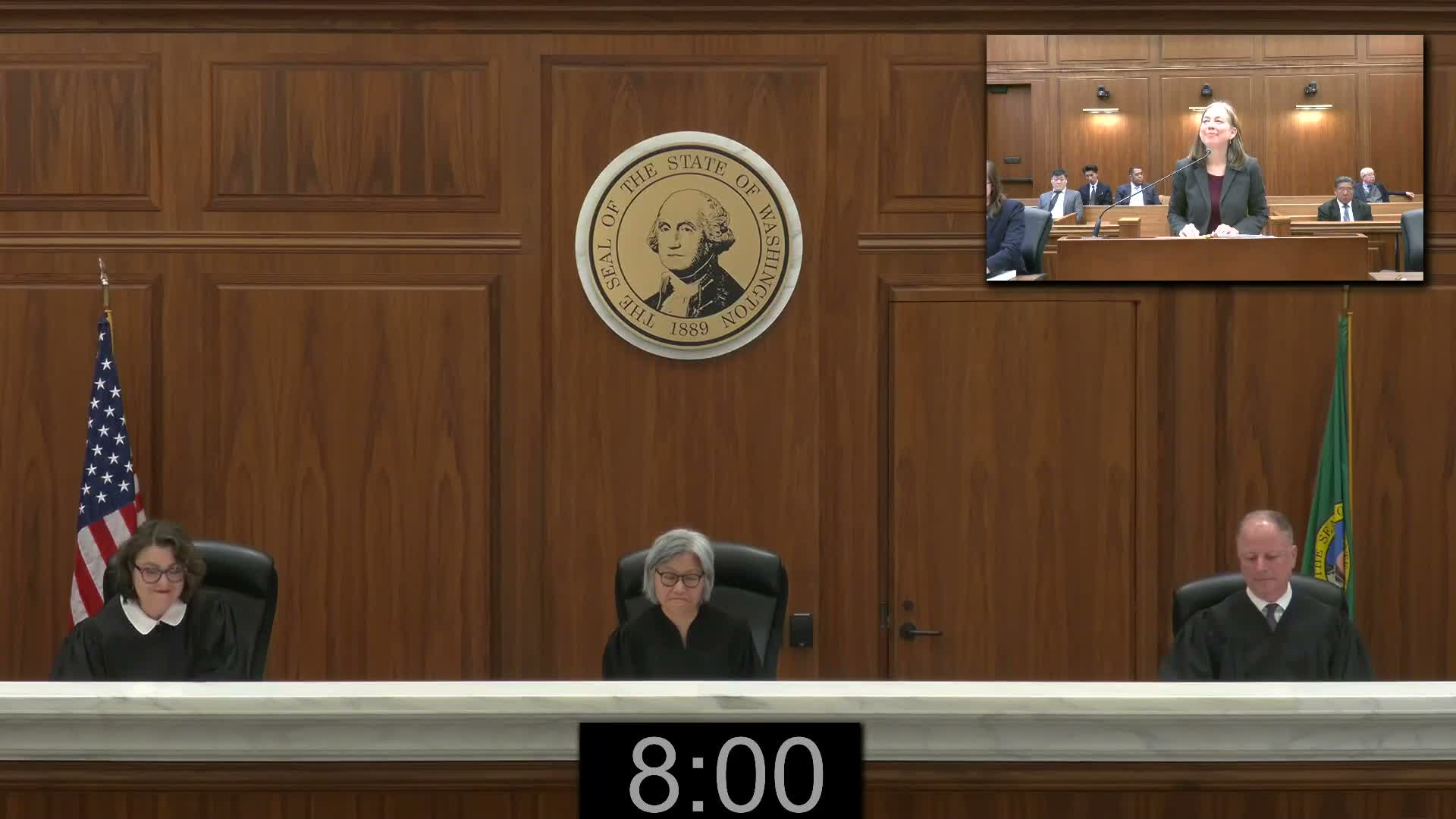
Lila Silverstein, counsel for defendant Jeremy Van Zandt Volpe, told the Washington Supreme Court that Article 1, Section 9 of the state constitution should be read to provide greater protection than the federal Fifth Amendment when a person ambiguously tries to end custodial questioning.
"If a person invokes their rights ambiguously or equivocally, detectives may not continue to interrogate the person and instead are limited to clarifying the request," Silverstein told the panel, asking the court to adopt the rule reflected historically in Rob Toye and in several other state-court decisions.
Silverstein said the court should act even if the precise argument was not framed below because the record—she said the court has the interrogation transcript—permits review under the court’s manifest-error authority. She argued several recent opinions, including Luna and Magana Arevalo, renew calls for state courts to interpret state constitutional protections independently where federal jurisprudence has narrowed rights.
"We ask this court to reverse," Silverstein said, describing the underlying facts she says show officers continued questioning after the defendant asked to call someone and asked to delay further questioning. She told the court Jeremy Van Zandt Volpe was 21 and "tried to invoke his right to cut off questioning" by repeatedly asking to call someone and to postpone the interrogation; Silverstein said detectives responded that they had to finish the interrogation and that he could not call anyone until it was over.
The State, represented by Erica Egertson, urged the court to reject the defense request. "Mr. Van Zandt Volpe's claim fails for two main reasons," Egertson told the panel: she said the claim is unpreserved because trial counsel did not make the specific factual arguments below and because the trial court did not make findings necessary for appellate review. Egertson also argued that binding Washington precedent treats Article 1, Section 9 and the Fifth Amendment as coextensive on this issue and that the court should therefore affirm the convictions.
Egertson said the trial record focuses on whether the defendant validly waived rights rather than on an unequivocal invocation, and she urged the court that where the record is incomplete the appellate court cannot make the necessary factual findings. She also cited Russell and other cases to say textual differences in the state constitution have not been treated as dispositive in this context.
The bench asked questions about preservation, the manifest-error standard for first-time appellate review, and whether adopting a more-protective state rule could cut both ways once federal law changed. A judge recited a trial-court finding that "at no time while being advised did he invoke his right to counsel," and the State emphasized the lack of trial findings on invocation.
On rebuttal, Silverstein stressed the issue is legal and argued the court should decide it now to provide guidance to trial courts and protect defendants who, she said, may speak equivocally to authority figures. She contrasted invocation and waiver, arguing invocation should be a bright-line rule that prevents further questioning until clarity is obtained.
The court heard the competing legal and factual claims; the transcript provided ends with counsel concluding argument and the court thanking the parties. The transcript does not record a decision from the bench.
"If a person invokes their rights ambiguously or equivocally, detectives may not continue to interrogate the person and instead are limited to clarifying the request," Silverstein told the panel, asking the court to adopt the rule reflected historically in Rob Toye and in several other state-court decisions.
Silverstein said the court should act even if the precise argument was not framed below because the record—she said the court has the interrogation transcript—permits review under the court’s manifest-error authority. She argued several recent opinions, including Luna and Magana Arevalo, renew calls for state courts to interpret state constitutional protections independently where federal jurisprudence has narrowed rights.
"We ask this court to reverse," Silverstein said, describing the underlying facts she says show officers continued questioning after the defendant asked to call someone and asked to delay further questioning. She told the court Jeremy Van Zandt Volpe was 21 and "tried to invoke his right to cut off questioning" by repeatedly asking to call someone and to postpone the interrogation; Silverstein said detectives responded that they had to finish the interrogation and that he could not call anyone until it was over.
The State, represented by Erica Egertson, urged the court to reject the defense request. "Mr. Van Zandt Volpe's claim fails for two main reasons," Egertson told the panel: she said the claim is unpreserved because trial counsel did not make the specific factual arguments below and because the trial court did not make findings necessary for appellate review. Egertson also argued that binding Washington precedent treats Article 1, Section 9 and the Fifth Amendment as coextensive on this issue and that the court should therefore affirm the convictions.
Egertson said the trial record focuses on whether the defendant validly waived rights rather than on an unequivocal invocation, and she urged the court that where the record is incomplete the appellate court cannot make the necessary factual findings. She also cited Russell and other cases to say textual differences in the state constitution have not been treated as dispositive in this context.
The bench asked questions about preservation, the manifest-error standard for first-time appellate review, and whether adopting a more-protective state rule could cut both ways once federal law changed. A judge recited a trial-court finding that "at no time while being advised did he invoke his right to counsel," and the State emphasized the lack of trial findings on invocation.
On rebuttal, Silverstein stressed the issue is legal and argued the court should decide it now to provide guidance to trial courts and protect defendants who, she said, may speak equivocally to authority figures. She contrasted invocation and waiver, arguing invocation should be a bright-line rule that prevents further questioning until clarity is obtained.
The court heard the competing legal and factual claims; the transcript provided ends with counsel concluding argument and the court thanking the parties. The transcript does not record a decision from the bench.
Don't Miss a Word: See the Full Meeting!
Go beyond summaries. Unlock every video, transcript, and key insight with a Founder Membership.
✓
Get instant access to full meeting videos
✓
Search and clip any phrase from complete transcripts
✓
Receive AI-powered summaries & custom alerts
✓
Enjoy lifetime, unrestricted access to government data
30-day money-back guarantee
