Appellate panel hears argument in State v. Cruz over counsel substitution and allegedly prejudicial evidence
March 12, 2026 | Other Court, Judicial , Washington
This article was created by AI summarizing key points discussed. AI makes mistakes, so for full details and context, please refer to the video of the full meeting. Please report any errors so we can fix them. Report an error »
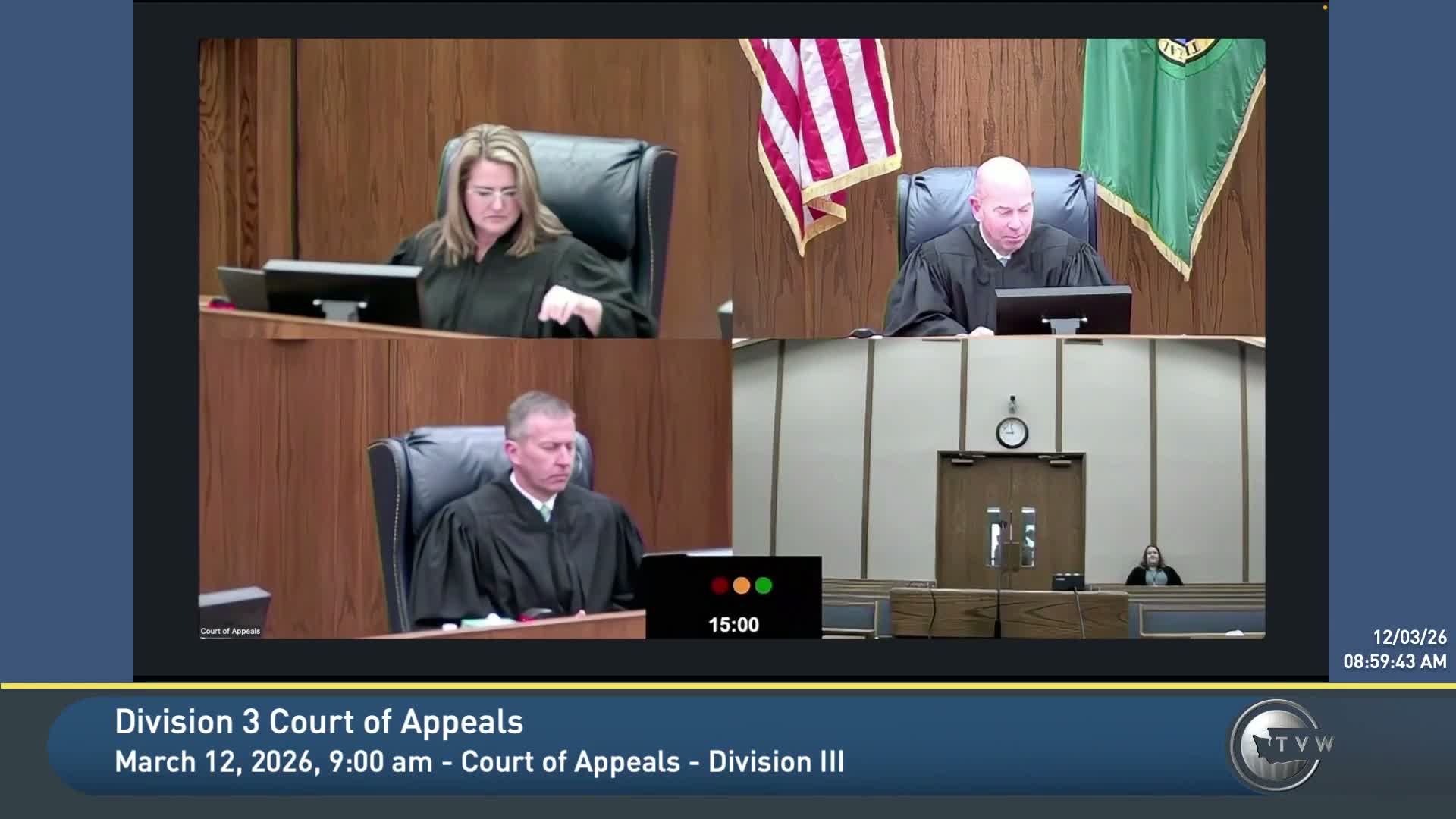
An appellate panel of Division Three Court of Appeals heard oral argument in State v. Cruz, during which appellant counsel Christine Tian told the court that "if the state is going to sentence a man to die in prison for a crime in which nobody died or was grievously injured, it must do so using fundamentally fair procedures." Tian argued the trial court erred by requiring Mr. Cruz to file a written motion from jail before the court would consider his request to discharge counsel, depriving him of a meaningful inquiry into alleged irreconcilable differences and, she said, his Sixth Amendment rights.
Tian (Washington Appellate Project) asked the court to treat the series of alleged failures as structural or constitutional errors that could require reversal or, at minimum, remand for an evidentiary hearing. She said the trial court effectively treated Mr. Cruz as a pro se litigant despite having counsel present and that the record lacks an adequate inquiry into whether conflicts between client and attorney were irreconcilable.
Why it matters: If the Court of Appeals finds the trial court failed to protect Mr. Cruz’s right to counsel at a critical stage, the conviction could be vacated or the case remanded for further proceedings; counsel and the panel also debated whether the claim should be preserved for a direct appeal or a possible personal restraint petition.
Judges on the panel pressed counsel about the completeness of the record. Presiding Judge Lauren Spirit said she was concerned the record on the substitution request may be incomplete and invited defense counsel to consider whether to proceed on direct appeal or preserve the issue for a possible PRP.
Tian also targeted jury-selection and evidentiary rulings. She argued juror 15’s questionnaire responses and statements raised a risk of religiously based bias, and that another juror (juror 28) appeared disengaged. On evidentiary matters, Tian challenged admission of prior domestic-violence evidence and a no-contact order under Evidence Rule 404(b), arguing the prosecution introduced details that were not necessary to prove the charged offense and risked unfair prejudice. She described the arrest video as a “multi-minute” recording showing a forcible takedown — broken windows, officers pointing rifles and a police dog — and argued its dramatic imagery suggested violent criminality beyond what was needed to prove vehicle-related conduct.
Responding for the state, Kevin McCray, special deputy prosecuting attorney for Grant County, told the court he did not view the record as showing structural error. "I don't think the motion was denied," McCray said, describing how the trial court instructed that a written motion be filed and later found nothing filed on the docket; he argued that, in those circumstances, the issue may have been waived and that the record must be developed to resolve fact-specific disputes about conflicts between client and counsel.
McCray also defended the prosecution's need to prove that a no-contact order existed and that the defendant knew about it, saying the state relied on multiple proofs including a certified copy of the order and Mr. Cruz’s video admission. He acknowledged there are contexts — and changing ethics rules (counsel referenced RPC 3.7) — that could affect disqualification questions and said the court must balance fairness and the practical realities of caseloads.
Counsel noted related Supreme Court review in other cases on persistent-offender and evidentiary issues (references during argument included Herndon and Monroe), and the panel discussed whether aspects of those pending decisions could affect resolution here. Tian told the panel she would submit a written statement supplementing oral argument, and she had reserved five minutes for rebuttal at the lectern.
After questioning and final remarks the panel announced the case submitted for decision; the court did not issue a ruling from the bench. The next case on the docket was scheduled to be heard remotely.
Tian (Washington Appellate Project) asked the court to treat the series of alleged failures as structural or constitutional errors that could require reversal or, at minimum, remand for an evidentiary hearing. She said the trial court effectively treated Mr. Cruz as a pro se litigant despite having counsel present and that the record lacks an adequate inquiry into whether conflicts between client and attorney were irreconcilable.
Why it matters: If the Court of Appeals finds the trial court failed to protect Mr. Cruz’s right to counsel at a critical stage, the conviction could be vacated or the case remanded for further proceedings; counsel and the panel also debated whether the claim should be preserved for a direct appeal or a possible personal restraint petition.
Judges on the panel pressed counsel about the completeness of the record. Presiding Judge Lauren Spirit said she was concerned the record on the substitution request may be incomplete and invited defense counsel to consider whether to proceed on direct appeal or preserve the issue for a possible PRP.
Tian also targeted jury-selection and evidentiary rulings. She argued juror 15’s questionnaire responses and statements raised a risk of religiously based bias, and that another juror (juror 28) appeared disengaged. On evidentiary matters, Tian challenged admission of prior domestic-violence evidence and a no-contact order under Evidence Rule 404(b), arguing the prosecution introduced details that were not necessary to prove the charged offense and risked unfair prejudice. She described the arrest video as a “multi-minute” recording showing a forcible takedown — broken windows, officers pointing rifles and a police dog — and argued its dramatic imagery suggested violent criminality beyond what was needed to prove vehicle-related conduct.
Responding for the state, Kevin McCray, special deputy prosecuting attorney for Grant County, told the court he did not view the record as showing structural error. "I don't think the motion was denied," McCray said, describing how the trial court instructed that a written motion be filed and later found nothing filed on the docket; he argued that, in those circumstances, the issue may have been waived and that the record must be developed to resolve fact-specific disputes about conflicts between client and counsel.
McCray also defended the prosecution's need to prove that a no-contact order existed and that the defendant knew about it, saying the state relied on multiple proofs including a certified copy of the order and Mr. Cruz’s video admission. He acknowledged there are contexts — and changing ethics rules (counsel referenced RPC 3.7) — that could affect disqualification questions and said the court must balance fairness and the practical realities of caseloads.
Counsel noted related Supreme Court review in other cases on persistent-offender and evidentiary issues (references during argument included Herndon and Monroe), and the panel discussed whether aspects of those pending decisions could affect resolution here. Tian told the panel she would submit a written statement supplementing oral argument, and she had reserved five minutes for rebuttal at the lectern.
After questioning and final remarks the panel announced the case submitted for decision; the court did not issue a ruling from the bench. The next case on the docket was scheduled to be heard remotely.
View the Full Meeting & All Its Details
This article offers just a summary. Unlock complete video, transcripts, and insights as a Founder Member.
✓
Watch full, unedited meeting videos
✓
Search every word spoken in unlimited transcripts
✓
AI summaries & real-time alerts (all government levels)
✓
Permanent access to expanding government content
30-day money-back guarantee
