Court hears arguments over forged 2020 lease and whether earlier 2019 agreement still binds tenant
March 11, 2026 | Other Court, Judicial , Washington
This article was created by AI summarizing key points discussed. AI makes mistakes, so for full details and context, please refer to the video of the full meeting. Please report any errors so we can fix them. Report an error »
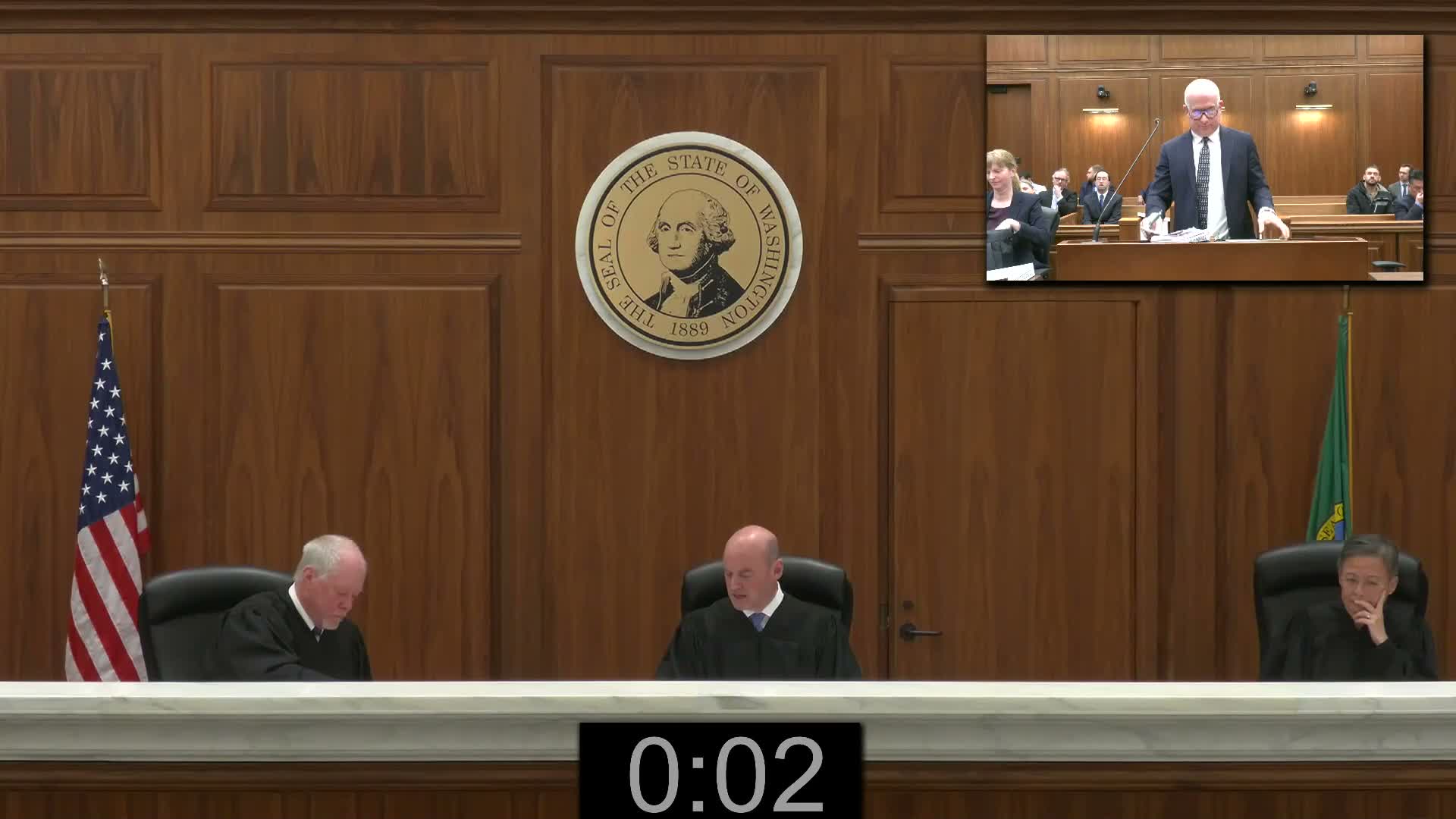
The court heard oral argument in Equity Residential Management v. Castro over whether a 2020 rent-reduction lease, signed by Equity and forged as to tenant Manuel Castro, superseded obligations under a prior 2019 rental agreement.
Jennifer Hohnstein, counsel for Equity Residential Management, told the court that although the 2020 form bore Castro’s signature, the trial court found that signature forged and that Castro was fraudulently induced into any agreement he did not actually consent to. “He cannot be bound to agreement to which he did not agree,” Hohnstein said, arguing that if Castro was not a party to the 2020 document it could not extinguish the 2019 lease unless the same parties were present to effect supersession.
Hohnstein told the bench Equity’s position was twofold: either the 2019 rental agreement remained in force, or Equity and the cotenants should all be bound by the lower rental rates in the 2020 document only if every party was properly bound. She emphasized that Castro had multiple alleged breaches under the 2019 lease that preceded the 2020 form, including failing to vacate, failing to restore the unit to a ready-to-rent condition, not returning access devices, and unpaid rent, and that fraud cannot retroactively forgive earlier breaches or existing debt.
John Yip, counsel for respondent Manuel Castro, responded that the parties had signed a series of leases and that the last lease Castro clearly signed expired on May 6, 2019. He argued that by operation of law that tenancy terminated on the specified date and that subsequent liability depends on actual holdover. “The law at the time says simply, in all cases where premises are rented for a specified time ... the tenancy shall be deemed terminated at the end of such a specified time,” Yip told the court, pressing that the statute in effect at the time prevented a preprinted form from altering expiration rules.
Yip noted record evidence suggesting the parties expected the May 6, 2019 expiration and that Castro denied ever receiving keys, arguing there was no competent evidence he remained in possession after that date. He also told the court the statute (quoted in argument as RCW 59 18 2 30) required interpreting ambiguous lease terms in favor of the tenant and said the statute later was amended in 2021, which could produce different results under the current law than under the law in force in 2019.
The bench pressed both sides on notice-language and contract integration clauses. The judge observed that the lease contains a paragraph requiring tenants to provide written notice at least 20 days before move-out and asked where ambiguity existed; counsel debated whether that paragraph and the document’s automatic-renewal language should be enforced or treated as unenforceable at the time.
Hohnstein cited precedent requiring the same parties for an agreement to supersede a prior contract (referencing Peterson and Higgins in argument), and she maintained that where a cotenant’s name was forged the non-signing cotenant could elect to rescind and not accept retroactive benefits while avoiding prior burdens. “You can’t simultaneously invoke the benefits of [an] agreement while denying the burdens,” she said.
Argument concluded after extended discussion of possession, notice, and statutory text. The court heard case citations and factual recitations from both sides and did not issue a ruling at the conclusion of oral argument. The next procedural step is pending the court’s decision.
This article is based on oral argument in Equity Residential Management v. Castro before Other Court; direct quotes and legal references are taken from counsel’s arguments in court.
Jennifer Hohnstein, counsel for Equity Residential Management, told the court that although the 2020 form bore Castro’s signature, the trial court found that signature forged and that Castro was fraudulently induced into any agreement he did not actually consent to. “He cannot be bound to agreement to which he did not agree,” Hohnstein said, arguing that if Castro was not a party to the 2020 document it could not extinguish the 2019 lease unless the same parties were present to effect supersession.
Hohnstein told the bench Equity’s position was twofold: either the 2019 rental agreement remained in force, or Equity and the cotenants should all be bound by the lower rental rates in the 2020 document only if every party was properly bound. She emphasized that Castro had multiple alleged breaches under the 2019 lease that preceded the 2020 form, including failing to vacate, failing to restore the unit to a ready-to-rent condition, not returning access devices, and unpaid rent, and that fraud cannot retroactively forgive earlier breaches or existing debt.
John Yip, counsel for respondent Manuel Castro, responded that the parties had signed a series of leases and that the last lease Castro clearly signed expired on May 6, 2019. He argued that by operation of law that tenancy terminated on the specified date and that subsequent liability depends on actual holdover. “The law at the time says simply, in all cases where premises are rented for a specified time ... the tenancy shall be deemed terminated at the end of such a specified time,” Yip told the court, pressing that the statute in effect at the time prevented a preprinted form from altering expiration rules.
Yip noted record evidence suggesting the parties expected the May 6, 2019 expiration and that Castro denied ever receiving keys, arguing there was no competent evidence he remained in possession after that date. He also told the court the statute (quoted in argument as RCW 59 18 2 30) required interpreting ambiguous lease terms in favor of the tenant and said the statute later was amended in 2021, which could produce different results under the current law than under the law in force in 2019.
The bench pressed both sides on notice-language and contract integration clauses. The judge observed that the lease contains a paragraph requiring tenants to provide written notice at least 20 days before move-out and asked where ambiguity existed; counsel debated whether that paragraph and the document’s automatic-renewal language should be enforced or treated as unenforceable at the time.
Hohnstein cited precedent requiring the same parties for an agreement to supersede a prior contract (referencing Peterson and Higgins in argument), and she maintained that where a cotenant’s name was forged the non-signing cotenant could elect to rescind and not accept retroactive benefits while avoiding prior burdens. “You can’t simultaneously invoke the benefits of [an] agreement while denying the burdens,” she said.
Argument concluded after extended discussion of possession, notice, and statutory text. The court heard case citations and factual recitations from both sides and did not issue a ruling at the conclusion of oral argument. The next procedural step is pending the court’s decision.
This article is based on oral argument in Equity Residential Management v. Castro before Other Court; direct quotes and legal references are taken from counsel’s arguments in court.
Don't Miss a Word: See the Full Meeting!
Go beyond summaries. Unlock every video, transcript, and key insight with a Founder Membership.
✓
Get instant access to full meeting videos
✓
Search and clip any phrase from complete transcripts
✓
Receive AI-powered summaries & custom alerts
✓
Enjoy lifetime, unrestricted access to government data
30-day money-back guarantee
