Appellate panel questions whether Davis is entitled to full de novo resentencing after offender-score change
March 11, 2026 | Other Court, Judicial , Washington
This article was created by AI summarizing key points discussed. AI makes mistakes, so for full details and context, please refer to the video of the full meeting. Please report any errors so we can fix them. Report an error »
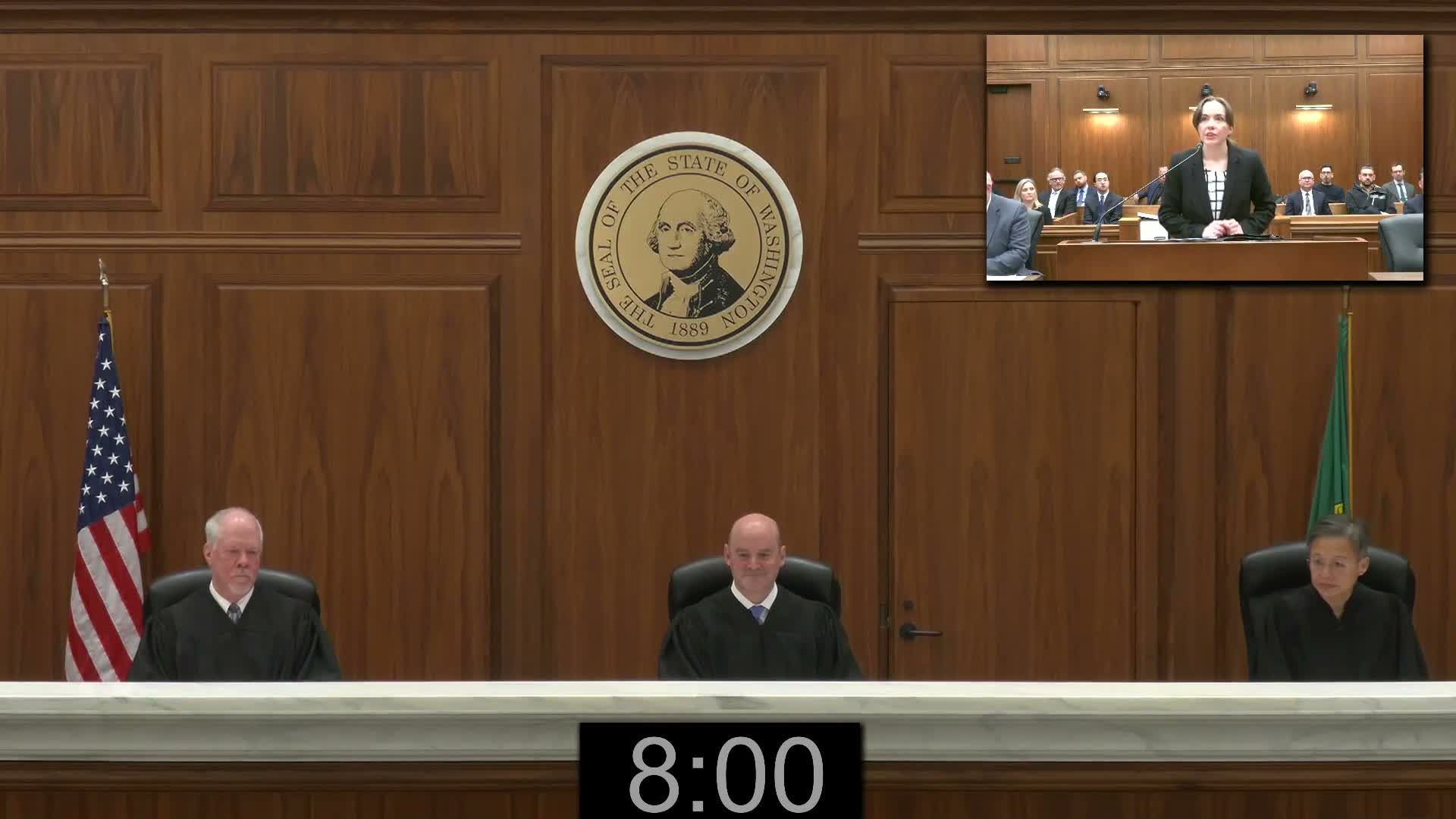
Stephanie Topplin, counsel for appellant Gary Davis, told a three-judge panel that Davis "is asking this court to reverse and remand for 2 reasons": he was entitled to a full de novo resentencing hearing, and the trial court erred by failing to apply Blakely v. Washington. Topplin said the superior court’s adjustment of Davis’s offender score changed his standard range and, because the court left the total months the same, "the court effectively increased his exceptional sentence."
The panel focused its questioning on whether a numeric change in an exceptional term — keeping the same exceptional months after reducing the offender score — is legally different from making new factual findings that support an exceptional sentence. One judge asked whether the critical inquiry is a change in the underlying factual findings or merely the numeric length of the exceptional term. Topplin urged the court to treat this case like State v. Ellis and related decisions, arguing those precedents require courts at a full de novo resentencing to apply otherwise nonretroactive rules.
Bill Larus, Grays Harbor County Deputy Prosecutor, representing the State, responded that this matter is a collateral CrR 7.8 attack and that collateral-attack principles and State v. Kelly control. Larus argued Anderson and Roland remain meaningful: Anderson was a youthful-offender collateral case governed by Roland’s treatment of exceptional-sentence findings, and Larus said Ellis (a youthful-offender appeal) is not closely analogous here. He urged the panel to conclude the offender-score change was not material to the sentence and to affirm the trial court.
The panel and counsel also discussed State v. O’Dell and whether the court should treat new procedural rules the same way in resentencing contexts; Topplin said courts have treated some otherwise nonretroactive decisions as applicable at full resentencing hearings. The judges pressed whether mitigating evidence presented at resentencing — including postoffense developments — could alter the factual findings that supported the original exceptional sentence, and whether youth-resentencing doctrine analogies are appropriate when the defendant was not a youthful offender.
The lawyers did not identify a binding holding that settles the distinct combination of facts here: a CrR 7.8 collateral attack in which the trial court reduced the offender score (from 1 to 0) but retained the same total sentence, producing what the defense describes as an increase in the exceptional portion. Topplin asked the panel to reverse; Larus asked the panel to affirm and to review State v. Kelly. The argument concluded with no ruling announced on the record.
The panel focused its questioning on whether a numeric change in an exceptional term — keeping the same exceptional months after reducing the offender score — is legally different from making new factual findings that support an exceptional sentence. One judge asked whether the critical inquiry is a change in the underlying factual findings or merely the numeric length of the exceptional term. Topplin urged the court to treat this case like State v. Ellis and related decisions, arguing those precedents require courts at a full de novo resentencing to apply otherwise nonretroactive rules.
Bill Larus, Grays Harbor County Deputy Prosecutor, representing the State, responded that this matter is a collateral CrR 7.8 attack and that collateral-attack principles and State v. Kelly control. Larus argued Anderson and Roland remain meaningful: Anderson was a youthful-offender collateral case governed by Roland’s treatment of exceptional-sentence findings, and Larus said Ellis (a youthful-offender appeal) is not closely analogous here. He urged the panel to conclude the offender-score change was not material to the sentence and to affirm the trial court.
The panel and counsel also discussed State v. O’Dell and whether the court should treat new procedural rules the same way in resentencing contexts; Topplin said courts have treated some otherwise nonretroactive decisions as applicable at full resentencing hearings. The judges pressed whether mitigating evidence presented at resentencing — including postoffense developments — could alter the factual findings that supported the original exceptional sentence, and whether youth-resentencing doctrine analogies are appropriate when the defendant was not a youthful offender.
The lawyers did not identify a binding holding that settles the distinct combination of facts here: a CrR 7.8 collateral attack in which the trial court reduced the offender score (from 1 to 0) but retained the same total sentence, producing what the defense describes as an increase in the exceptional portion. Topplin asked the panel to reverse; Larus asked the panel to affirm and to review State v. Kelly. The argument concluded with no ruling announced on the record.
View the Full Meeting & All Its Details
This article offers just a summary. Unlock complete video, transcripts, and insights as a Founder Member.
✓
Watch full, unedited meeting videos
✓
Search every word spoken in unlimited transcripts
✓
AI summaries & real-time alerts (all government levels)
✓
Permanent access to expanding government content
30-day money-back guarantee
