Legislative Finance shows retirement-modeling tradeoffs as committee considers HB 78
March 12, 2026 | 2026 Legislature Alaska, Alaska
This article was created by AI summarizing key points discussed. AI makes mistakes, so for full details and context, please refer to the video of the full meeting. Please report any errors so we can fix them. Report an error »
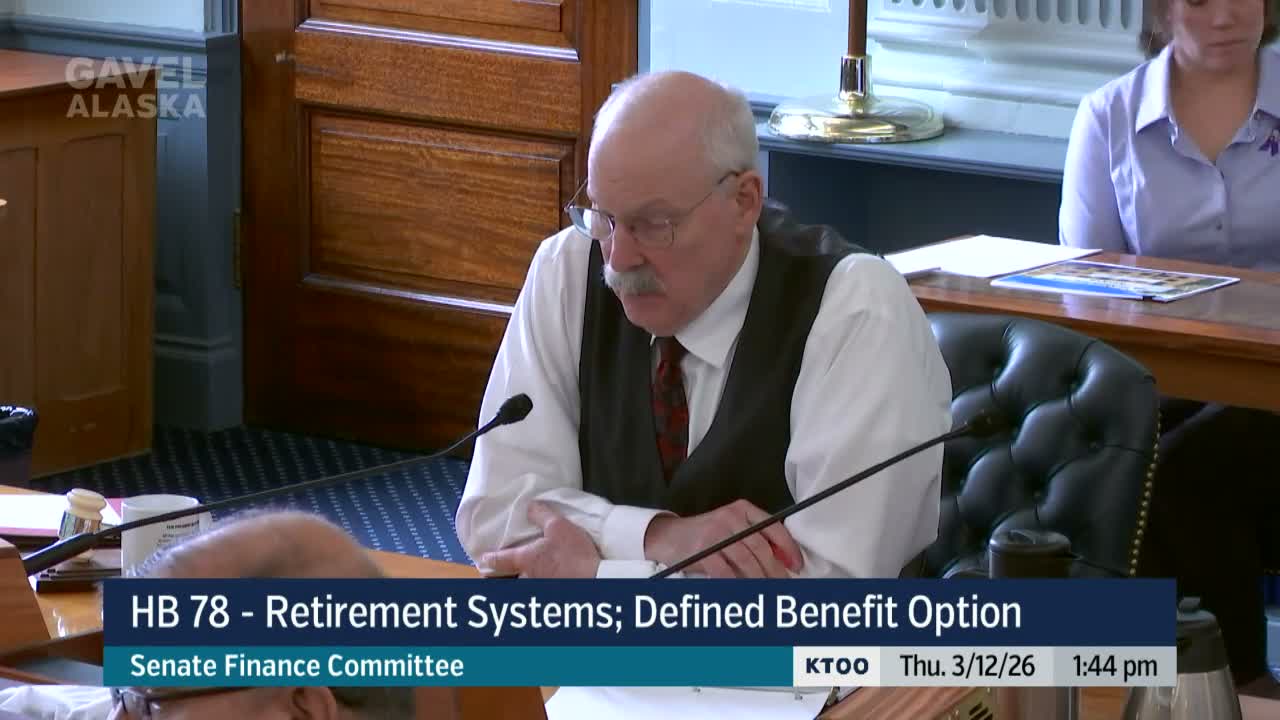
Alexi Painter, director of the Legislative Finance Division, presented an interactive modeling tool to the Senate Finance Committee on March 12 to compare the state’s current retirement tiers with House Bill 78, which would create a defined-benefit option. "Our goal here was really to make sort of a more interactive model so you could compare different assumptions," Painter said as he walked members through baseline assumptions and sensitivity tests.
Painter said the model uses defaults including 2.75% salary growth, a starting age of 25, a 7% default investment return and 2.5% inflation, and he emphasized that outcomes are highly sensitive to the annuity-conversion rate and career length. Under favorable, higher-return assumptions (Painter noted an 8% long-term average for PERS over FY1996–FY2025), defined-contribution results with the supplemental benefit system (SBS) can appear competitive; under lower-return or adverse sequence scenarios, defined-benefit provisions and SBS materially outperform DC-only outcomes.
Committee members asked Painter to add scenarios that mirror modern portfolio management draws, vary career lengths (20, 30, 40 years), and show how outcomes change if retirees do not annuitize their SBS balances. "One of the most powerful assumptions when you're comparing a DB versus a DC system…is the annuity conversion rate," Painter told members. He agreed to run additional scenarios and to incorporate Department of Revenue historical returns when they are provided.
During sponsor remarks, Chuck Cobb, facilitator for House District 10, argued HB 78 would strengthen retention and reduce workforce costs such as premium pay and turnover. "These numbers are orders of magnitude higher than the projected cost of this plan," Cobb said, referring to premium-pay and errors/omissions costs he said are currently borne by the state; those figures were stated during sponsor remarks and were not adjudicated or confirmed during the hearing.
Painter cautioned about limitations in the retention data presented—Legislative Finance’s retention data run to FY2022 and cannot track employees across employers, which reduces statistical power—and recommended the committee request DRB and Department of Revenue returns for updated comparisons. The committee did not take action on HB 78 at the March 12 meeting and asked presenters for additional analyses and updated returns at a future session.
Painter said the model uses defaults including 2.75% salary growth, a starting age of 25, a 7% default investment return and 2.5% inflation, and he emphasized that outcomes are highly sensitive to the annuity-conversion rate and career length. Under favorable, higher-return assumptions (Painter noted an 8% long-term average for PERS over FY1996–FY2025), defined-contribution results with the supplemental benefit system (SBS) can appear competitive; under lower-return or adverse sequence scenarios, defined-benefit provisions and SBS materially outperform DC-only outcomes.
Committee members asked Painter to add scenarios that mirror modern portfolio management draws, vary career lengths (20, 30, 40 years), and show how outcomes change if retirees do not annuitize their SBS balances. "One of the most powerful assumptions when you're comparing a DB versus a DC system…is the annuity conversion rate," Painter told members. He agreed to run additional scenarios and to incorporate Department of Revenue historical returns when they are provided.
During sponsor remarks, Chuck Cobb, facilitator for House District 10, argued HB 78 would strengthen retention and reduce workforce costs such as premium pay and turnover. "These numbers are orders of magnitude higher than the projected cost of this plan," Cobb said, referring to premium-pay and errors/omissions costs he said are currently borne by the state; those figures were stated during sponsor remarks and were not adjudicated or confirmed during the hearing.
Painter cautioned about limitations in the retention data presented—Legislative Finance’s retention data run to FY2022 and cannot track employees across employers, which reduces statistical power—and recommended the committee request DRB and Department of Revenue returns for updated comparisons. The committee did not take action on HB 78 at the March 12 meeting and asked presenters for additional analyses and updated returns at a future session.
View the Full Meeting & All Its Details
This article offers just a summary. Unlock complete video, transcripts, and insights as a Founder Member.
✓
Watch full, unedited meeting videos
✓
Search every word spoken in unlimited transcripts
✓
AI summaries & real-time alerts (all government levels)
✓
Permanent access to expanding government content
30-day money-back guarantee
