State officials pitch apprenticeships and pre‑apprenticeships to expand disability employment
March 11, 2026 | 2026 Legislature MA, Massachusetts
This article was created by AI summarizing key points discussed. AI makes mistakes, so for full details and context, please refer to the video of the full meeting. Please report any errors so we can fix them. Report an error »
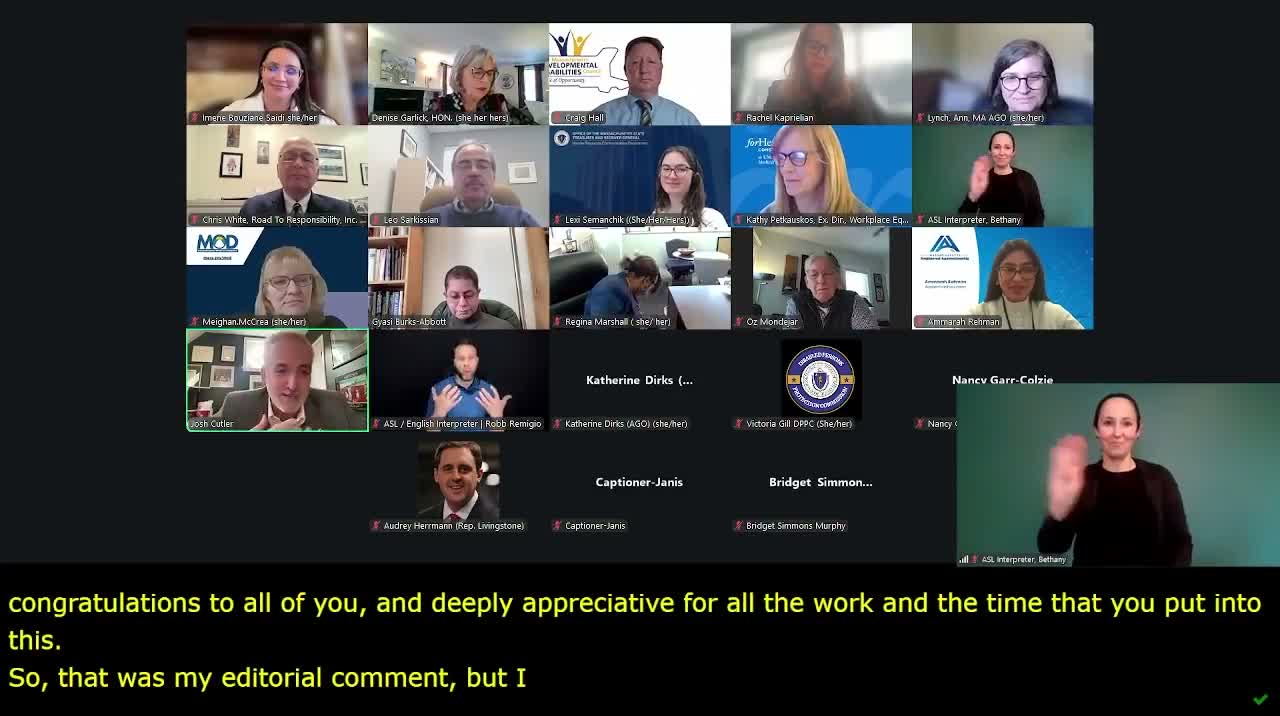
Undersecretary of Labor Josh Cutler and Division of Apprenticeship Standards liaison Amaya Grama told the commission that registered apprenticeships — and tethered pre‑apprenticeship programs — are an underused but growing pathway to employment for people with disabilities.
"Ensuring that people with disabilities can fully participate in our workforce has long been a priority," Cutler said, describing the state's "learn‑while‑you‑earn" model and noting Massachusetts celebrated its 10,000th apprentice last fall. He emphasized the state's push to expand apprenticeship into human services, IT, early education and other ‘‘expansion industries.’"
Amaya Grama described the core features of registered apprenticeship: substantial employer involvement, a minimum of 2,000 supervised on‑the‑job hours in many programs, related technical instruction in the classroom, wage progression during the program, and an industry credential issued through the U.S. Department of Labor when employers register. She said Massachusetts requires paid apprenticeships with a minimum wage of $15 an hour and wage progression built into program standards.
Grama also explained pre‑apprenticeships, which are shorter (suggested 150 hours), can be paid or unpaid, and are tethered to registered apprenticeship programs so participants have a pathway to interviews and hiring. She cited Bridgewater State University's EXCEL program as an example that serves neurodivergent students and people with disabilities and can pipeline participants into CNC operator apprenticeships and other occupations; she noted employers such as AccuRounds have partnered with that program.
Commissioners asked whether flexible, employer‑aligned credentials (for example credentials for direct support professionals or personal care attendants) could be used. Grama said the system is flexible: employers register, programs can be designed to match employer needs, and the Division can review curricula to ensure alignment with apprenticeship standards.
Commissioners also raised practical ramp‑up issues — staffing, employer engagement, and data on program outcomes — and proposed follow‑up steps including field visits to Bridgewater State and coordination with community colleges, career centers and transition offices to scale successful models.
The commission did not vote on policy changes at this meeting but directed staff to explore follow‑up site visits and data requests to better understand participation and outcomes for people with disabilities in pre‑apprenticeship and apprenticeship programs.
"Ensuring that people with disabilities can fully participate in our workforce has long been a priority," Cutler said, describing the state's "learn‑while‑you‑earn" model and noting Massachusetts celebrated its 10,000th apprentice last fall. He emphasized the state's push to expand apprenticeship into human services, IT, early education and other ‘‘expansion industries.’"
Amaya Grama described the core features of registered apprenticeship: substantial employer involvement, a minimum of 2,000 supervised on‑the‑job hours in many programs, related technical instruction in the classroom, wage progression during the program, and an industry credential issued through the U.S. Department of Labor when employers register. She said Massachusetts requires paid apprenticeships with a minimum wage of $15 an hour and wage progression built into program standards.
Grama also explained pre‑apprenticeships, which are shorter (suggested 150 hours), can be paid or unpaid, and are tethered to registered apprenticeship programs so participants have a pathway to interviews and hiring. She cited Bridgewater State University's EXCEL program as an example that serves neurodivergent students and people with disabilities and can pipeline participants into CNC operator apprenticeships and other occupations; she noted employers such as AccuRounds have partnered with that program.
Commissioners asked whether flexible, employer‑aligned credentials (for example credentials for direct support professionals or personal care attendants) could be used. Grama said the system is flexible: employers register, programs can be designed to match employer needs, and the Division can review curricula to ensure alignment with apprenticeship standards.
Commissioners also raised practical ramp‑up issues — staffing, employer engagement, and data on program outcomes — and proposed follow‑up steps including field visits to Bridgewater State and coordination with community colleges, career centers and transition offices to scale successful models.
The commission did not vote on policy changes at this meeting but directed staff to explore follow‑up site visits and data requests to better understand participation and outcomes for people with disabilities in pre‑apprenticeship and apprenticeship programs.
Don't Miss a Word: See the Full Meeting!
Go beyond summaries. Unlock every video, transcript, and key insight with a Founder Membership.
✓
Get instant access to full meeting videos
✓
Search and clip any phrase from complete transcripts
✓
Receive AI-powered summaries & custom alerts
✓
Enjoy lifetime, unrestricted access to government data
30-day money-back guarantee
