Parkland board approves ordinance adding 'fast casual' restaurant category to zoning code, 5–1
March 12, 2026 | City of Parkland, Broward County, Florida
This article was created by AI summarizing key points discussed. AI makes mistakes, so for full details and context, please refer to the video of the full meeting. Please report any errors so we can fix them. Report an error »
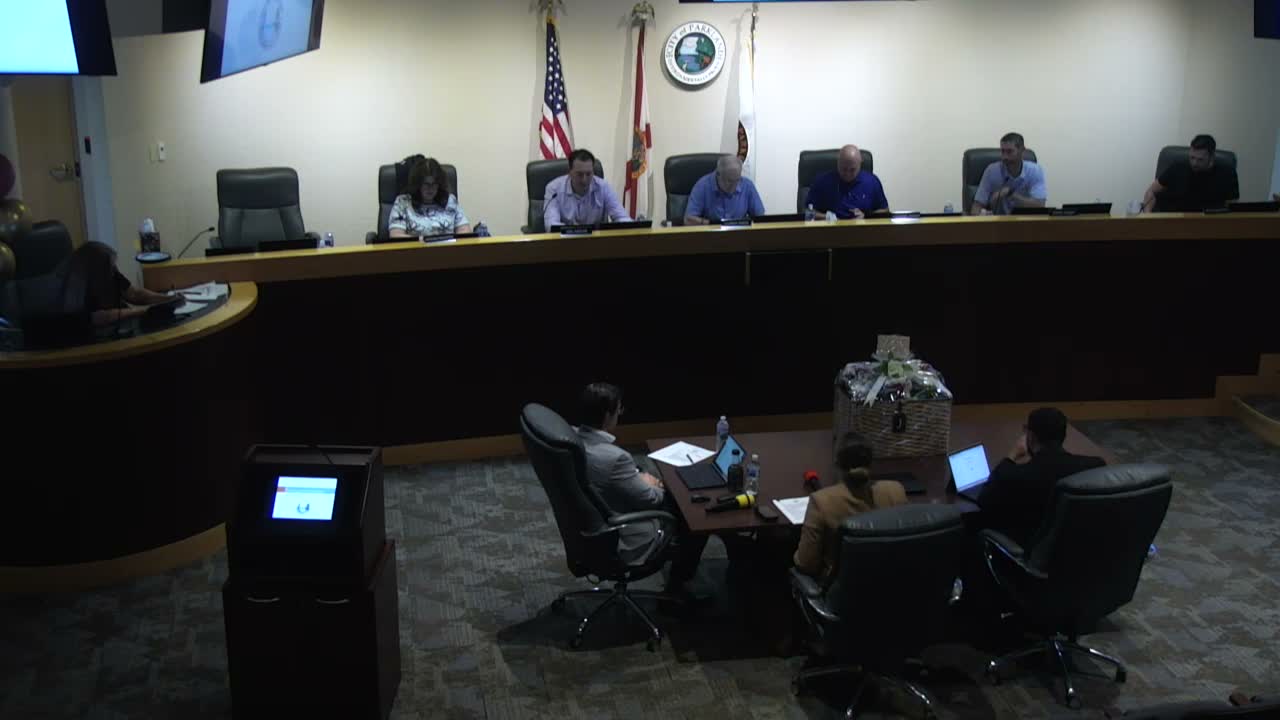
The Parkland Planning & Zoning Board voted 5–1 on March 12 to approve Ordinance 2026‑004, amending the City of Parkland's land development code to add a definition for "fast casual restaurant" and to permit the use by right in the city's B‑1, B‑2 and B‑3 commercial districts.
Planner Caitlin Forbes told the board the city's code previously recognized only "full service" and "fast food" restaurants, leaving a gap that has forced many newer, counter‑service concepts into a more burdensome special‑exception review. "Fast casual restaurants shall not include drive throughs," Forbes said, reading the proposed definition and noting examples such as Shake Shack and Panera.
Staff proposed treating fast casuals like full‑service restaurants for parking and set an initial requirement of one parking space per 35 square feet of customer service area. Forbes said that rate may be adjusted later if the city finds it overly conservative. The board also discussed that the special exception process for fast‑food restaurants incurs an application cost of roughly $5,400, which staff and members said has discouraged some prospective operators.
Board members questioned whether existing businesses that match the new definition would be reclassified. Forbes said reclassification would generally arise only when a business seeks to expand or relocate, at which point permitted‑use and parking requirements would be applied.
Members also pressed staff on how the city's distance‑separation rules for alcoholic‑beverage establishments would interact with the new category. "Our distance separation requirements currently only exempt full‑service restaurants," Forbes said. She told the board staff would review the alcoholic‑beverage ordinance to determine whether fast casuals should be treated the same as full‑service restaurants for separation exemptions.
After discussion, Joel Kaplan moved to approve the ordinance and Derek Bigsby seconded. During the roll call Jordana Goldstein voted no, stating, "I'm gonna say no even though that was not my intention originally — with that add on it was an issue." The remaining voting members voted yes, producing a 5–1 outcome in favor of the amendment.
City Attorney Soroka and staff said they would clarify language in the agenda summary and clean up drafting before the item goes to the City Commission. The board's recommendation will be forwarded to the commission for final consideration.
The board indicated it will offer advisory comments on whether fast casuals should receive the same alcoholic‑beverage separation exemptions as full‑service restaurants; staff said they will prepare that analysis for the Commission.
Planner Caitlin Forbes told the board the city's code previously recognized only "full service" and "fast food" restaurants, leaving a gap that has forced many newer, counter‑service concepts into a more burdensome special‑exception review. "Fast casual restaurants shall not include drive throughs," Forbes said, reading the proposed definition and noting examples such as Shake Shack and Panera.
Staff proposed treating fast casuals like full‑service restaurants for parking and set an initial requirement of one parking space per 35 square feet of customer service area. Forbes said that rate may be adjusted later if the city finds it overly conservative. The board also discussed that the special exception process for fast‑food restaurants incurs an application cost of roughly $5,400, which staff and members said has discouraged some prospective operators.
Board members questioned whether existing businesses that match the new definition would be reclassified. Forbes said reclassification would generally arise only when a business seeks to expand or relocate, at which point permitted‑use and parking requirements would be applied.
Members also pressed staff on how the city's distance‑separation rules for alcoholic‑beverage establishments would interact with the new category. "Our distance separation requirements currently only exempt full‑service restaurants," Forbes said. She told the board staff would review the alcoholic‑beverage ordinance to determine whether fast casuals should be treated the same as full‑service restaurants for separation exemptions.
After discussion, Joel Kaplan moved to approve the ordinance and Derek Bigsby seconded. During the roll call Jordana Goldstein voted no, stating, "I'm gonna say no even though that was not my intention originally — with that add on it was an issue." The remaining voting members voted yes, producing a 5–1 outcome in favor of the amendment.
City Attorney Soroka and staff said they would clarify language in the agenda summary and clean up drafting before the item goes to the City Commission. The board's recommendation will be forwarded to the commission for final consideration.
The board indicated it will offer advisory comments on whether fast casuals should receive the same alcoholic‑beverage separation exemptions as full‑service restaurants; staff said they will prepare that analysis for the Commission.
View the Full Meeting & All Its Details
This article offers just a summary. Unlock complete video, transcripts, and insights as a Founder Member.
✓
Watch full, unedited meeting videos
✓
Search every word spoken in unlimited transcripts
✓
AI summaries & real-time alerts (all government levels)
✓
Permanent access to expanding government content
30-day money-back guarantee
