Senate rejects amendment to restore $14 million to municipal equalization fund
March 11, 2026 | 2026 Legislature NE, Nebraska
This article was created by AI summarizing key points discussed. AI makes mistakes, so for full details and context, please refer to the video of the full meeting. Please report any errors so we can fix them. Report an error »
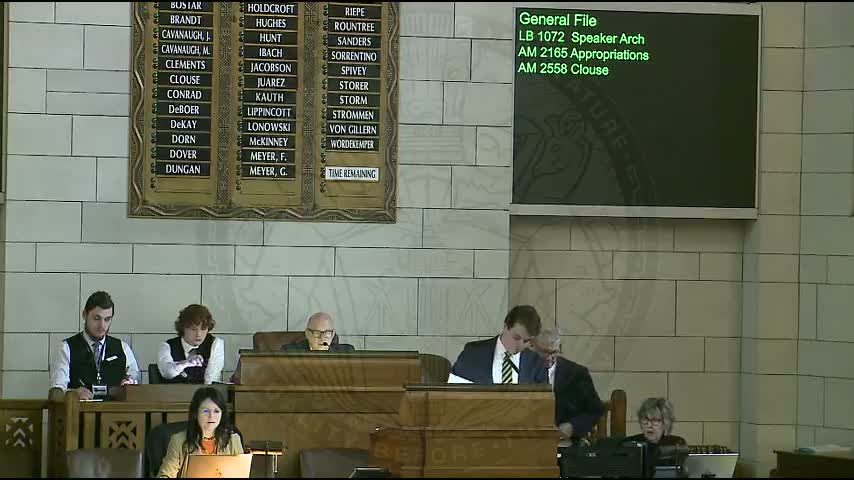
Senators on the floor voted down AM 2558, an amendment by Senator Klaus that would have prevented a one-time $14 million transfer out of the municipal equalization fund. The roll-call recorded 20 ayes and 16 nays; the presiding officer announced that the amendment was not adopted.
The amendment's sponsor, Senator Klaus, told colleagues the municipal equalization fund (MEF) has become opaque and sometimes rewards communities that raise levies rather than those that most need help. "I am opposed to this piece in the budget... it's only about $14,000,000 but it does impact every community in this state," Klaus said, urging the Legislature to let cities keep more locally generated revenue and to revisit the MEF formula in next year's session.
Opponents of AM 2558 framed the measure as an unaffordable cut at a time when the state's budget faces a shortfall. Senator Clements argued the adjustment would increase the shortfall and keep the state from crediting funds it would otherwise receive later in the biennium: "It's not going to hurt cities very much at all, and it is a $14,000,000 benefit to the budget," he said, noting projections that the fund would generate roughly $49 million in 2026 with about $35 million returning to cities.
Other senators pressed on likely local impacts. Senator Quick and others noted communities that rely on modest equalization payments for municipal services, saying a $50,000 to $100,000 reduction can matter to smaller towns. Senator Raybould and Senator Doerner raised procedural and technical questions about how the fund's administration fees and formula operate and whether the committee's adjustments preserved principal for municipalities.
The debate also touched on tangential fiscal arguments: Senator Sorrentino noted the broader budget context and argued that modest investments for vouchers or scholarships should be weighed against large savings the state realizes when students attend private schools rather than public systems. Fiscal staff figures about projected receipts and municipal impacts were referenced repeatedly by lawmakers.
With the roll-call complete, the amendment failed and the budget proceeds with the committee's treatment of the municipal equalization allocation. Sponsors of the measure said they will pursue statutory or policy changes next year to revisit how equalization dollars are calculated and administered.
The amendment's sponsor, Senator Klaus, told colleagues the municipal equalization fund (MEF) has become opaque and sometimes rewards communities that raise levies rather than those that most need help. "I am opposed to this piece in the budget... it's only about $14,000,000 but it does impact every community in this state," Klaus said, urging the Legislature to let cities keep more locally generated revenue and to revisit the MEF formula in next year's session.
Opponents of AM 2558 framed the measure as an unaffordable cut at a time when the state's budget faces a shortfall. Senator Clements argued the adjustment would increase the shortfall and keep the state from crediting funds it would otherwise receive later in the biennium: "It's not going to hurt cities very much at all, and it is a $14,000,000 benefit to the budget," he said, noting projections that the fund would generate roughly $49 million in 2026 with about $35 million returning to cities.
Other senators pressed on likely local impacts. Senator Quick and others noted communities that rely on modest equalization payments for municipal services, saying a $50,000 to $100,000 reduction can matter to smaller towns. Senator Raybould and Senator Doerner raised procedural and technical questions about how the fund's administration fees and formula operate and whether the committee's adjustments preserved principal for municipalities.
The debate also touched on tangential fiscal arguments: Senator Sorrentino noted the broader budget context and argued that modest investments for vouchers or scholarships should be weighed against large savings the state realizes when students attend private schools rather than public systems. Fiscal staff figures about projected receipts and municipal impacts were referenced repeatedly by lawmakers.
With the roll-call complete, the amendment failed and the budget proceeds with the committee's treatment of the municipal equalization allocation. Sponsors of the measure said they will pursue statutory or policy changes next year to revisit how equalization dollars are calculated and administered.
Don't Miss a Word: See the Full Meeting!
Go beyond summaries. Unlock every video, transcript, and key insight with a Founder Membership.
✓
Get instant access to full meeting videos
✓
Search and clip any phrase from complete transcripts
✓
Receive AI-powered summaries & custom alerts
✓
Enjoy lifetime, unrestricted access to government data
30-day money-back guarantee
