Panel hears bill to expand homestead and renter credits, lays it over
March 12, 2026 | 2026 Legislature MN, Minnesota
This article was created by AI summarizing key points discussed. AI makes mistakes, so for full details and context, please refer to the video of the full meeting. Please report any errors so we can fix them. Report an error »
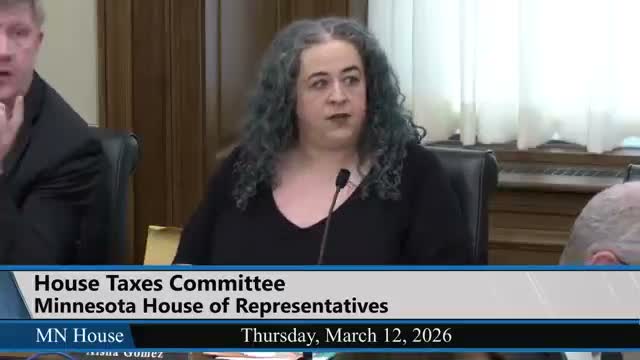
Representative Ray Rower introduced House File 4119, saying the bill would increase the homestead credit refund and reduce the portion of rent treated as property tax in the renter's credit calculation to provide targeted relief for homeowners and renters who need it most. "Together, these will reach over 800,000 Minnesotans," Rower said.
Michael Dahl, public policy director at Home Line, told the committee that demand for financial help among renters has surged: "In January and February, 2026 compared to the same months in 2025, we saw an 84% increase" in calls for financial assistance. He said the bill offers "one meaningful way" to address that need.
Nan Madden, director of the Minnesota Budget Project, urged the committee to preserve income limits and maximum credit amounts while increasing the credit amounts, noting that more than 310,000 Minnesota households received the renter's credit in 2023 and that seniors or people with disabilities made up a large share of recipients in many counties.
Members discussed the limits of state authority over local property tax pressures and debated how the proposal interacts with unfunded mandates and local budgets. Representative Hewitt said adjusting brackets and co-pays can help keep credits aligned with cost-of-living increases; Representative Weiner and others said broader changes are needed to address mandates that drive local property-tax increases.
After questions and closing remarks, Chair Gomez renewed the motion that House File 4119, as amended, be laid over for possible inclusion in the 2026 tax bill. The committee carried the motion by voice vote.
The bill was laid over; further fiscal discussion and technical work are expected as the measure moves through the process.
Michael Dahl, public policy director at Home Line, told the committee that demand for financial help among renters has surged: "In January and February, 2026 compared to the same months in 2025, we saw an 84% increase" in calls for financial assistance. He said the bill offers "one meaningful way" to address that need.
Nan Madden, director of the Minnesota Budget Project, urged the committee to preserve income limits and maximum credit amounts while increasing the credit amounts, noting that more than 310,000 Minnesota households received the renter's credit in 2023 and that seniors or people with disabilities made up a large share of recipients in many counties.
Members discussed the limits of state authority over local property tax pressures and debated how the proposal interacts with unfunded mandates and local budgets. Representative Hewitt said adjusting brackets and co-pays can help keep credits aligned with cost-of-living increases; Representative Weiner and others said broader changes are needed to address mandates that drive local property-tax increases.
After questions and closing remarks, Chair Gomez renewed the motion that House File 4119, as amended, be laid over for possible inclusion in the 2026 tax bill. The committee carried the motion by voice vote.
The bill was laid over; further fiscal discussion and technical work are expected as the measure moves through the process.
Don't Miss a Word: See the Full Meeting!
Go beyond summaries. Unlock every video, transcript, and key insight with a Founder Membership.
✓
Get instant access to full meeting videos
✓
Search and clip any phrase from complete transcripts
✓
Receive AI-powered summaries & custom alerts
✓
Enjoy lifetime, unrestricted access to government data
30-day money-back guarantee
