Assembly committee grills administration, analysts over proposed SAF diesel‑excise tax credit
March 11, 2026 | California State Assembly, House, Legislative, California
This article was created by AI summarizing key points discussed. AI makes mistakes, so for full details and context, please refer to the video of the full meeting. Please report any errors so we can fix them. Report an error »
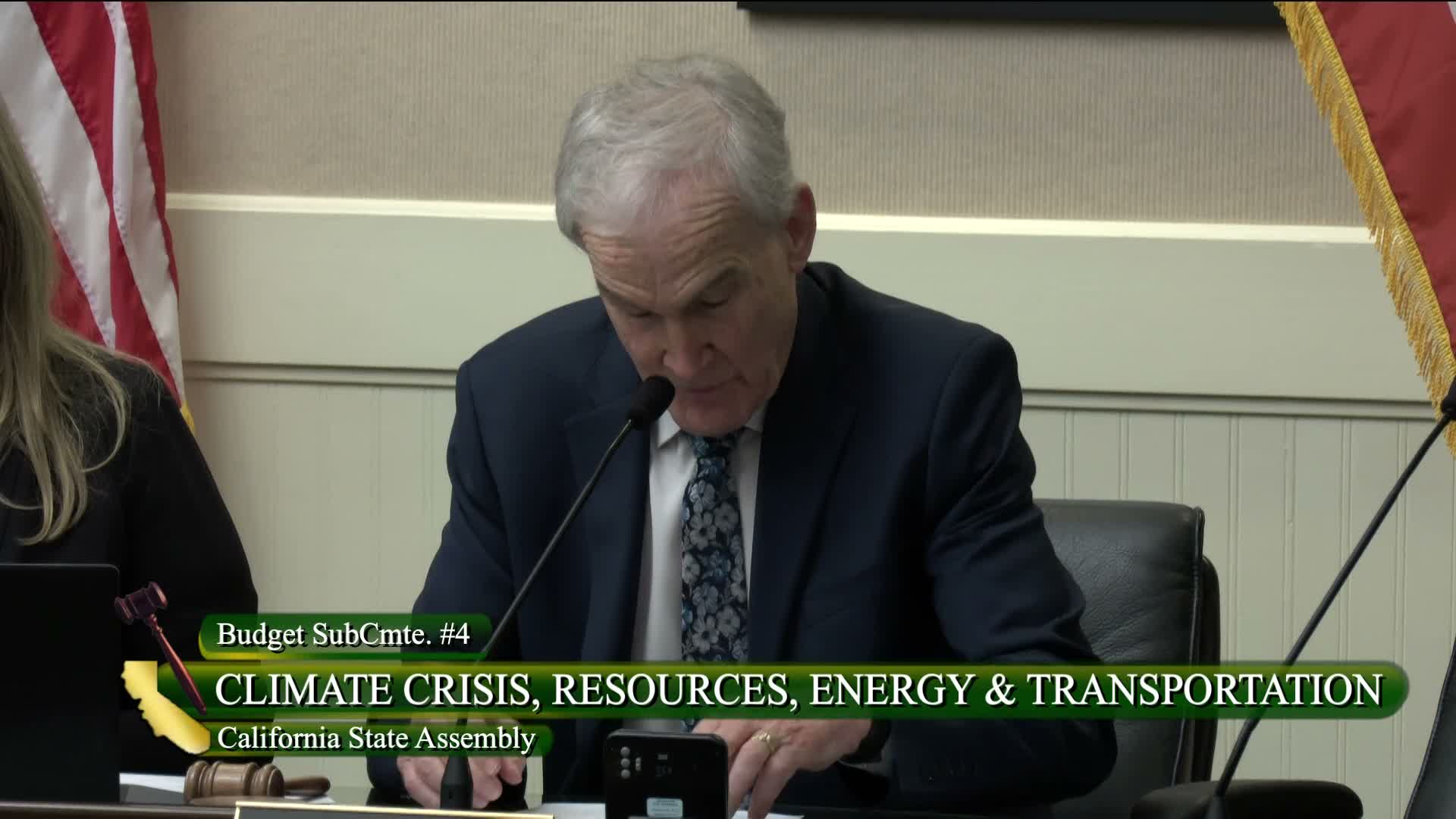
SACRAMENTO — Lawmakers pressed state budget officials and independent analysts on March 11 over the governor’s proposal to create a $1–$2 tax credit against the state diesel excise tax for sustainable aviation fuel (SAF), questioning whether the incentive would deliver meaningful climate benefits or simply shift money away from local roads and transit.
“Sixty percent of California’s refineries are in my district,” Assemblymember Anna Marie Avila Farias said in a one‑minute opening remark, urging the committee to consider local job and investment impacts from any policy change. “We must stand by the industry partners who have made the choice to embrace renewable fuels.” (Anna Marie Avila Farias)
The Department of Finance presented the policy rationale. “The governor’s budget includes a $1 to $2 tax credit against the state diesel excise tax for sustainable aviation fuel sold for use in California from 2026 to 2036,” Andrew March said, framing the measure as a tool to decarbonize aviation, a sector the administration described as among the hardest to electrify. (Andrew March, Department of Finance)
The Legislative Analyst’s Office urged caution. “We’re recommending rejecting the proposal,” Helen Kurzstein said, telling members the LAO has five main concerns: the approach is relatively expensive compared with other decarbonization options; the net environmental benefits are uncertain and could be overstated because of fuel‑shuffling; the fiscal exposure to diesel‑excise revenues is unclear and could be much larger than the administration’s estimate; and the proposal risks contravening the spirit of voter limits that direct transportation funds to roads and transit. (Helen Kurzstein, LAO)
An academic witness said the credit could induce larger SAF volumes — and costs — than officials expect. “Our model projects SAF production at least double that projected by the administration and up to 7½ times the administration’s projection,” Aaron Smith of UC Berkeley testified, and he warned that increased competition for limited feedstocks could raise fuel costs and reduce the cost‑effectiveness of greenhouse‑gas reductions. (Aaron Smith, UC Berkeley)
Administration witnesses pushed back on the worst‑case scenarios. Andrew March and CARB staff said the credit is structured to rely on LCFS (Low Carbon Fuel Standard) lifecycle accounting and is not transferable; eligibility requires diesel excise tax liability, which limits who can claim the credit. The administration also pointed to other states’ programs and said they have not observed wholesale gaming of credit structures. (Andrew March; Matthew Botel, CARB)
Committee members focused repeatedly on two linked risks: whether the credit would largely divert diesel‑excise receipts that now fund local streets, state highway work, and trade‑corridor projects; and whether the credit, as written, would actually benefit the refiners and union jobs the administration says it seeks to protect. The LAO estimated the administration’s $165–$300 million estimate could be too low and noted a broad uncertainty range that could reach far higher amounts in some scenarios. (Helen Kurzstein, LAO)
Multiple public commenters took opposing stances. Labor and airline industry speakers urged the committee to adopt mechanisms that keep SAF production and jobs in California; environmental groups and local governments warned the credit could erode transportation funding and urged investment in heavy‑duty vehicle electrification and other higher‑value GGRF uses. (Public commenters)
No action was taken; the chair called the hearing informational and asked the administration and outside analysts to provide more detailed market and feedstock assumptions, requests for which members said they would judge the proposal’s merits.
What’s next: Committee staff and the administration were asked to produce market‑capacity and feedstock data and to respond to LAO cost and revenue scenarios. The committee did not schedule a vote and invited continued submissions from stakeholders.
“Sixty percent of California’s refineries are in my district,” Assemblymember Anna Marie Avila Farias said in a one‑minute opening remark, urging the committee to consider local job and investment impacts from any policy change. “We must stand by the industry partners who have made the choice to embrace renewable fuels.” (Anna Marie Avila Farias)
The Department of Finance presented the policy rationale. “The governor’s budget includes a $1 to $2 tax credit against the state diesel excise tax for sustainable aviation fuel sold for use in California from 2026 to 2036,” Andrew March said, framing the measure as a tool to decarbonize aviation, a sector the administration described as among the hardest to electrify. (Andrew March, Department of Finance)
The Legislative Analyst’s Office urged caution. “We’re recommending rejecting the proposal,” Helen Kurzstein said, telling members the LAO has five main concerns: the approach is relatively expensive compared with other decarbonization options; the net environmental benefits are uncertain and could be overstated because of fuel‑shuffling; the fiscal exposure to diesel‑excise revenues is unclear and could be much larger than the administration’s estimate; and the proposal risks contravening the spirit of voter limits that direct transportation funds to roads and transit. (Helen Kurzstein, LAO)
An academic witness said the credit could induce larger SAF volumes — and costs — than officials expect. “Our model projects SAF production at least double that projected by the administration and up to 7½ times the administration’s projection,” Aaron Smith of UC Berkeley testified, and he warned that increased competition for limited feedstocks could raise fuel costs and reduce the cost‑effectiveness of greenhouse‑gas reductions. (Aaron Smith, UC Berkeley)
Administration witnesses pushed back on the worst‑case scenarios. Andrew March and CARB staff said the credit is structured to rely on LCFS (Low Carbon Fuel Standard) lifecycle accounting and is not transferable; eligibility requires diesel excise tax liability, which limits who can claim the credit. The administration also pointed to other states’ programs and said they have not observed wholesale gaming of credit structures. (Andrew March; Matthew Botel, CARB)
Committee members focused repeatedly on two linked risks: whether the credit would largely divert diesel‑excise receipts that now fund local streets, state highway work, and trade‑corridor projects; and whether the credit, as written, would actually benefit the refiners and union jobs the administration says it seeks to protect. The LAO estimated the administration’s $165–$300 million estimate could be too low and noted a broad uncertainty range that could reach far higher amounts in some scenarios. (Helen Kurzstein, LAO)
Multiple public commenters took opposing stances. Labor and airline industry speakers urged the committee to adopt mechanisms that keep SAF production and jobs in California; environmental groups and local governments warned the credit could erode transportation funding and urged investment in heavy‑duty vehicle electrification and other higher‑value GGRF uses. (Public commenters)
No action was taken; the chair called the hearing informational and asked the administration and outside analysts to provide more detailed market and feedstock assumptions, requests for which members said they would judge the proposal’s merits.
What’s next: Committee staff and the administration were asked to produce market‑capacity and feedstock data and to respond to LAO cost and revenue scenarios. The committee did not schedule a vote and invited continued submissions from stakeholders.
Don't Miss a Word: See the Full Meeting!
Go beyond summaries. Unlock every video, transcript, and key insight with a Founder Membership.
✓
Get instant access to full meeting videos
✓
Search and clip any phrase from complete transcripts
✓
Receive AI-powered summaries & custom alerts
✓
Enjoy lifetime, unrestricted access to government data
30-day money-back guarantee
