Committee backs HCR 2003 after heated testimony on girls' sports and facilities
March 11, 2026 | 2026 Legislature Arizona, Arizona
This article was created by AI summarizing key points discussed. AI makes mistakes, so for full details and context, please refer to the video of the full meeting. Please report any errors so we can fix them. Report an error »
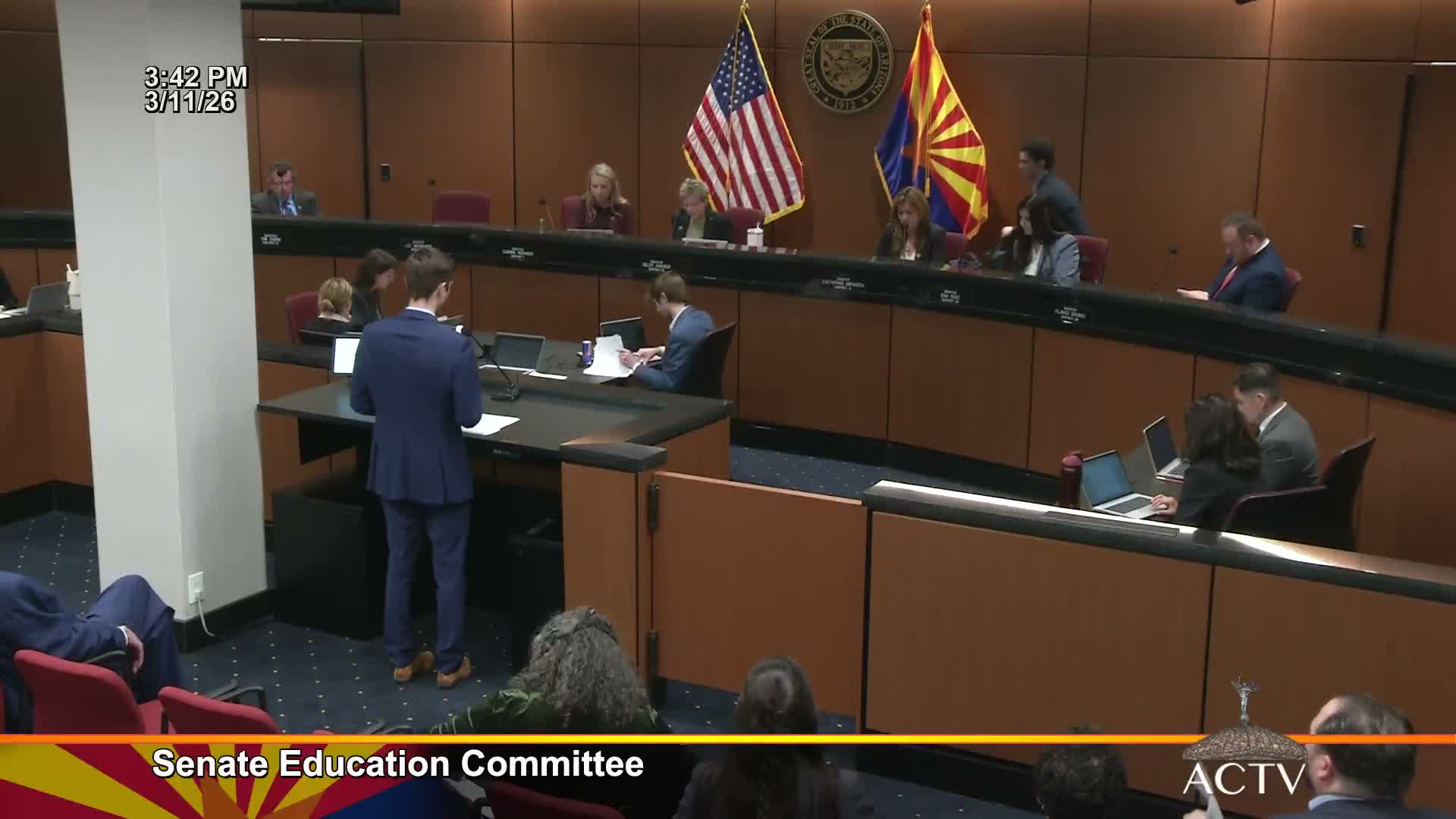
The Senate Education Committee voted 4-3 to give HCR 2003, the "Protect Girls in Sports in Arizona" resolution, a due-pass recommendation after an extended public hearing that split coaches, school leaders, civil-rights advocates and athletes.
Sponsor materials and staff explanation described a measure that would require athletic associations that sponsor interscholastic or intramural sports to designate each sport or team as male, female or coeducational beginning Jan. 1, 2027. The resolution would also prohibit schools and associations from authorizing an individual to use a restroom, locker room, shower or other private space not designated for the individual's sex where the school provides such private spaces integral to athletics, and it creates a private cause of action for an athlete who suffers harm if an association knowingly violates the designation requirements. The measure would be submitted to voters for approval.
Superintendent Horn told the committee he has fielded calls from school leaders dealing with questions about access to bathrooms and locker rooms and defended statutes and litigation he said supported separating male and female athletic competition. "If you want to maintain your ADM, don't do something that's going to turn off so many parents," he said, arguing that allowing biological males into girls' spaces would drive families away and harm girls' opportunities.
Opponents said the resolution is discriminatory and vague. Jean Woodbury, representing the ACLU of Arizona, urged the committee to vote no, saying the proposal would exclude transgender students as a group rather than addressing individual performance-related measures. "We can have fair standards, but excluding all trans people isn't fair," Woodbury said.
Athletes and coaches split on the policy. Kayla Wright, a Division I volleyball captain, recounted competing against a male starting player and said her team was "disheartened by the lack of fairness," urging lawmakers to protect women's opportunities. Ryan Tolman, a Gilbert teacher and club director, testified that the presence of biological males on girls' teams can be dangerous and unfair and urged a yes vote.
Committee members questioned witnesses about the bill's definitions and the incidence of transgender athletes in Arizona. One senator cited state data that the number of transgender student-athletes is a fraction of 1 percent; witnesses on both sides disputed whether the number or individual cases should drive policy.
By roll call, the committee recorded 4 ayes and 3 nays, giving HCR 2003 a due-pass recommendation to continue through the legislative process.
The committee record shows the resolution will be put on the ballot if advanced and would take effect for designations and facility-use provisions beginning Jan. 1, 2027 if approved by voters. The measure drew repeated questions about enforcement, how private organizations and private rec leagues would comply, and whether the statutory language would reach single-use gender-neutral restrooms.
Sponsor materials and staff explanation described a measure that would require athletic associations that sponsor interscholastic or intramural sports to designate each sport or team as male, female or coeducational beginning Jan. 1, 2027. The resolution would also prohibit schools and associations from authorizing an individual to use a restroom, locker room, shower or other private space not designated for the individual's sex where the school provides such private spaces integral to athletics, and it creates a private cause of action for an athlete who suffers harm if an association knowingly violates the designation requirements. The measure would be submitted to voters for approval.
Superintendent Horn told the committee he has fielded calls from school leaders dealing with questions about access to bathrooms and locker rooms and defended statutes and litigation he said supported separating male and female athletic competition. "If you want to maintain your ADM, don't do something that's going to turn off so many parents," he said, arguing that allowing biological males into girls' spaces would drive families away and harm girls' opportunities.
Opponents said the resolution is discriminatory and vague. Jean Woodbury, representing the ACLU of Arizona, urged the committee to vote no, saying the proposal would exclude transgender students as a group rather than addressing individual performance-related measures. "We can have fair standards, but excluding all trans people isn't fair," Woodbury said.
Athletes and coaches split on the policy. Kayla Wright, a Division I volleyball captain, recounted competing against a male starting player and said her team was "disheartened by the lack of fairness," urging lawmakers to protect women's opportunities. Ryan Tolman, a Gilbert teacher and club director, testified that the presence of biological males on girls' teams can be dangerous and unfair and urged a yes vote.
Committee members questioned witnesses about the bill's definitions and the incidence of transgender athletes in Arizona. One senator cited state data that the number of transgender student-athletes is a fraction of 1 percent; witnesses on both sides disputed whether the number or individual cases should drive policy.
By roll call, the committee recorded 4 ayes and 3 nays, giving HCR 2003 a due-pass recommendation to continue through the legislative process.
The committee record shows the resolution will be put on the ballot if advanced and would take effect for designations and facility-use provisions beginning Jan. 1, 2027 if approved by voters. The measure drew repeated questions about enforcement, how private organizations and private rec leagues would comply, and whether the statutory language would reach single-use gender-neutral restrooms.
Don't Miss a Word: See the Full Meeting!
Go beyond summaries. Unlock every video, transcript, and key insight with a Founder Membership.
✓
Get instant access to full meeting videos
✓
Search and clip any phrase from complete transcripts
✓
Receive AI-powered summaries & custom alerts
✓
Enjoy lifetime, unrestricted access to government data
30-day money-back guarantee
