Committee advances parents'rights bill after hours of divided testimony
March 11, 2026 | 2026 Legislature Arizona, Arizona
This article was created by AI summarizing key points discussed. AI makes mistakes, so for full details and context, please refer to the video of the full meeting. Please report any errors so we can fix them. Report an error »
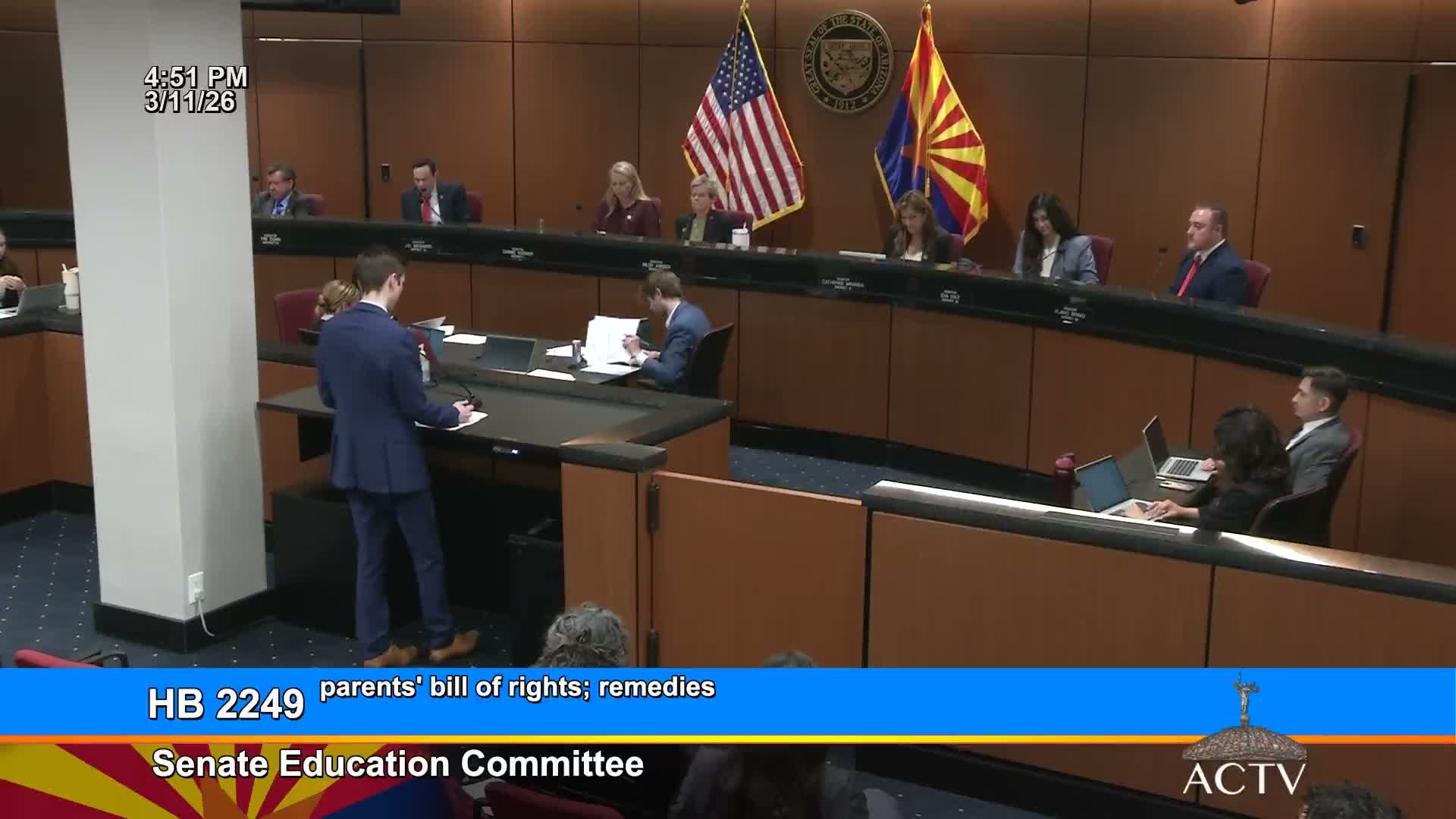
The Senate Education Committee gave House Bill 22-49 a due-pass recommendation following a full committee hearing that featured sharply divided testimony from educators, civil-rights groups, parents and attorneys.
The bill would expand parents' rights by requiring written parental consent and notification if any school employee facilitates social transitioning for a minor child, define forms of social transitioning (including using a name or pronouns not aligned with the child's legal name), and provide private causes of action with specified minimum liability amounts for governmental entities and employees in certain circumstances. The sponsor explained an amendment specifying that a school district or district employee may not implement a form of social transitioning without written parental consent and clarified accrual and immunity-waiver provisions for some claims.
Opponents, including Estelle LeBlanc of the Arizona Education Association and Jean Woodbury of the ACLU of Arizona, warned the bill is vague on key definitions such as what constitutes a separate "instance" and said the statutory penalties and individual liability provisions would chill educators and create costly litigation risks for schools and teachers. Estelle LeBlanc said the measure duplicates existing law that already restricts strikes and imposes severe career-ending consequences.
Supporters and parents described cases they said showed school employees facilitating transitions without parental knowledge, and an attorney who testified recounted a Mesa case and urged the committee to adopt the bill to ensure parental notification and accountability. Representative Fink, the sponsor, said the measure is intended to protect parental authority and that she would work on clarifying language.
Committee members asked multiple technical questions about the bill's time windows, what counts as an instance, whether punishment applies to inadvertent conduct, and the law's interplay with existing litigation. The committee adopted the sponsor's multi-page amendment and recorded a due-pass recommendation (4 ayes, 3 nays).
The bill would expand parents' rights by requiring written parental consent and notification if any school employee facilitates social transitioning for a minor child, define forms of social transitioning (including using a name or pronouns not aligned with the child's legal name), and provide private causes of action with specified minimum liability amounts for governmental entities and employees in certain circumstances. The sponsor explained an amendment specifying that a school district or district employee may not implement a form of social transitioning without written parental consent and clarified accrual and immunity-waiver provisions for some claims.
Opponents, including Estelle LeBlanc of the Arizona Education Association and Jean Woodbury of the ACLU of Arizona, warned the bill is vague on key definitions such as what constitutes a separate "instance" and said the statutory penalties and individual liability provisions would chill educators and create costly litigation risks for schools and teachers. Estelle LeBlanc said the measure duplicates existing law that already restricts strikes and imposes severe career-ending consequences.
Supporters and parents described cases they said showed school employees facilitating transitions without parental knowledge, and an attorney who testified recounted a Mesa case and urged the committee to adopt the bill to ensure parental notification and accountability. Representative Fink, the sponsor, said the measure is intended to protect parental authority and that she would work on clarifying language.
Committee members asked multiple technical questions about the bill's time windows, what counts as an instance, whether punishment applies to inadvertent conduct, and the law's interplay with existing litigation. The committee adopted the sponsor's multi-page amendment and recorded a due-pass recommendation (4 ayes, 3 nays).
Don't Miss a Word: See the Full Meeting!
Go beyond summaries. Unlock every video, transcript, and key insight with a Founder Membership.
✓
Get instant access to full meeting videos
✓
Search and clip any phrase from complete transcripts
✓
Receive AI-powered summaries & custom alerts
✓
Enjoy lifetime, unrestricted access to government data
30-day money-back guarantee
