Senate committee approves temporary plan to house dangerous, incompetent defendants while urging state solution
March 11, 2026 | 2026 Legislature Arizona, Arizona
This article was created by AI summarizing key points discussed. AI makes mistakes, so for full details and context, please refer to the video of the full meeting. Please report any errors so we can fix them. Report an error »
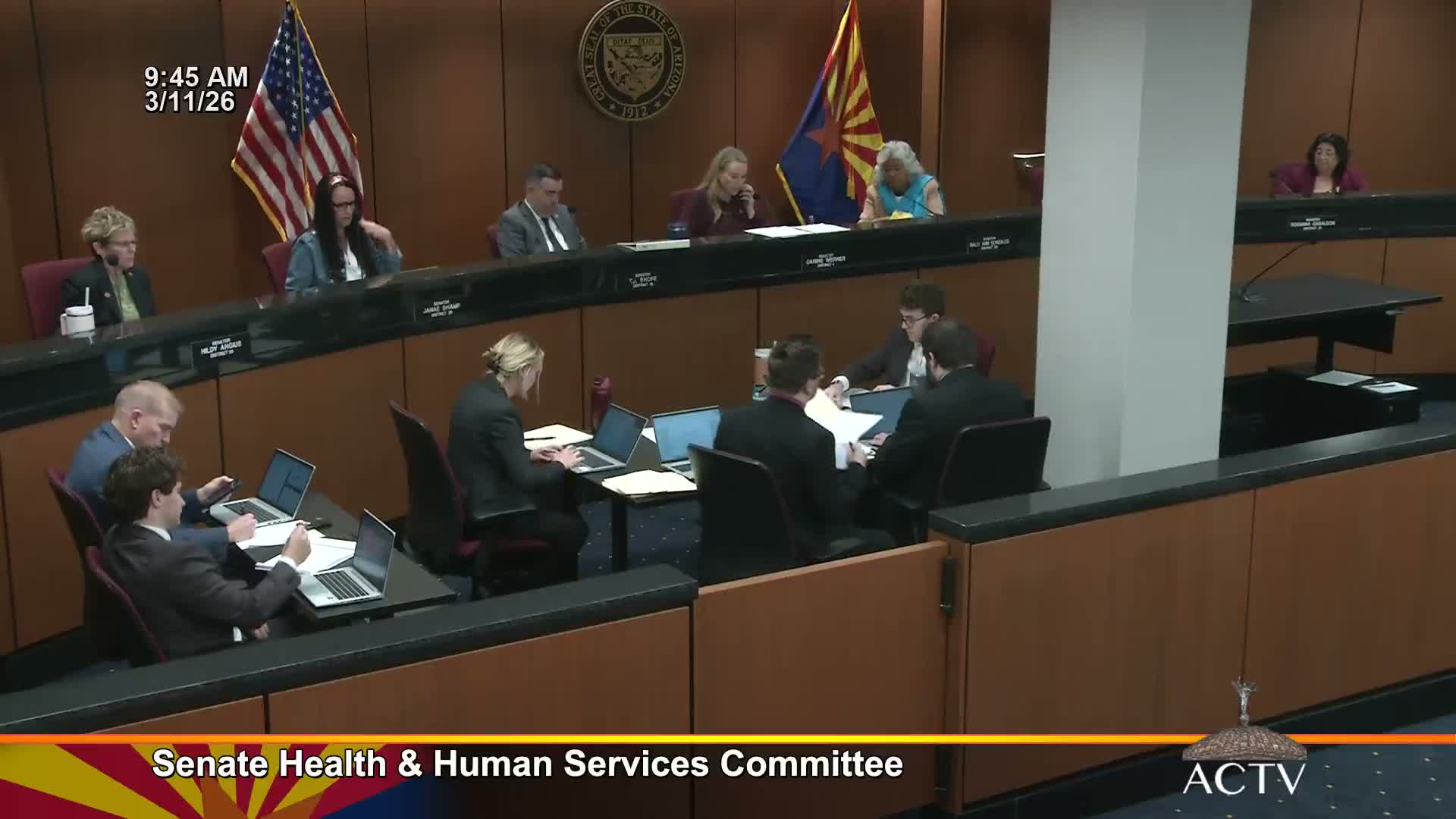
The Arizona Senate Health Committee on March 10 voted to advance HB2307 as amended, adopting a stop‑gap to place certain defendants when secure state beds are unavailable and directing a study of long‑term solutions.
Representative Biasucci introduced the bill and described a case where a defendant deemed dangerous and incompetent could not be kept or treated because appropriate secure beds did not exist. Sponsor testimony framed the measure as an emergency response to avoid releasing people back into communities when restoration-of-competency treatment is needed.
Senator Angus and the amendment’s authors said the committee’s change removes an explicit out‑of‑state contracting mandate and, until 12/31/2031, allows the Arizona State Hospital (ASH) forensic campus to accept up to three defendants meeting the bill’s narrow criteria. "This is a beginning and an emergency stopgap program we put together," Angus said, urging further work with the governor’s office on funding and a floor amendment.
County officials and prosecutors supported urgent action but objected to language they said could shift costs to counties. "Let the counties decide," Mohave County prosecutor James Shaba said, explaining that counties have shouldered placement burdens in the absence of state capacity. Jacob Ebony of the County Supervisors Association warned the amendment could effectively require counties to pay costs the state historically covered.
Carly Fleage, legislative liaison for the Arizona Department of Health Services, told the committee ASH lacks capacity for a new long‑term patient population and that the amendment attempts to minimize state hospital risk by limiting the number of placements and keeping psychiatric treatment costs with the state hospital while deferring potentially nonpsychiatric medical costs to counties in limited circumstances.
Committee members recorded a 4–3 vote to advance the bill as amended. Supporters characterized the amendment as a temporary, five‑year measure with a legislative study committee tasked to plan secure state facilities and funding; opponents said the change left unresolved questions about fiscal responsibility and eligibility criteria.
What’s next: HB2307 will move forward to additional floor consideration where members expect further amendments and negotiations over state funding and county participation.
Representative Biasucci introduced the bill and described a case where a defendant deemed dangerous and incompetent could not be kept or treated because appropriate secure beds did not exist. Sponsor testimony framed the measure as an emergency response to avoid releasing people back into communities when restoration-of-competency treatment is needed.
Senator Angus and the amendment’s authors said the committee’s change removes an explicit out‑of‑state contracting mandate and, until 12/31/2031, allows the Arizona State Hospital (ASH) forensic campus to accept up to three defendants meeting the bill’s narrow criteria. "This is a beginning and an emergency stopgap program we put together," Angus said, urging further work with the governor’s office on funding and a floor amendment.
County officials and prosecutors supported urgent action but objected to language they said could shift costs to counties. "Let the counties decide," Mohave County prosecutor James Shaba said, explaining that counties have shouldered placement burdens in the absence of state capacity. Jacob Ebony of the County Supervisors Association warned the amendment could effectively require counties to pay costs the state historically covered.
Carly Fleage, legislative liaison for the Arizona Department of Health Services, told the committee ASH lacks capacity for a new long‑term patient population and that the amendment attempts to minimize state hospital risk by limiting the number of placements and keeping psychiatric treatment costs with the state hospital while deferring potentially nonpsychiatric medical costs to counties in limited circumstances.
Committee members recorded a 4–3 vote to advance the bill as amended. Supporters characterized the amendment as a temporary, five‑year measure with a legislative study committee tasked to plan secure state facilities and funding; opponents said the change left unresolved questions about fiscal responsibility and eligibility criteria.
What’s next: HB2307 will move forward to additional floor consideration where members expect further amendments and negotiations over state funding and county participation.
Don't Miss a Word: See the Full Meeting!
Go beyond summaries. Unlock every video, transcript, and key insight with a Founder Membership.
✓
Get instant access to full meeting videos
✓
Search and clip any phrase from complete transcripts
✓
Receive AI-powered summaries & custom alerts
✓
Enjoy lifetime, unrestricted access to government data
30-day money-back guarantee
