AEA outlines Bradley Lake expansion plan, eyes tax credits and multiple financing paths
March 10, 2026 | 2026 Legislature Alaska, Alaska
This article was created by AI summarizing key points discussed. AI makes mistakes, so for full details and context, please refer to the video of the full meeting. Please report any errors so we can fix them. Report an error »
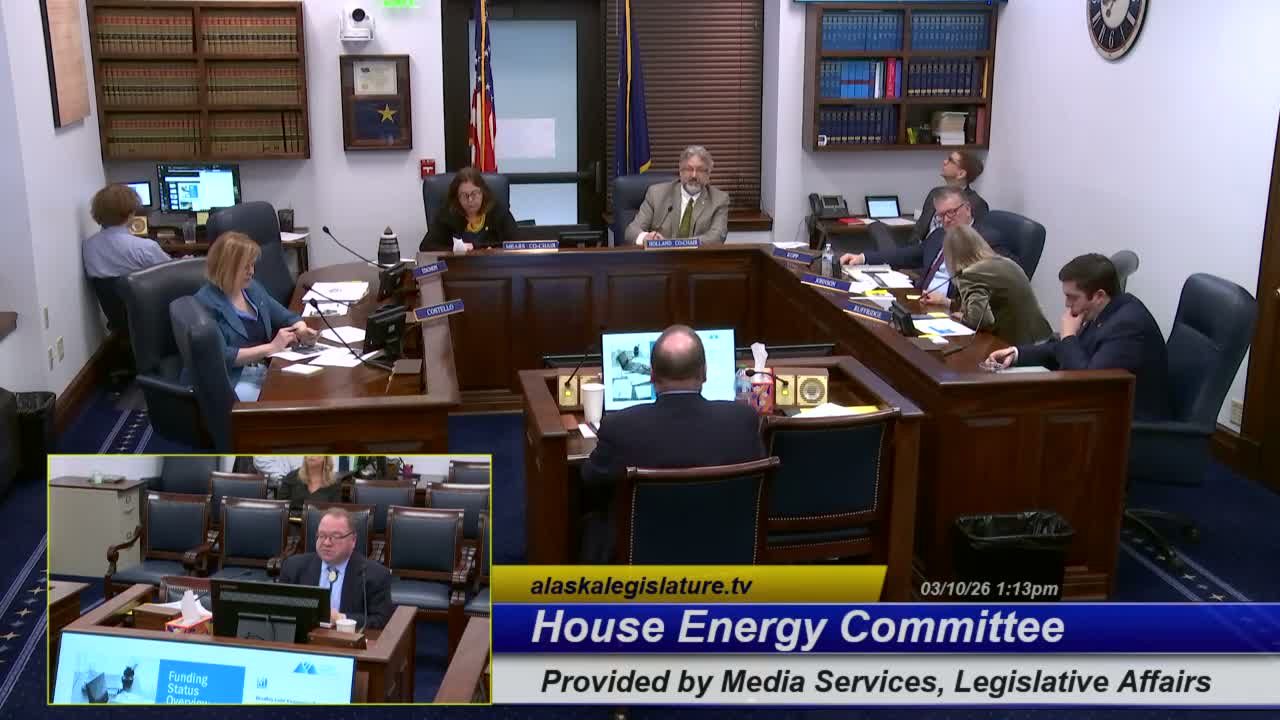
Cochair Holland and members of the House Energy Committee heard from Curtis Thayer, executive director of the Alaska Energy Authority, about the Bradley Lake expansion (Dixon diversion). Thayer said the project’s total capital cost is about $400 million and AEA has provided roughly $20.7 million for preconstruction work so far. He told the committee AEA aims to begin construction in 2027 and complete commissioning by December 2030.
Thayer said the expansion — which includes raising Bradley’s dam by about 16 feet and extensive geotechnical and directional-drill work — is expected to boost Bradley’s output by roughly 40–50%. “This will displace 1,500,000,000 cubic feet of natural gas,” Thayer said, adding that environmental studies and a preliminary FERC amendment have been filed and that a full FERC amendment process remains a critical path item.
The agency is pursuing several financing paths. Thayer described efforts to secure investment tax credits (potentially up to $100 million if the project is in service by the statutory deadline), USDA Rural Utilities Service borrowing programs, tax-exempt bond authority (Bradley qualifies for tax-exempt bonds), State Bond Bank participation, and Title 17 Department of Energy financing. He explained tradeoffs: investment tax credits pay out after a project is placed in service and the particular combination of credits and loans affects debt terms and any prepayment penalties.
On project schedule and approvals, Thayer said AEA filed a preliminary amendment with FERC recently and expects a multi-step permitting and licensing review before construction can proceed. He described the preconstruction work already completed — environmental surveys, fish studies, boreholes and consultant reviews — and said these steps reduce project risk ahead of FERC’s substantive license amendment review.
Thayer asked the committee for continued engagement and said AEA would return with modelled rate impacts once PFM completes scenario runs accounting for different tax-credit outcomes. “We’re running scenarios with investment tax credits, no tax credits, partial credits — those numbers will determine rate outcomes,” he said.
Next steps: AEA expects to refine cost-per-kilowatt scenarios with its financial advisor and provide the committee with rate-impact analysis as a follow-up.
Thayer said the expansion — which includes raising Bradley’s dam by about 16 feet and extensive geotechnical and directional-drill work — is expected to boost Bradley’s output by roughly 40–50%. “This will displace 1,500,000,000 cubic feet of natural gas,” Thayer said, adding that environmental studies and a preliminary FERC amendment have been filed and that a full FERC amendment process remains a critical path item.
The agency is pursuing several financing paths. Thayer described efforts to secure investment tax credits (potentially up to $100 million if the project is in service by the statutory deadline), USDA Rural Utilities Service borrowing programs, tax-exempt bond authority (Bradley qualifies for tax-exempt bonds), State Bond Bank participation, and Title 17 Department of Energy financing. He explained tradeoffs: investment tax credits pay out after a project is placed in service and the particular combination of credits and loans affects debt terms and any prepayment penalties.
On project schedule and approvals, Thayer said AEA filed a preliminary amendment with FERC recently and expects a multi-step permitting and licensing review before construction can proceed. He described the preconstruction work already completed — environmental surveys, fish studies, boreholes and consultant reviews — and said these steps reduce project risk ahead of FERC’s substantive license amendment review.
Thayer asked the committee for continued engagement and said AEA would return with modelled rate impacts once PFM completes scenario runs accounting for different tax-credit outcomes. “We’re running scenarios with investment tax credits, no tax credits, partial credits — those numbers will determine rate outcomes,” he said.
Next steps: AEA expects to refine cost-per-kilowatt scenarios with its financial advisor and provide the committee with rate-impact analysis as a follow-up.
Don't Miss a Word: See the Full Meeting!
Go beyond summaries. Unlock every video, transcript, and key insight with a Founder Membership.
✓
Get instant access to full meeting videos
✓
Search and clip any phrase from complete transcripts
✓
Receive AI-powered summaries & custom alerts
✓
Enjoy lifetime, unrestricted access to government data
30-day money-back guarantee
