Alaska Energy Authority outlines funding path for Bradley Lake expansion and Cook Inlet PowerLink
March 11, 2026 | 2026 Legislature Alaska, Alaska
This article was created by AI summarizing key points discussed. AI makes mistakes, so for full details and context, please refer to the video of the full meeting. Please report any errors so we can fix them. Report an error »
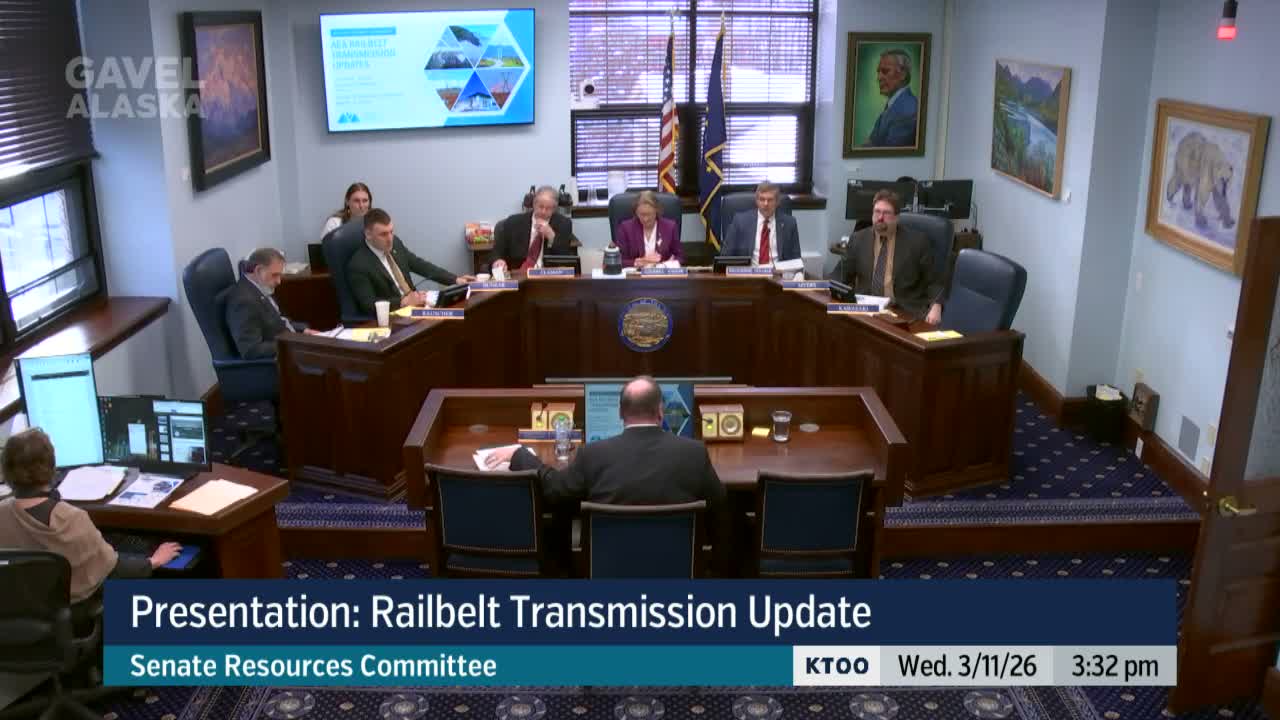
Curtis Thayer, executive director of the Alaska Energy Authority, briefed the Senate Resources Committee on March 11 on two major Railbelt projects and the agency's broader grant programs. Thayer said the Bradley Lake expansion is estimated at about $400 million and that AEA has raised roughly $20.7 million for pre-construction work. "It will increase Bradley by about 50%, which is about 30,000 homes," Thayer said, and he added the expansion could displace about 1,500,000,000 cubic feet of natural gas, "which is 7 and a half percent of the unmet need."
Thayer described recent regulatory progress: AEA filed an initial FERC amendment last month and, he said, early engagement with FERC commissioners has made a faster review possible. "They think they can do the review in less than a year," Thayer told the committee, adding that a shorter review would make construction in the spring or early summer of next year plausible.
On the Cook Inlet PowerLink, which Thayer said the agency is calling the Cook Inlet PowerLink for federal applications rather than GRIP or HVDC, he gave a $413 million total cost estimate and said AEA has identified about $270 million so far. "Funds still needed is about a $142,000,000," Thayer said. He warned that the federal grant agreement requires the line to be in service by 2032 and said federal reviewers have asked AEA to show a credible plan for the remaining match.
Thayer reviewed financing options AEA is modeling: Department of Energy lending at treasury-like rates, USDA Rural Utility Service special borrowing with a lower spread, tax-exempt bonds available under a statutory provision noted in the agency's files, the National Rural Utilities Cooperative financing market, and taxable bond market issuance. He said outside counsel and advisors (bond counsel, PFM and tax counsel) are helping AEA evaluate tax-credit structures that could add up to roughly $100 million in potential credits at completion. "We're running all those financial models right now," Thayer said.
The committee pressed Thayer on technical and supply-chain timelines. Members inspected a cable prop that Thayer brought to the committee; he said the buried HVDC cable weighs roughly 30 pounds per foot, requires about 80 miles of specialized cable, and will likely require a custom U.S. build. "There's only a few places in the world that can build that," he said, adding that long lead times mean ordering cable now would still take years to deliver.
Thayer also summarized AEA's statewide grant activity: the Renewable Energy Fund (Round 18) submissions (29 projects requesting about $41 million for FY27), Power Cost Equalization work that helps about 188 rural communities, and recent federal awards including an EPA $100 million award for bulk-fuel tank upgrades that did not require a state match. He described AEA's circuit rider program (four technicians who made nearly 300 responses and visited 50 communities in the last year) and noted about $300 million in deferred bulk-fuel maintenance and roughly $1 billion in rural facility needs.
Why it matters: Thayer framed the projects as investments in grid resilience and long-term ratepayer costs. He pointed to past incidents when outages or infrastructure damage increased costs for ratepayers and stressed redundancy for the Railbelt transmission system. The committee asked for additional details on lead times, exact loan terms and how modeling will translate to consumer rates; Thayer said those numbers are being refined and will be shared with the committee.
The committee recessed for the next presentation after the AEA briefing. The next committee meeting is scheduled for March 13, when the committee will hear HDR 29 and Senate Bill 275.
Thayer described recent regulatory progress: AEA filed an initial FERC amendment last month and, he said, early engagement with FERC commissioners has made a faster review possible. "They think they can do the review in less than a year," Thayer told the committee, adding that a shorter review would make construction in the spring or early summer of next year plausible.
On the Cook Inlet PowerLink, which Thayer said the agency is calling the Cook Inlet PowerLink for federal applications rather than GRIP or HVDC, he gave a $413 million total cost estimate and said AEA has identified about $270 million so far. "Funds still needed is about a $142,000,000," Thayer said. He warned that the federal grant agreement requires the line to be in service by 2032 and said federal reviewers have asked AEA to show a credible plan for the remaining match.
Thayer reviewed financing options AEA is modeling: Department of Energy lending at treasury-like rates, USDA Rural Utility Service special borrowing with a lower spread, tax-exempt bonds available under a statutory provision noted in the agency's files, the National Rural Utilities Cooperative financing market, and taxable bond market issuance. He said outside counsel and advisors (bond counsel, PFM and tax counsel) are helping AEA evaluate tax-credit structures that could add up to roughly $100 million in potential credits at completion. "We're running all those financial models right now," Thayer said.
The committee pressed Thayer on technical and supply-chain timelines. Members inspected a cable prop that Thayer brought to the committee; he said the buried HVDC cable weighs roughly 30 pounds per foot, requires about 80 miles of specialized cable, and will likely require a custom U.S. build. "There's only a few places in the world that can build that," he said, adding that long lead times mean ordering cable now would still take years to deliver.
Thayer also summarized AEA's statewide grant activity: the Renewable Energy Fund (Round 18) submissions (29 projects requesting about $41 million for FY27), Power Cost Equalization work that helps about 188 rural communities, and recent federal awards including an EPA $100 million award for bulk-fuel tank upgrades that did not require a state match. He described AEA's circuit rider program (four technicians who made nearly 300 responses and visited 50 communities in the last year) and noted about $300 million in deferred bulk-fuel maintenance and roughly $1 billion in rural facility needs.
Why it matters: Thayer framed the projects as investments in grid resilience and long-term ratepayer costs. He pointed to past incidents when outages or infrastructure damage increased costs for ratepayers and stressed redundancy for the Railbelt transmission system. The committee asked for additional details on lead times, exact loan terms and how modeling will translate to consumer rates; Thayer said those numbers are being refined and will be shared with the committee.
The committee recessed for the next presentation after the AEA briefing. The next committee meeting is scheduled for March 13, when the committee will hear HDR 29 and Senate Bill 275.
View the Full Meeting & All Its Details
This article offers just a summary. Unlock complete video, transcripts, and insights as a Founder Member.
✓
Watch full, unedited meeting videos
✓
Search every word spoken in unlimited transcripts
✓
AI summaries & real-time alerts (all government levels)
✓
Permanent access to expanding government content
30-day money-back guarantee
