Council for Secure America: Alaska’s energy underpins U.S. national security
March 11, 2026 | 2026 Legislature Alaska, Alaska
This article was created by AI summarizing key points discussed. AI makes mistakes, so for full details and context, please refer to the video of the full meeting. Please report any errors so we can fix them. Report an error »
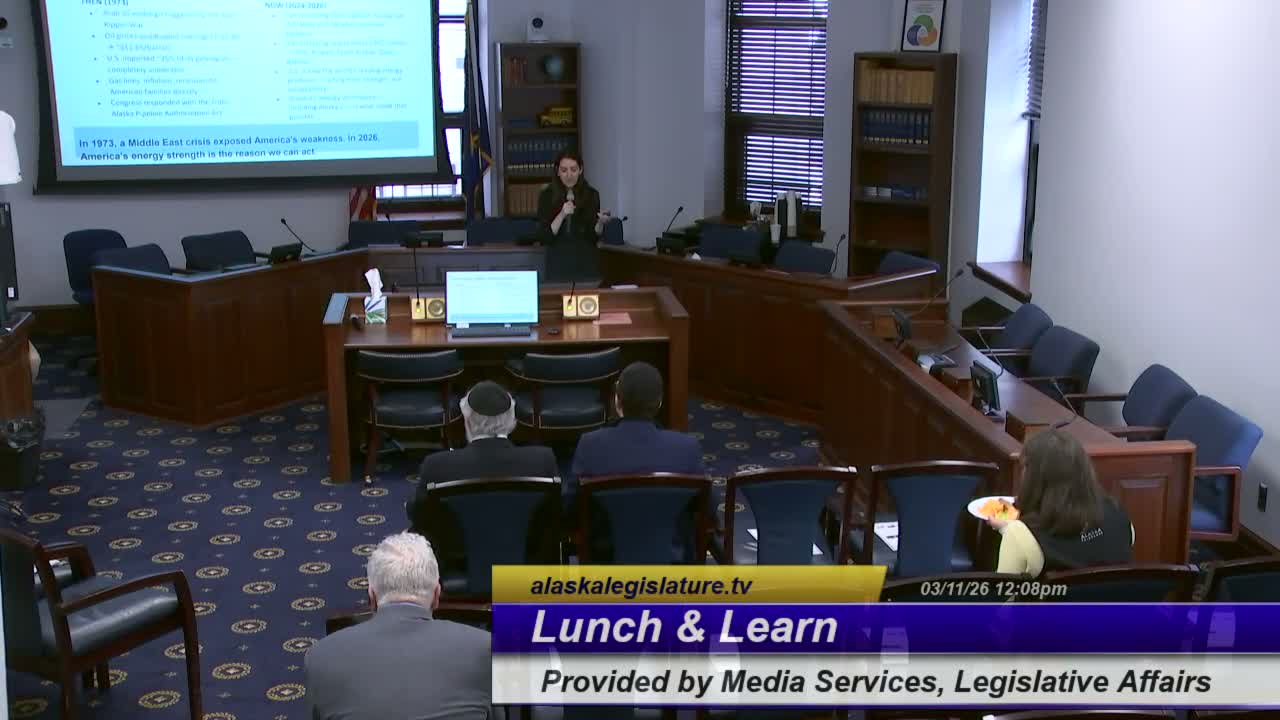
Jennifer Sutton, executive director of the nonprofit Council for Secure America, told a lunch-and-learn audience that Alaska’s energy production and the Trans-Alaska Pipeline have been central to U.S. energy dominance and national security.
"Domestic energy dominance, which we see here in Alaska, is what made that possible," Sutton said, arguing that domestic production has allowed the United States to act from "a position of strength and not vulnerability." She traced the policy arc from the 1973 Arab oil embargo through congressional actions that led to the Trans-Alaska Pipeline Authorization Act and the pipeline’s completion in 1977.
Sutton framed the historical episode as decisive for U.S. supply resilience, citing numbers presented during the briefing: oil prices that rose from $2.90 to $11.65 a barrel during the 1973 embargo; U.S. petroleum imports near 35% of consumption at that time; the Trans-Alaska Pipeline carrying more than 18 billion barrels since 1977; and Alaska production peaking near 2,000,000 barrels per day in 1988. "Alaska was there first," she said, noting the Alyeska pipeline (TAPS) was constructed to avoid the economic shocks of the 1970s.
Sutton linked recent geopolitics to energy: she argued that U.S. energy strength helped enable the Abraham Accords and gives the United States greater latitude in responding to Iranian attacks on regional partners. She warned that Iran’s oil revenues and sanctions-evasion networks have funded proxy forces, saying those revenues "fund Hezbollah, Hamas, the Houthis in Yemen" and that degrading those revenues weakens proxy networks.
On global chokepoints, Sutton cited the Strait of Hormuz and presented figures to underscore scale: roughly 20% of global oil and 25% of global LNG move through the strait daily, she said, adding that U.S. domestic production reduces American vulnerability to a hypothetical shutdown.
Sutton described CSA’s work as nonpartisan public education: producing rapid-response primers, polling, off‑the‑record briefings, and organizing trips to oil-producing regions to inform policymakers. She identified the group as a 501(c)(3) and said it does not push specific legislation. She noted advisory board members, including Elliot Abrams, and said one-page primers and open-source materials were available to attendees.
During a question-and-answer period, an audience member who identified as a geologist asked whether Alaska should diversify beyond petroleum given finite reserves (including references to the Arctic National Wildlife Refuge). Sutton replied that CSA favors "energy addition" — a posture she described as supporting "all forms of energy" while emphasizing U.S.-based technology and the need to judge diversification through a national-security lens. "A Chinese solar panel is not going to make America safer at the expense right now of drilling in certain states," she said, characterizing CSA’s preference for American-made technology and diversified energy sources.
Sutton also described CSA’s sourcing for primers and polling, citing open-source research and named outlets (she mentioned Yale School of Management and Politico as sources for some data points) and reiterated the organization’s educational purpose. She invited attendees to share contact information to receive follow-up materials and expressed interest in organizing stakeholder trips to the North Slope so "the people of Alaska could tell their story."
The briefing closed with distribution of one-page primers and an offer to add interested attendees to CSA’s mailing list; no formal actions or votes were taken.
"Domestic energy dominance, which we see here in Alaska, is what made that possible," Sutton said, arguing that domestic production has allowed the United States to act from "a position of strength and not vulnerability." She traced the policy arc from the 1973 Arab oil embargo through congressional actions that led to the Trans-Alaska Pipeline Authorization Act and the pipeline’s completion in 1977.
Sutton framed the historical episode as decisive for U.S. supply resilience, citing numbers presented during the briefing: oil prices that rose from $2.90 to $11.65 a barrel during the 1973 embargo; U.S. petroleum imports near 35% of consumption at that time; the Trans-Alaska Pipeline carrying more than 18 billion barrels since 1977; and Alaska production peaking near 2,000,000 barrels per day in 1988. "Alaska was there first," she said, noting the Alyeska pipeline (TAPS) was constructed to avoid the economic shocks of the 1970s.
Sutton linked recent geopolitics to energy: she argued that U.S. energy strength helped enable the Abraham Accords and gives the United States greater latitude in responding to Iranian attacks on regional partners. She warned that Iran’s oil revenues and sanctions-evasion networks have funded proxy forces, saying those revenues "fund Hezbollah, Hamas, the Houthis in Yemen" and that degrading those revenues weakens proxy networks.
On global chokepoints, Sutton cited the Strait of Hormuz and presented figures to underscore scale: roughly 20% of global oil and 25% of global LNG move through the strait daily, she said, adding that U.S. domestic production reduces American vulnerability to a hypothetical shutdown.
Sutton described CSA’s work as nonpartisan public education: producing rapid-response primers, polling, off‑the‑record briefings, and organizing trips to oil-producing regions to inform policymakers. She identified the group as a 501(c)(3) and said it does not push specific legislation. She noted advisory board members, including Elliot Abrams, and said one-page primers and open-source materials were available to attendees.
During a question-and-answer period, an audience member who identified as a geologist asked whether Alaska should diversify beyond petroleum given finite reserves (including references to the Arctic National Wildlife Refuge). Sutton replied that CSA favors "energy addition" — a posture she described as supporting "all forms of energy" while emphasizing U.S.-based technology and the need to judge diversification through a national-security lens. "A Chinese solar panel is not going to make America safer at the expense right now of drilling in certain states," she said, characterizing CSA’s preference for American-made technology and diversified energy sources.
Sutton also described CSA’s sourcing for primers and polling, citing open-source research and named outlets (she mentioned Yale School of Management and Politico as sources for some data points) and reiterated the organization’s educational purpose. She invited attendees to share contact information to receive follow-up materials and expressed interest in organizing stakeholder trips to the North Slope so "the people of Alaska could tell their story."
The briefing closed with distribution of one-page primers and an offer to add interested attendees to CSA’s mailing list; no formal actions or votes were taken.
Don't Miss a Word: See the Full Meeting!
Go beyond summaries. Unlock every video, transcript, and key insight with a Founder Membership.
✓
Get instant access to full meeting videos
✓
Search and clip any phrase from complete transcripts
✓
Receive AI-powered summaries & custom alerts
✓
Enjoy lifetime, unrestricted access to government data
30-day money-back guarantee
