Emergency management details NextGen 911 cutover, dispatch performance and staffing needs
March 25, 2024 | Edmond, Oklahoma County, Oklahoma
This article was created by AI summarizing key points discussed. AI makes mistakes, so for full details and context, please refer to the video of the full meeting. Please report any errors so we can fix them. Report an error »
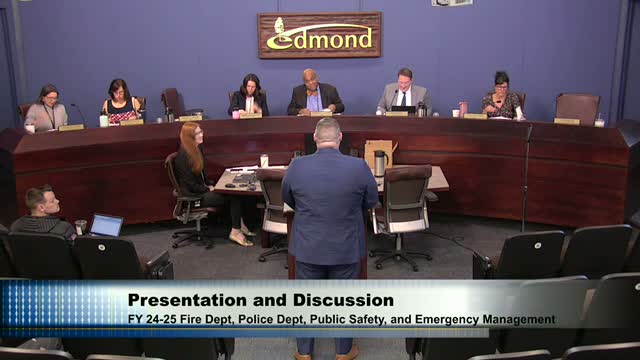
Benjamin Curry, director of emergency communications and emergency management, briefed the council on the city’s emergency management and 9-1-1 operations, emphasizing planning, coordination and technological upgrades. "Our bread and butter is the city's EOP," Curry said, describing quarterly reviews and an annual update the department performs to keep contact information and assignments current.
Curry described the Emergency Operations Center in the Public Safety Center basement, which the city activates for large incidents. He highlighted partnerships with the National Weather Service and the Edmond Amateur Radio Society for ground spotting and situational awareness during severe-weather events.
On 9-1-1 operations, Curry gave recent performance metrics and call volumes. He said the PSAP answered tens of thousands of calls last year and reported recent average call-taking and dispatch times well below the department goals (call-taking ~16 seconds; dispatch ~11.13 seconds against 30-second internal targets) and a quality-assurance compliance score of about 96%.
Curry also described staffing gaps for supervisors and dispatchers and flagged radio infrastructure challenges: the city owns a two-site radio system with one tower at UCO that may be displaced by campus development; staff have issued an RFP and are exploring a Coffee Creek/Boulevard site with planned public meetings.
On technology modernization, Curry said Edmond is scheduled to cut over new call-handling equipment on April 16, with the IP-based ESInet backbone to follow through ACOG over roughly a year. "With NextGen 9-1-1, that data then can be transferred from PSAP to PSAP," he said, noting improved location data and call-transfer capabilities.
What’s next: Curry plans short EOC orientation sessions for council members and will return with facility/tower designs and staffing requests for the dispatch center as the procurement and NextGen migration advance.
Curry described the Emergency Operations Center in the Public Safety Center basement, which the city activates for large incidents. He highlighted partnerships with the National Weather Service and the Edmond Amateur Radio Society for ground spotting and situational awareness during severe-weather events.
On 9-1-1 operations, Curry gave recent performance metrics and call volumes. He said the PSAP answered tens of thousands of calls last year and reported recent average call-taking and dispatch times well below the department goals (call-taking ~16 seconds; dispatch ~11.13 seconds against 30-second internal targets) and a quality-assurance compliance score of about 96%.
Curry also described staffing gaps for supervisors and dispatchers and flagged radio infrastructure challenges: the city owns a two-site radio system with one tower at UCO that may be displaced by campus development; staff have issued an RFP and are exploring a Coffee Creek/Boulevard site with planned public meetings.
On technology modernization, Curry said Edmond is scheduled to cut over new call-handling equipment on April 16, with the IP-based ESInet backbone to follow through ACOG over roughly a year. "With NextGen 9-1-1, that data then can be transferred from PSAP to PSAP," he said, noting improved location data and call-transfer capabilities.
What’s next: Curry plans short EOC orientation sessions for council members and will return with facility/tower designs and staffing requests for the dispatch center as the procurement and NextGen migration advance.
View the Full Meeting & All Its Details
This article offers just a summary. Unlock complete video, transcripts, and insights as a Founder Member.
✓
Watch full, unedited meeting videos
✓
Search every word spoken in unlimited transcripts
✓
AI summaries & real-time alerts (all government levels)
✓
Permanent access to expanding government content
30-day money-back guarantee
