Votes at a glance: House advances slate of bills on consumer protections, corrections, health care and public safety
March 11, 2026 | Legislative Sessions, Washington
This article was created by AI summarizing key points discussed. AI makes mistakes, so for full details and context, please refer to the video of the full meeting. Please report any errors so we can fix them. Report an error »
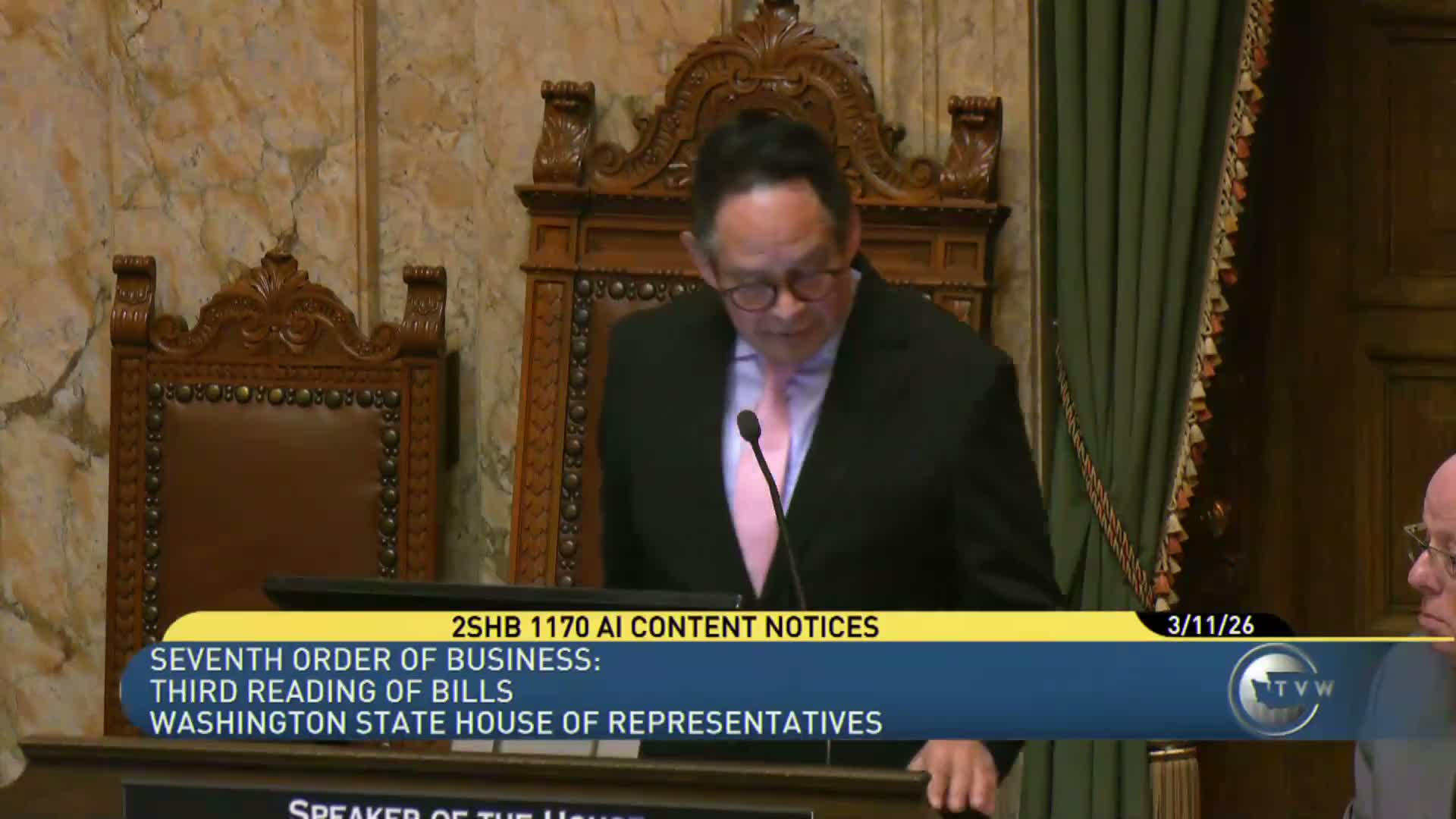
On a packed floor the state House processed and approved a broad set of bills spanning consumer protections, corrections policy, healthcare transaction rules, renewable-energy tax treatment and firearms-related provisions.
Key outcomes (selected):
- Engrossed Second Substitute House Bill 11-70: Final passage declared after roll call (55 yeas, 38 nays, 5 excused). Representative Shavers and others spoke in favor; Representative Barnard announced a no vote.
- Engrossed Second Substitute House Bill 22-51: Passed (see separate article) 54-40, 4 excused.
- Engrossed House Bill 24-45: Passed by roll call (66 yeas, 29 nays, 3 excused); Representative Richards thanked the Attorney General’s Office and stakeholders for unanimous Senate support.
- Substitute House Bill 23-34: Passed 80 yeas, 15 nays, 3 excused after sponsors and supporters spoke in favor.
- Engrossed Third Substitute House Bill 19-60 (renewables excise): Sponsors described the bill as replacing inconsistent property-tax treatment for wind, solar and storage with a stable excise tax that would route revenue to counties and junior taxing districts. The bill passed 86 yeas, 9 nays, 3 excused.
- Engross Substitute House Bill 1500 (resale certificates/HOA): Passed following remarks noting negotiated improvements; vote recorded 61 yays, 34 nays, 3 excused.
- Second Substitute House Bill 19-09 (court unification task force): Passed after debate; members expressed both support and concern about enlarging task forces and potential inefficiencies.
- Substitute House Bill 25-39 (inmate funds and related corrections provisions): Passed 57 yays, 38 nays, 3 excused; debate highlighted changes to inmate-allowed balances and inflation adjustments.
- Engross Substitute House Bill 25-48 (healthcare transaction paperwork/fee waiver): Passed 55 yays, 41 nays, 2 excused; opponents noted concern about fee waivers for government entities.
- Engross Substitute House Bill 23-20 (3D-printed firearms provisions): Passed 58 yays, 38 nays, 2 excused; proponents cited public-safety incidents and untraceable ghost guns; opponents raised First Amendment concerns about criminalizing possession of computer code.
Most bills were adopted either by oral voice vote or by roll-call tally as recorded on the floor; the transcript lists vote tallies for each recorded roll call and the House declared the measures passed where a constitutional majority was recorded.
Key outcomes (selected):
- Engrossed Second Substitute House Bill 11-70: Final passage declared after roll call (55 yeas, 38 nays, 5 excused). Representative Shavers and others spoke in favor; Representative Barnard announced a no vote.
- Engrossed Second Substitute House Bill 22-51: Passed (see separate article) 54-40, 4 excused.
- Engrossed House Bill 24-45: Passed by roll call (66 yeas, 29 nays, 3 excused); Representative Richards thanked the Attorney General’s Office and stakeholders for unanimous Senate support.
- Substitute House Bill 23-34: Passed 80 yeas, 15 nays, 3 excused after sponsors and supporters spoke in favor.
- Engrossed Third Substitute House Bill 19-60 (renewables excise): Sponsors described the bill as replacing inconsistent property-tax treatment for wind, solar and storage with a stable excise tax that would route revenue to counties and junior taxing districts. The bill passed 86 yeas, 9 nays, 3 excused.
- Engross Substitute House Bill 1500 (resale certificates/HOA): Passed following remarks noting negotiated improvements; vote recorded 61 yays, 34 nays, 3 excused.
- Second Substitute House Bill 19-09 (court unification task force): Passed after debate; members expressed both support and concern about enlarging task forces and potential inefficiencies.
- Substitute House Bill 25-39 (inmate funds and related corrections provisions): Passed 57 yays, 38 nays, 3 excused; debate highlighted changes to inmate-allowed balances and inflation adjustments.
- Engross Substitute House Bill 25-48 (healthcare transaction paperwork/fee waiver): Passed 55 yays, 41 nays, 2 excused; opponents noted concern about fee waivers for government entities.
- Engross Substitute House Bill 23-20 (3D-printed firearms provisions): Passed 58 yays, 38 nays, 2 excused; proponents cited public-safety incidents and untraceable ghost guns; opponents raised First Amendment concerns about criminalizing possession of computer code.
Most bills were adopted either by oral voice vote or by roll-call tally as recorded on the floor; the transcript lists vote tallies for each recorded roll call and the House declared the measures passed where a constitutional majority was recorded.
View the Full Meeting & All Its Details
This article offers just a summary. Unlock complete video, transcripts, and insights as a Founder Member.
✓
Watch full, unedited meeting videos
✓
Search every word spoken in unlimited transcripts
✓
AI summaries & real-time alerts (all government levels)
✓
Permanent access to expanding government content
30-day money-back guarantee
