Belgrade staff brief council on lagoon rehab, WERF expansion, Well 9 and lead-service-line push
March 09, 2026 | Belgrade, Gallatin County, Montana
This article was created by AI summarizing key points discussed. AI makes mistakes, so for full details and context, please refer to the video of the full meeting. Please report any errors so we can fix them. Report an error »
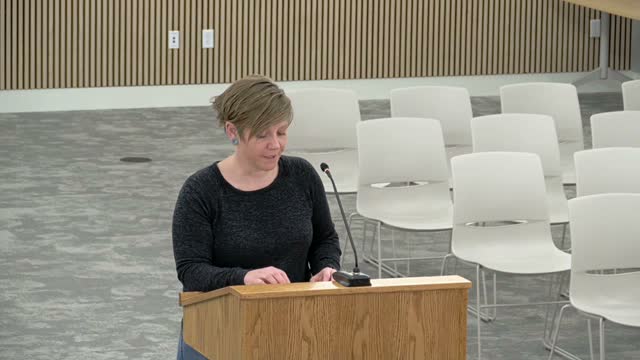
Public Works Director Camry Iulia summarized current water and wastewater work, telling council members the lagoon rehabilitation project is substantially complete but still requires spring leak testing on Pond 3 per DEQ. She said that testing was delayed by winter conditions and will be the final closing step on that project.
Iulia described the Belgrade WERF phase 1.5 project as an expansion that will “expand the liquids treatment capacity of the plant by about 2,000,000 gallons a day,” add solids‑handling capacity, expand monitoring wells for compliance and include lift‑station upgrades. She said design work is underway with multiple contract amendments in place and a design kickoff scheduled.
On drinking water, staff finished drilling Well 9 but encountered sand production that requires reduced production while the well develops; the city has submitted final design materials to DEQ and awaits approval before ordering electrical equipment. Iulia said final construction for the Well 9 work is expected to be complete this summer and that staff plan to restore park areas afterward.
Iulia also described a lead‑service‑line inventory: many service lines are currently classified as 'unknown' and must be assumed to contain lead under the law. To resolve unknowns, staff will begin a meter‑replacement program in about 30 days to expose service‑line material for verification and then will pothole with a vacuum truck where needed. She noted funding options exist (including the state revolving fund) but often require replacing service lines all the way into homes, which raises questions about city versus homeowner responsibility.
Council members pressed for timelines, responsibilities and procurement plans; staff said some construction and replacement work will be contracted out and that the city intends to prioritize meter replacements and targeted excavation to reduce uncertainty about materials.
No formal votes were taken; staff will return with schedules and contract recommendations as design and DEQ approvals come in.
Iulia described the Belgrade WERF phase 1.5 project as an expansion that will “expand the liquids treatment capacity of the plant by about 2,000,000 gallons a day,” add solids‑handling capacity, expand monitoring wells for compliance and include lift‑station upgrades. She said design work is underway with multiple contract amendments in place and a design kickoff scheduled.
On drinking water, staff finished drilling Well 9 but encountered sand production that requires reduced production while the well develops; the city has submitted final design materials to DEQ and awaits approval before ordering electrical equipment. Iulia said final construction for the Well 9 work is expected to be complete this summer and that staff plan to restore park areas afterward.
Iulia also described a lead‑service‑line inventory: many service lines are currently classified as 'unknown' and must be assumed to contain lead under the law. To resolve unknowns, staff will begin a meter‑replacement program in about 30 days to expose service‑line material for verification and then will pothole with a vacuum truck where needed. She noted funding options exist (including the state revolving fund) but often require replacing service lines all the way into homes, which raises questions about city versus homeowner responsibility.
Council members pressed for timelines, responsibilities and procurement plans; staff said some construction and replacement work will be contracted out and that the city intends to prioritize meter replacements and targeted excavation to reduce uncertainty about materials.
No formal votes were taken; staff will return with schedules and contract recommendations as design and DEQ approvals come in.
View the Full Meeting & All Its Details
This article offers just a summary. Unlock complete video, transcripts, and insights as a Founder Member.
✓
Watch full, unedited meeting videos
✓
Search every word spoken in unlimited transcripts
✓
AI summaries & real-time alerts (all government levels)
✓
Permanent access to expanding government content
30-day money-back guarantee
