Belgrade board backs rezoning for Copper Ranch to allow proposed affordable apartments
December 29, 2025 | Belgrade, Gallatin County, Montana
This article was created by AI summarizing key points discussed. AI makes mistakes, so for full details and context, please refer to the video of the full meeting. Please report any errors so we can fix them. Report an error »
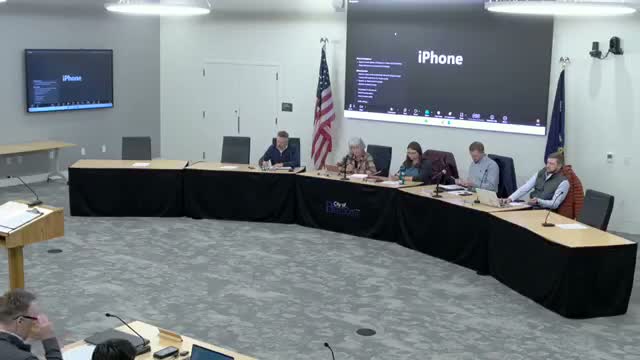
The Belgrade Planning Board voted to recommend that the City Council rezone a parcel identified as the Copper Ranch B Zone (owned by Yellowstone Crossing HC LLC) from Commercial Corridor to Community Living, a change that would allow multifamily development and, per staff, could enable roughly 320 deed-restricted affordable units if the applicant secures appropriate funding and restrictions.
Brad Stein, senior planner, described the request as applicant-driven and located east of Depot Lane between the railroad tracks and the interstate. "The request is for, around 320 affordable dwelling units, and this would be an actual affordable development within the city of Belgrade," Stein said, adding that the proposed units would be deed-restricted and could fall into the low and very-low income ranges. He noted the applicant indicated they were pursuing funding described in the record as "light tech funding."
Matt Ekstrom, an engineer with Morris and Marley, identified himself as the applicant’s representative and said he was available for questions. Board members asked why the area had earlier been designated commercial; staff explained the prior large rezoning rollup and said the Community Living (CL) designation fits the proposed housing use.
Board members voiced support for creating affordable housing in the location near the interstate and new interchange. One member asked whether a CL zoning designation could later be used for non-affordable housing; Stein said yes, zoning to CL does not itself require affordability and that affordability requirements typically accompany funding programs with time-limited deed restrictions—often on the order of 20 to 30 years, per staff.
A board member moved to recommend the rezoning; another member seconded. The board took a voice vote and advanced the recommendation to the City Council for its consideration. The transcript records no final council action; the council will review the recommendation and the corresponding zone-text and map amendments in subsequent readings.
Next steps: the item moves to City Council; staff and the applicant will need to address any affordability conditions and funding requirements before long-term deed restrictions can be assumed.
Brad Stein, senior planner, described the request as applicant-driven and located east of Depot Lane between the railroad tracks and the interstate. "The request is for, around 320 affordable dwelling units, and this would be an actual affordable development within the city of Belgrade," Stein said, adding that the proposed units would be deed-restricted and could fall into the low and very-low income ranges. He noted the applicant indicated they were pursuing funding described in the record as "light tech funding."
Matt Ekstrom, an engineer with Morris and Marley, identified himself as the applicant’s representative and said he was available for questions. Board members asked why the area had earlier been designated commercial; staff explained the prior large rezoning rollup and said the Community Living (CL) designation fits the proposed housing use.
Board members voiced support for creating affordable housing in the location near the interstate and new interchange. One member asked whether a CL zoning designation could later be used for non-affordable housing; Stein said yes, zoning to CL does not itself require affordability and that affordability requirements typically accompany funding programs with time-limited deed restrictions—often on the order of 20 to 30 years, per staff.
A board member moved to recommend the rezoning; another member seconded. The board took a voice vote and advanced the recommendation to the City Council for its consideration. The transcript records no final council action; the council will review the recommendation and the corresponding zone-text and map amendments in subsequent readings.
Next steps: the item moves to City Council; staff and the applicant will need to address any affordability conditions and funding requirements before long-term deed restrictions can be assumed.
View the Full Meeting & All Its Details
This article offers just a summary. Unlock complete video, transcripts, and insights as a Founder Member.
✓
Watch full, unedited meeting videos
✓
Search every word spoken in unlimited transcripts
✓
AI summaries & real-time alerts (all government levels)
✓
Permanent access to expanding government content
30-day money-back guarantee
