Committee advances 'Charlie Kirk American Heritage Act' after lengthy debate and student testimony
March 11, 2026 | 2026 Legislature TN, Tennessee
This article was created by AI summarizing key points discussed. AI makes mistakes, so for full details and context, please refer to the video of the full meeting. Please report any errors so we can fix them. Report an error »
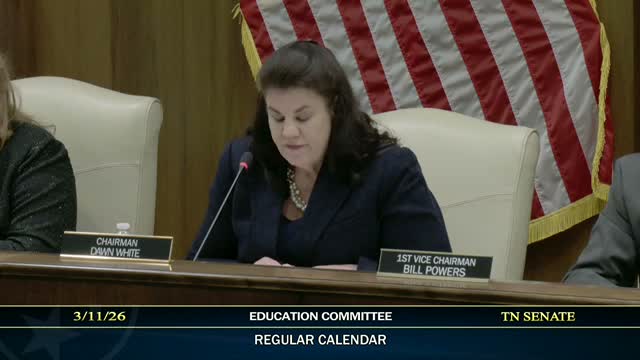
Senator Rose presented SB 18‑28, which the sponsor described as authorizing instruction about the positive influence of Judeo‑Christian heritage when teaching American history. The amendment adopted in committee names the bill the “Charlie Kirk American Heritage Act.”
Rose and supporters read historical examples they said connect religion and early American civic life, including excerpts from the Mayflower Compact and quotations attributed to Washington, Franklin, Adams and other historical figures. Rose said the bill permits instruction about the religious influences on founding events and requires at least one additional foundational document related to African American freedom struggles.
Several student witnesses representing Turning Point/Club America spoke in favor. Lakey Derrick, who said he founded a Turning Point chapter at East Tennessee State University, urged a committee vote: "Your vote yes for SB 18‑28 means that you will be joining us in that fight," he told members. Another student, Ben Mason of Providence Academy, told the committee that, in his view, the nation’s founding was rooted in Judeo‑Christian values.
Opponents, including Leader Akberry and others, asked whether the legislation would run afoul of the First Amendment or be seen as endorsing a particular religion in public schools. Senator Akberry said posting religious texts in schools could make some students uncomfortable and questioned equating religious documents with founding constitutional texts. Senator Crow and others argued the measure simply allows historical instruction about religion’s role in U.S. history and that the bill explicitly prohibits proselytizing.
After debate and a brief recess for student testimony, the committee voted 8‑1 to send SB 18‑28 to the calendar (one no vote recorded). The sponsor said the bill aims to clarify that public schools may teach the historical role of religion without proselytizing.
What’s next: The bill will be placed on the Senate calendar for further consideration and any floor amendments.
Rose and supporters read historical examples they said connect religion and early American civic life, including excerpts from the Mayflower Compact and quotations attributed to Washington, Franklin, Adams and other historical figures. Rose said the bill permits instruction about the religious influences on founding events and requires at least one additional foundational document related to African American freedom struggles.
Several student witnesses representing Turning Point/Club America spoke in favor. Lakey Derrick, who said he founded a Turning Point chapter at East Tennessee State University, urged a committee vote: "Your vote yes for SB 18‑28 means that you will be joining us in that fight," he told members. Another student, Ben Mason of Providence Academy, told the committee that, in his view, the nation’s founding was rooted in Judeo‑Christian values.
Opponents, including Leader Akberry and others, asked whether the legislation would run afoul of the First Amendment or be seen as endorsing a particular religion in public schools. Senator Akberry said posting religious texts in schools could make some students uncomfortable and questioned equating religious documents with founding constitutional texts. Senator Crow and others argued the measure simply allows historical instruction about religion’s role in U.S. history and that the bill explicitly prohibits proselytizing.
After debate and a brief recess for student testimony, the committee voted 8‑1 to send SB 18‑28 to the calendar (one no vote recorded). The sponsor said the bill aims to clarify that public schools may teach the historical role of religion without proselytizing.
What’s next: The bill will be placed on the Senate calendar for further consideration and any floor amendments.
Don't Miss a Word: See the Full Meeting!
Go beyond summaries. Unlock every video, transcript, and key insight with a Founder Membership.
✓
Get instant access to full meeting videos
✓
Search and clip any phrase from complete transcripts
✓
Receive AI-powered summaries & custom alerts
✓
Enjoy lifetime, unrestricted access to government data
30-day money-back guarantee
