Sen. Sutherland and backers pitch market-based recycling plan, ask producers to help fund collection
March 11, 2026 | 2026 Legislature TN, Tennessee
This article was created by AI summarizing key points discussed. AI makes mistakes, so for full details and context, please refer to the video of the full meeting. Please report any errors so we can fix them. Report an error »
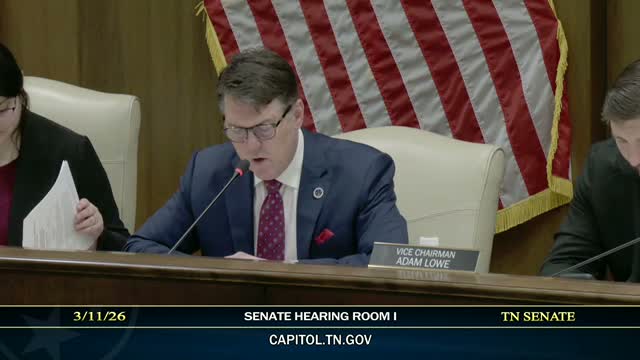
Sen. Sutherland said Tennessee faces a mounting solid-waste problem and urged a market-based fix rather than more landfills.
Sutherland told the Senate Energy, Agriculture & Natural Resources Committee that new landfills are politically difficult and that recycling investments are a better path. “Houston, we have a problem,” he said, arguing private investment and better reuse markets could reduce landfill pressure.
Pat Couples, who identified himself as representing the Waste to Jobs Coalition, said the coalition’s approach is not a bottle-deposit system and would exempt nearly all small businesses by setting a $10 million revenue threshold and a one-time packaging minimum. “So 99.5% of Tennessee businesses are excluded,” Couples said, arguing the proposal would not raise consumer prices and would return materials to Tennessee manufacturers.
Greg Adkins of the Beverage Association of Tennessee said the industry has invested in recycling infrastructure and grant programs and noted the sector already makes significant contributions through taxes and grants. “We currently give grants…and we also pay a 1.9% gross receipts tax, which is over $20,000,000 a year,” Adkins said, framing industry action as part of any workable solution.
Committee members pressed witnesses on whether voluntary grants and producer-funded programs can scale up to meet the need; some members warned that shifting costs to local governments via higher tipping fees effectively becomes a tax on taxpayers. Sutherland said his request was largely to get stakeholders in the same room and to invite two named representatives to advise the committee on implementation options.
The hearing record shows the discussion focused on how to build recycling markets without placing an undue tax burden on small businesses or consumers, and on practical measures—optical sorters, local recycling centers adjoining landfills, and reuse of industrial byproducts—designed to reduce landfill volumes.
Next steps: the sponsor asked the committee to continue stakeholder work over the summer; no final vote on policy language was recorded in the committee during this session.
Sutherland told the Senate Energy, Agriculture & Natural Resources Committee that new landfills are politically difficult and that recycling investments are a better path. “Houston, we have a problem,” he said, arguing private investment and better reuse markets could reduce landfill pressure.
Pat Couples, who identified himself as representing the Waste to Jobs Coalition, said the coalition’s approach is not a bottle-deposit system and would exempt nearly all small businesses by setting a $10 million revenue threshold and a one-time packaging minimum. “So 99.5% of Tennessee businesses are excluded,” Couples said, arguing the proposal would not raise consumer prices and would return materials to Tennessee manufacturers.
Greg Adkins of the Beverage Association of Tennessee said the industry has invested in recycling infrastructure and grant programs and noted the sector already makes significant contributions through taxes and grants. “We currently give grants…and we also pay a 1.9% gross receipts tax, which is over $20,000,000 a year,” Adkins said, framing industry action as part of any workable solution.
Committee members pressed witnesses on whether voluntary grants and producer-funded programs can scale up to meet the need; some members warned that shifting costs to local governments via higher tipping fees effectively becomes a tax on taxpayers. Sutherland said his request was largely to get stakeholders in the same room and to invite two named representatives to advise the committee on implementation options.
The hearing record shows the discussion focused on how to build recycling markets without placing an undue tax burden on small businesses or consumers, and on practical measures—optical sorters, local recycling centers adjoining landfills, and reuse of industrial byproducts—designed to reduce landfill volumes.
Next steps: the sponsor asked the committee to continue stakeholder work over the summer; no final vote on policy language was recorded in the committee during this session.
Don't Miss a Word: See the Full Meeting!
Go beyond summaries. Unlock every video, transcript, and key insight with a Founder Membership.
✓
Get instant access to full meeting videos
✓
Search and clip any phrase from complete transcripts
✓
Receive AI-powered summaries & custom alerts
✓
Enjoy lifetime, unrestricted access to government data
30-day money-back guarantee
