Privacy bill prompting heated debate: committee adopts amendments, gives favorable report as amended
March 11, 2026 | 2026 Legislative Meetings, South Carolina
This article was created by AI summarizing key points discussed. AI makes mistakes, so for full details and context, please refer to the video of the full meeting. Please report any errors so we can fix them. Report an error »
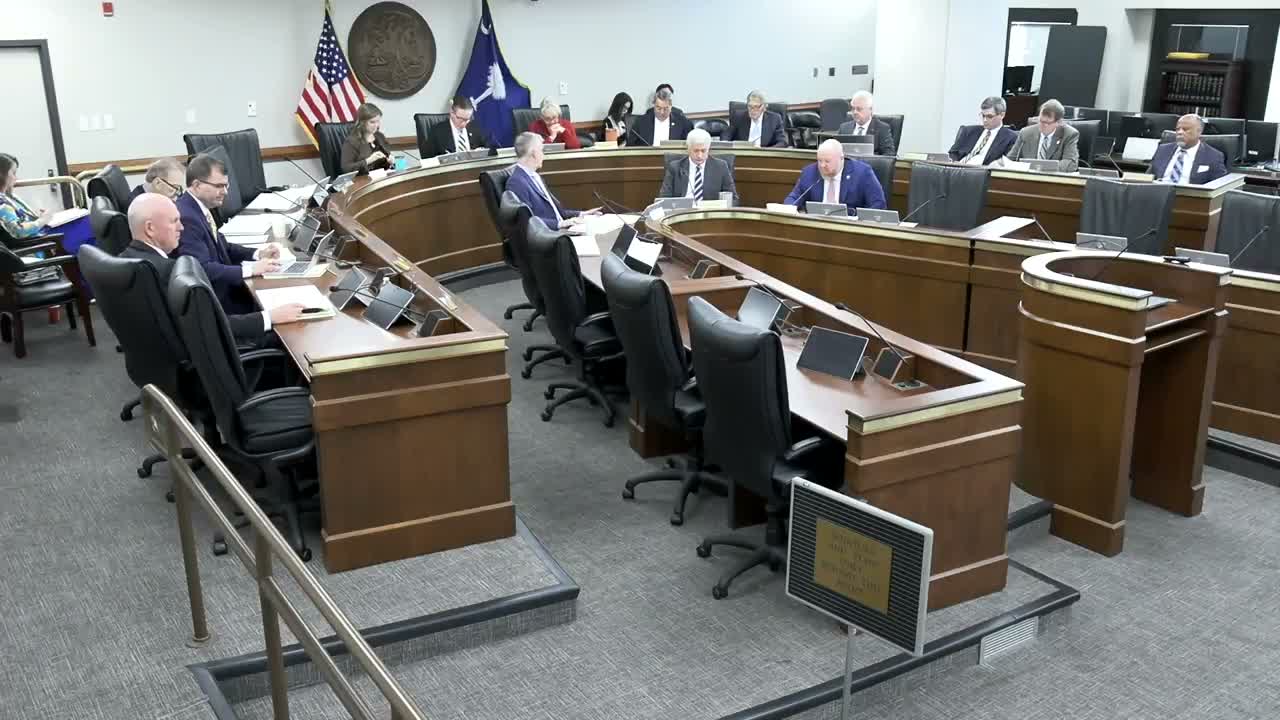
The committee took up H4756, the Student Physical Privacy Act, a contested bill that would require public K‑12 districts and public institutions of higher education to designate restrooms and changing facilities for use by members of one sex and to provide at least one single‑user restroom accommodation in specified circumstances. The bill also proposes enforcement mechanisms — including a 25% withholding of certain funds for noncompliance — and creates a private cause of action for individuals to seek declaratory and injunctive relief.
Donna Barton, the committee’s research director, summarized the bill and the committee amendment that changes the private cause of action language. “The most significant piece of the amendment is the cause of action section,” Barton said, noting the amendment modifies who may bring suit and that prior proviso language had been enjoined in Doe v. State of South Carolina. She also told the committee the U.S. Court of Appeals had referenced a pending U.S. Supreme Court matter argued 01/13/2026.
Sponsor Sen. Stubbs (S6) described a compromise approach intended to provide at least one single‑user accommodation and avoid forcing people into uncomfortable situations, while allowing flexibility for overnight or special events. “I think this is common sense legislation,” Stubbs said, acknowledging strong feelings on both sides.
Several members raised concerns about the private cause of action and potential litigation costs. Senator Hornsford (S3) moved an amendment to delete the private cause of action, saying schools could face unpredictable attorney fee exposure; that amendment was carried. Other senators proposed clarifying the standard for ‘‘reasonable steps’’ to prevent misuse of opposite‑sex facilities and discussed whether enforcement responsibility should rest with the Department of Education or the State Board of Education for withholding funds; the committee adopted an amendment changing the enforcement designation to the State Board of Education.
Committee debate also addressed whether the bill should apply to higher education; one senator moved to delete higher education from the bill but the motion failed. Senators discussed pragmatic exemptions for coaching and athletic staff when individuals are not in a state of undress. Given the number of complex issues and anticipated floor amendments, the chair suggested continued work in committee and the bill was given a favorable report as amended; members also carried over one amendment for further drafting.
The discussion repeatedly returned to legal risk and implementation details: members asked staff to draft clearer tests for what constitutes ‘‘reasonable steps’’ to avoid prompting litigation and to clarify timelines for effectiveness if the governor signs the bill.
Donna Barton, the committee’s research director, summarized the bill and the committee amendment that changes the private cause of action language. “The most significant piece of the amendment is the cause of action section,” Barton said, noting the amendment modifies who may bring suit and that prior proviso language had been enjoined in Doe v. State of South Carolina. She also told the committee the U.S. Court of Appeals had referenced a pending U.S. Supreme Court matter argued 01/13/2026.
Sponsor Sen. Stubbs (S6) described a compromise approach intended to provide at least one single‑user accommodation and avoid forcing people into uncomfortable situations, while allowing flexibility for overnight or special events. “I think this is common sense legislation,” Stubbs said, acknowledging strong feelings on both sides.
Several members raised concerns about the private cause of action and potential litigation costs. Senator Hornsford (S3) moved an amendment to delete the private cause of action, saying schools could face unpredictable attorney fee exposure; that amendment was carried. Other senators proposed clarifying the standard for ‘‘reasonable steps’’ to prevent misuse of opposite‑sex facilities and discussed whether enforcement responsibility should rest with the Department of Education or the State Board of Education for withholding funds; the committee adopted an amendment changing the enforcement designation to the State Board of Education.
Committee debate also addressed whether the bill should apply to higher education; one senator moved to delete higher education from the bill but the motion failed. Senators discussed pragmatic exemptions for coaching and athletic staff when individuals are not in a state of undress. Given the number of complex issues and anticipated floor amendments, the chair suggested continued work in committee and the bill was given a favorable report as amended; members also carried over one amendment for further drafting.
The discussion repeatedly returned to legal risk and implementation details: members asked staff to draft clearer tests for what constitutes ‘‘reasonable steps’’ to avoid prompting litigation and to clarify timelines for effectiveness if the governor signs the bill.
Don't Miss a Word: See the Full Meeting!
Go beyond summaries. Unlock every video, transcript, and key insight with a Founder Membership.
✓
Get instant access to full meeting videos
✓
Search and clip any phrase from complete transcripts
✓
Receive AI-powered summaries & custom alerts
✓
Enjoy lifetime, unrestricted access to government data
30-day money-back guarantee
