Council authorizes $60,000 pavement condition study using lidar and machine learning
March 10, 2026 | Parker, Collin County, Texas
This article was created by AI summarizing key points discussed. AI makes mistakes, so for full details and context, please refer to the video of the full meeting. Please report any errors so we can fix them. Report an error »
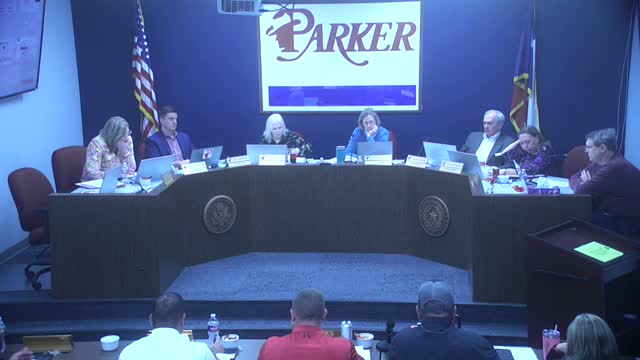
Parker City Council voted unanimously on March 10 to authorize a pavement condition study and data agreement with a vendor that will use lidar, high-resolution imaging and machine-learning algorithms to create a detailed pavement condition index (PCI) and supporting data for the city's capital planning.
Staff described the study as an advanced approach that will produce the city’s PCI and a digital dataset useful for drainage checks, asset location, and a future GIS interface. The contract is structured on an hourly basis with a not-to-exceed amount of $60,000. The vendor representative described a workflow that captures dense point-cloud and imagery data and then classifies defects (cracks, potholes, ponding) via custom algorithms; he said early work achieved approximately "93% accuracy." The vendor noted some proprietary processing and machine-learning components and the city attorney and staff said the contract will be revised to ensure the city owns the PCI and has necessary access while protecting vendor proprietary code.
Council members asked about costs, frequency of updates, deliverables and whether traffic volumes would be incorporated. Staff said the study will produce a PCI report with digital deliverables and a web-accessible interface; traffic will be incorporated via staff analysis or surrogate estimates rather than live counts for every road. Council and staff discussed that the greater data detail could enable more timely maintenance and potential cost savings over time.
The resolution (2026-888) passed 4-0. Staff will finalize contract language on data ownership and access, schedule flights/collections, and return deliverables per the agreement.
Staff described the study as an advanced approach that will produce the city’s PCI and a digital dataset useful for drainage checks, asset location, and a future GIS interface. The contract is structured on an hourly basis with a not-to-exceed amount of $60,000. The vendor representative described a workflow that captures dense point-cloud and imagery data and then classifies defects (cracks, potholes, ponding) via custom algorithms; he said early work achieved approximately "93% accuracy." The vendor noted some proprietary processing and machine-learning components and the city attorney and staff said the contract will be revised to ensure the city owns the PCI and has necessary access while protecting vendor proprietary code.
Council members asked about costs, frequency of updates, deliverables and whether traffic volumes would be incorporated. Staff said the study will produce a PCI report with digital deliverables and a web-accessible interface; traffic will be incorporated via staff analysis or surrogate estimates rather than live counts for every road. Council and staff discussed that the greater data detail could enable more timely maintenance and potential cost savings over time.
The resolution (2026-888) passed 4-0. Staff will finalize contract language on data ownership and access, schedule flights/collections, and return deliverables per the agreement.
View the Full Meeting & All Its Details
This article offers just a summary. Unlock complete video, transcripts, and insights as a Founder Member.
✓
Watch full, unedited meeting videos
✓
Search every word spoken in unlimited transcripts
✓
AI summaries & real-time alerts (all government levels)
✓
Permanent access to expanding government content
30-day money-back guarantee
