Committee reworks scoring for construction manager RFQ, debates references vs. presentation weighting
March 11, 2026 | Fairfield, Fairfield, Connecticut
This article was created by AI summarizing key points discussed. AI makes mistakes, so for full details and context, please refer to the video of the full meeting. Please report any errors so we can fix them. Report an error »
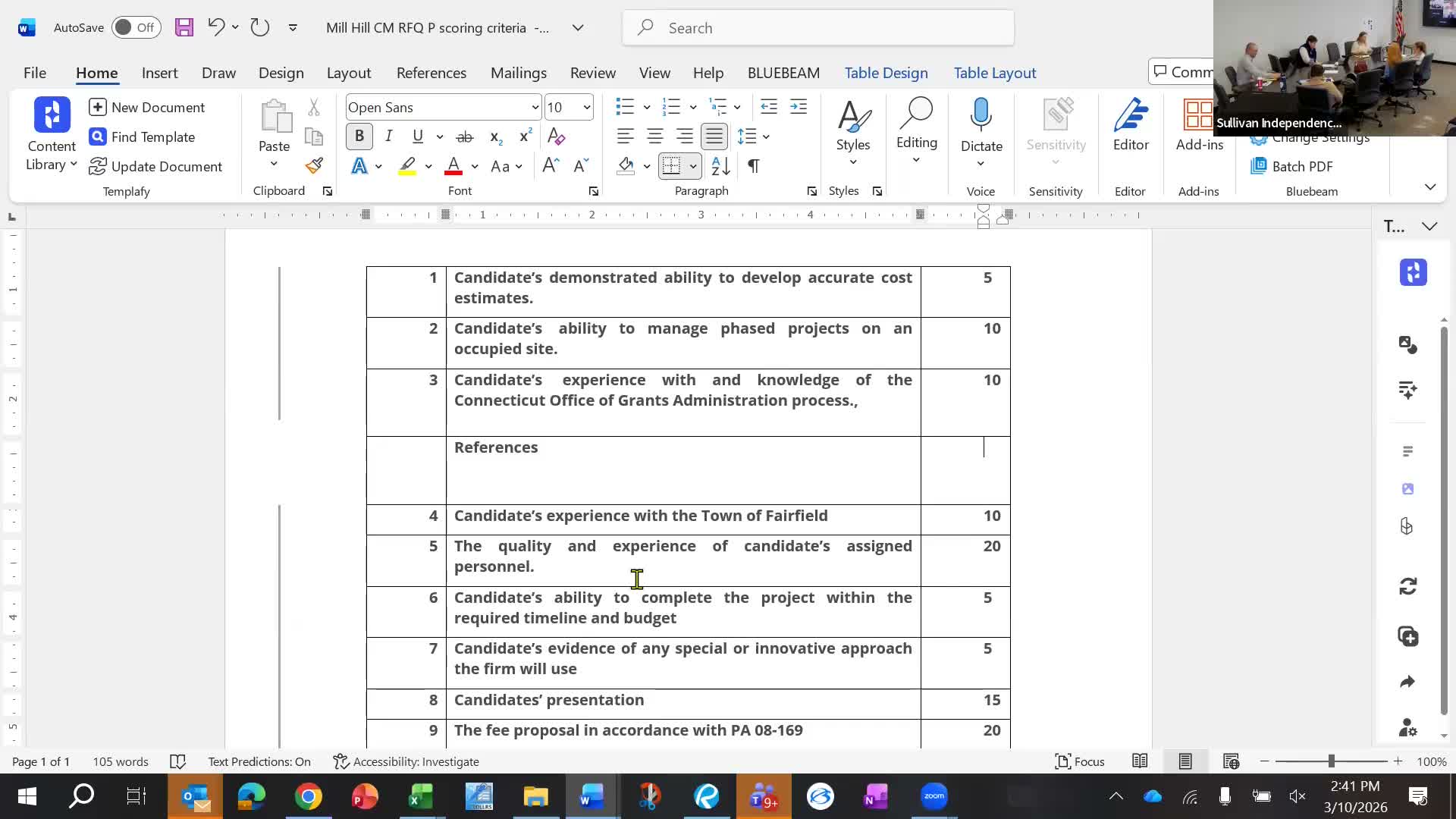
Committee members spent the bulk of the meeting debating how to structure scoring for the CMRF/QP (construction management) solicitation, including whether to add a 'references' category and how to balance references, fee, assigned personnel and presentation points.
A committee member cautioned that requiring five returned references could disadvantage firms because ‘‘it was very hit or miss’’ to obtain callbacks. The Chair and others responded that references were a useful shortlisting tool, saying references helped ‘‘weed them out pretty quickly’’ when firms did not provide reliable references. John Purcell asked for clarification on what counted as relevant experience; committee members referenced RFQ expectations that look for prior school projects over a stated dollar threshold.
Members proposed a range of numerical reweights: suggestions included lowering fee weight to 10–15 points, keeping references at 5, raising candidate presentation weighting to 20–30, and increasing the score for assigned personnel or ability to complete the project within required timeline and budget. Several members argued for separating evaluation into two phases: phase 1 for shortlisting on qualifications and references; phase 2 for presentations and final scoring. That change was framed as a way to avoid rescoring earlier qualification points after a strong presentation.
The committee asked purchasing staff (Adam and Lee) to be consulted on how to implement the two-phase process in Bonfire and requested a draft revised scoring sheet for review at the next meeting. Members also discussed logistics for presentations: allotting time for scoring immediately after each presentation and locking scores on the day to keep impressions fresh.
No formal vote was recorded on scoring weights at this meeting; the Chair instructed staff to draft the revisions and bring them back for a formal vote at the next meeting.
A committee member cautioned that requiring five returned references could disadvantage firms because ‘‘it was very hit or miss’’ to obtain callbacks. The Chair and others responded that references were a useful shortlisting tool, saying references helped ‘‘weed them out pretty quickly’’ when firms did not provide reliable references. John Purcell asked for clarification on what counted as relevant experience; committee members referenced RFQ expectations that look for prior school projects over a stated dollar threshold.
Members proposed a range of numerical reweights: suggestions included lowering fee weight to 10–15 points, keeping references at 5, raising candidate presentation weighting to 20–30, and increasing the score for assigned personnel or ability to complete the project within required timeline and budget. Several members argued for separating evaluation into two phases: phase 1 for shortlisting on qualifications and references; phase 2 for presentations and final scoring. That change was framed as a way to avoid rescoring earlier qualification points after a strong presentation.
The committee asked purchasing staff (Adam and Lee) to be consulted on how to implement the two-phase process in Bonfire and requested a draft revised scoring sheet for review at the next meeting. Members also discussed logistics for presentations: allotting time for scoring immediately after each presentation and locking scores on the day to keep impressions fresh.
No formal vote was recorded on scoring weights at this meeting; the Chair instructed staff to draft the revisions and bring them back for a formal vote at the next meeting.
Don't Miss a Word: See the Full Meeting!
Go beyond summaries. Unlock every video, transcript, and key insight with a Founder Membership.
✓
Get instant access to full meeting videos
✓
Search and clip any phrase from complete transcripts
✓
Receive AI-powered summaries & custom alerts
✓
Enjoy lifetime, unrestricted access to government data
30-day money-back guarantee
