University economist warns lottery revenues cannot sustain growing scholarship demand; sports-wagering gains at risk from prediction markets
March 10, 2026 | 2026 Legislature TN, Tennessee
This article was created by AI summarizing key points discussed. AI makes mistakes, so for full details and context, please refer to the video of the full meeting. Please report any errors so we can fix them. Report an error »
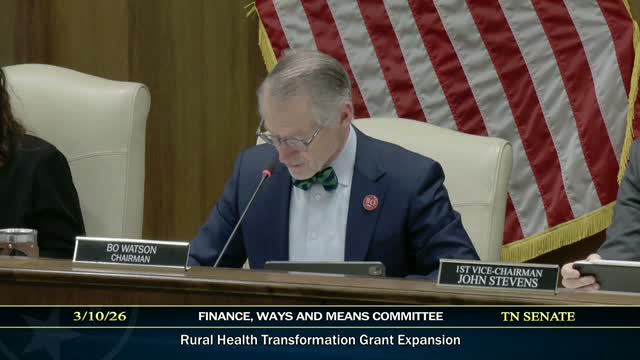
Don Bruce, director of the Boyd Center for Business and Economic Research at the University of Tennessee, told the Senate Finance, Ways and Means Committee that Tennessee faces a structural funding challenge for lottery-funded scholarships.
Bruce said scholarship expenditures have risen strongly (driven by expanded eligibility and awards) while traditional lottery net proceeds have been volatile and fell sharply in the most recent fiscal year (nearly an 18% year-over-year drop). He said the funding board's baseline projections for lottery proceeds lie below the projected scholarship outlays, producing what he described as a structural deficit in the range of about $80 million.
Why it matters: Tennessee uses lottery proceeds and sports-wagering privilege tax revenue to fund the HOPE scholarship programs. Bruce said sports-wagering tax receipts (Tennessee taxes the handle at 1.85%) helped fill a widening gap but are themselves vulnerable to market changes and the growth of prediction markets, which federal statutes treat differently and which can escape state taxation.
What he said and committee response
- Structural gap: Bruce presented funding-board charts showing lottery proceeds (green line) rising more slowly than projected scholarship expenditures (blue line), producing a multi-year shortfall. He said that the state has been able to rely on sports-wagering revenues to fill earlier gaps but that approach is fragile.
- Sports-wagering outlook: Bruce outlined three pressures: cross-border in-person gambling, an expanding prediction-market sector that can mimic sports wagering while being labeled as financial transactions (and thereby evade state taxes), and the broader macroeconomic environment. He noted Tennessee's 1.85% tax on the handle is unique and effectively taxes wagering differently than most states (other states tax gross revenue); nonetheless Bruce said the immediate tax rate is not the primary driver of the shift toward prediction markets.
- Policy options: Bruce recommended revenue diversification for lottery- and wagering-funded scholarship programs and cooperative work with other states and federal authorities to address the prediction-market threat. He said states have not yet solved the prediction-market problem and urged vigilance.
Attributions: the presentation and direct findings are from Don Bruce (Boyd Center) and were introduced by the state comptroller. Committee members asked follow-up questions and were told next week's committee meeting will include lottery and sports-wagering agency testimony.
Bruce said scholarship expenditures have risen strongly (driven by expanded eligibility and awards) while traditional lottery net proceeds have been volatile and fell sharply in the most recent fiscal year (nearly an 18% year-over-year drop). He said the funding board's baseline projections for lottery proceeds lie below the projected scholarship outlays, producing what he described as a structural deficit in the range of about $80 million.
Why it matters: Tennessee uses lottery proceeds and sports-wagering privilege tax revenue to fund the HOPE scholarship programs. Bruce said sports-wagering tax receipts (Tennessee taxes the handle at 1.85%) helped fill a widening gap but are themselves vulnerable to market changes and the growth of prediction markets, which federal statutes treat differently and which can escape state taxation.
What he said and committee response
- Structural gap: Bruce presented funding-board charts showing lottery proceeds (green line) rising more slowly than projected scholarship expenditures (blue line), producing a multi-year shortfall. He said that the state has been able to rely on sports-wagering revenues to fill earlier gaps but that approach is fragile.
- Sports-wagering outlook: Bruce outlined three pressures: cross-border in-person gambling, an expanding prediction-market sector that can mimic sports wagering while being labeled as financial transactions (and thereby evade state taxes), and the broader macroeconomic environment. He noted Tennessee's 1.85% tax on the handle is unique and effectively taxes wagering differently than most states (other states tax gross revenue); nonetheless Bruce said the immediate tax rate is not the primary driver of the shift toward prediction markets.
- Policy options: Bruce recommended revenue diversification for lottery- and wagering-funded scholarship programs and cooperative work with other states and federal authorities to address the prediction-market threat. He said states have not yet solved the prediction-market problem and urged vigilance.
Attributions: the presentation and direct findings are from Don Bruce (Boyd Center) and were introduced by the state comptroller. Committee members asked follow-up questions and were told next week's committee meeting will include lottery and sports-wagering agency testimony.
Don't Miss a Word: See the Full Meeting!
Go beyond summaries. Unlock every video, transcript, and key insight with a Founder Membership.
✓
Get instant access to full meeting videos
✓
Search and clip any phrase from complete transcripts
✓
Receive AI-powered summaries & custom alerts
✓
Enjoy lifetime, unrestricted access to government data
30-day money-back guarantee
