Council hears in-depth briefing on tax-increment financing, urban renewal authorities and special/metro districts
March 09, 2026 | Colorado Springs City, El Paso County, Colorado
This article was created by AI summarizing key points discussed. AI makes mistakes, so for full details and context, please refer to the video of the full meeting. Please report any errors so we can fix them. Report an error »
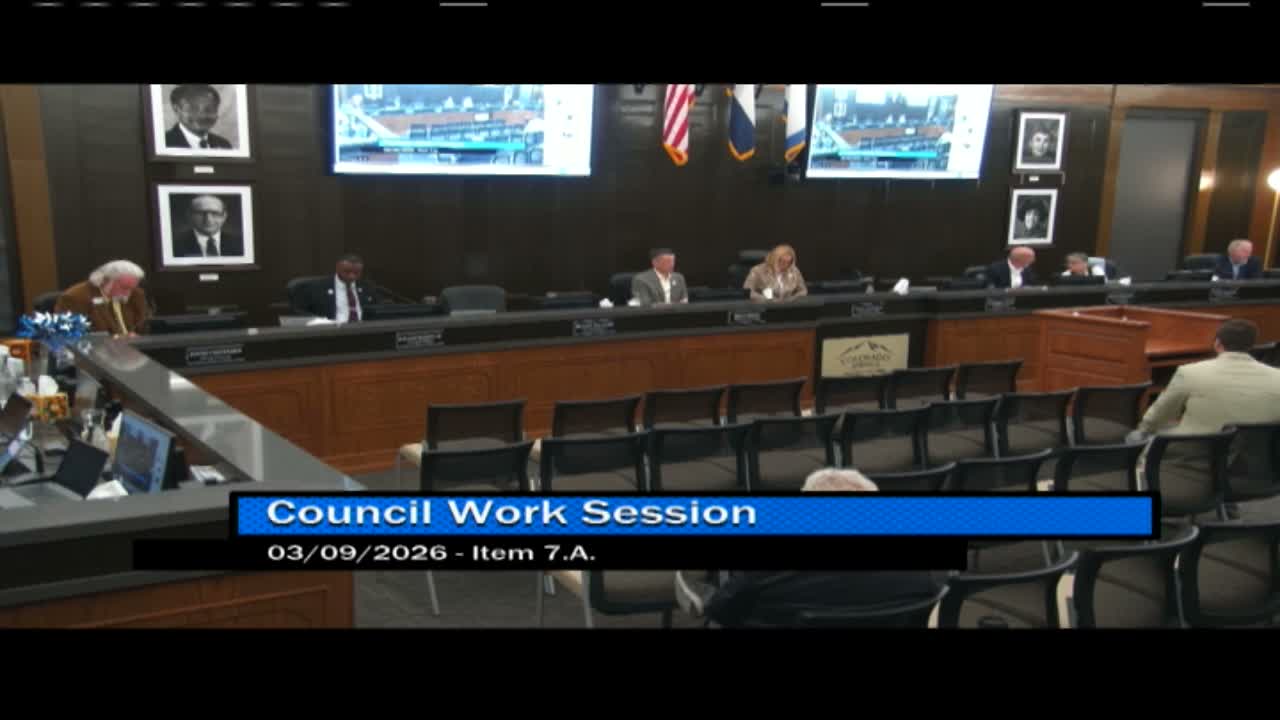
Carolyn, a private attorney with Brownstein Hyatt Farber Schreck, told the City Council on March 9 that tax-increment financing (TIF) and special/metropolitan districts are neutral tools cities can use to finance infrastructure if general revenues are insufficient.
"These tools in and of themselves are value neutral," Carolyn said, explaining she advises both developers and local governments. She outlined the mechanics of TIF — a base valuation is set when an urban renewal plan is adopted, and the net increase in assessed value (the increment) can be pledged to finance public improvements or be borrowed against to attract private investment. She noted the statutory maximum term for tax increment pledges is 25 years.
The presentation emphasized that a legislative finding of blight requires four or more of the statute’s 11 factors across a defined geographic area, and that boundaries should be drawn as narrowly as possible. The presenter also described the post‑2015 statutory regime (House Bill 13‑48) that adds three appointed seats to URA boards and creates a required negotiation (and a mediation/arbitration) process when other taxing entities are asked to cede a portion of property‑tax increment.
Council members pressed the presenter on several technical points. One councilor asked whether TIF was part of the original 1958 urban renewal law; the attorney confirmed the tax‑increment mechanism was added later. Another asked how much discretion the county assessor has in attributing increases to base versus increment; the presenter said assessor guidance and a handbook (chapter 12) govern attribution, though some interpretation can produce disagreements that are sometimes worked out, informally and through the statute’s mediation process.
Jeriah Walker, Executive Director of the Colorado Springs Urban Renewal Authority, answered local questions about an auditorium block planned as a possible overflow beneficiary for URA funds. Walker said the Hyatt Hotel is the only new development in that block so far and that the URA currently draws property‑tax increment (not city sales tax) for that area; the auditorium appears in the URA’s schedule of possible improvements that could receive funds if incremental proceeds exceed earlier obligations.
The briefing also covered special and metropolitan districts (Title 32 entities). The presenter said those districts are local governments that can finance, construct, own, operate and maintain public improvements; a metropolitan district may perform two or more authorized functions while a special district typically serves a single purpose (water, sewer, parks, etc.). She stressed that metro district debt is not the municipality’s debt and is constrained by TABOR and by service‑plan caps the city sets at formation.
Transparency and oversight were a frequent focus. The presenter reviewed statutory disclosure requirements, open‑meetings and public‑records obligations, annual filings to the Department of Local Affairs (DOLA), and real‑estate disclosures that must appear in purchase documents for property inside districts. She noted that board elections are held every two years and that it typically takes several election cycles (an average she termed about eight years for residential districts) for non‑developer‑affiliated residents to gain board seats.
Council members asked about using these tools to address deferred maintenance and parks needs; one member noted the city’s parks infrastructure shortfall is roughly $327,000,000. The presenter suggested model service plans, budget‑committee reviews, fiscal‑impact studies and carefully tailored service‑plan limits as ways to manage risk and increase transparency.
The presentation closed with an offer to make the slide deck and a broader resource list available to council and staff. No formal action was taken; staff indicated follow‑up materials would be provided and the Urban Renewal Authority executive director remains available for project‑specific questions.
"These tools in and of themselves are value neutral," Carolyn said, explaining she advises both developers and local governments. She outlined the mechanics of TIF — a base valuation is set when an urban renewal plan is adopted, and the net increase in assessed value (the increment) can be pledged to finance public improvements or be borrowed against to attract private investment. She noted the statutory maximum term for tax increment pledges is 25 years.
The presentation emphasized that a legislative finding of blight requires four or more of the statute’s 11 factors across a defined geographic area, and that boundaries should be drawn as narrowly as possible. The presenter also described the post‑2015 statutory regime (House Bill 13‑48) that adds three appointed seats to URA boards and creates a required negotiation (and a mediation/arbitration) process when other taxing entities are asked to cede a portion of property‑tax increment.
Council members pressed the presenter on several technical points. One councilor asked whether TIF was part of the original 1958 urban renewal law; the attorney confirmed the tax‑increment mechanism was added later. Another asked how much discretion the county assessor has in attributing increases to base versus increment; the presenter said assessor guidance and a handbook (chapter 12) govern attribution, though some interpretation can produce disagreements that are sometimes worked out, informally and through the statute’s mediation process.
Jeriah Walker, Executive Director of the Colorado Springs Urban Renewal Authority, answered local questions about an auditorium block planned as a possible overflow beneficiary for URA funds. Walker said the Hyatt Hotel is the only new development in that block so far and that the URA currently draws property‑tax increment (not city sales tax) for that area; the auditorium appears in the URA’s schedule of possible improvements that could receive funds if incremental proceeds exceed earlier obligations.
The briefing also covered special and metropolitan districts (Title 32 entities). The presenter said those districts are local governments that can finance, construct, own, operate and maintain public improvements; a metropolitan district may perform two or more authorized functions while a special district typically serves a single purpose (water, sewer, parks, etc.). She stressed that metro district debt is not the municipality’s debt and is constrained by TABOR and by service‑plan caps the city sets at formation.
Transparency and oversight were a frequent focus. The presenter reviewed statutory disclosure requirements, open‑meetings and public‑records obligations, annual filings to the Department of Local Affairs (DOLA), and real‑estate disclosures that must appear in purchase documents for property inside districts. She noted that board elections are held every two years and that it typically takes several election cycles (an average she termed about eight years for residential districts) for non‑developer‑affiliated residents to gain board seats.
Council members asked about using these tools to address deferred maintenance and parks needs; one member noted the city’s parks infrastructure shortfall is roughly $327,000,000. The presenter suggested model service plans, budget‑committee reviews, fiscal‑impact studies and carefully tailored service‑plan limits as ways to manage risk and increase transparency.
The presentation closed with an offer to make the slide deck and a broader resource list available to council and staff. No formal action was taken; staff indicated follow‑up materials would be provided and the Urban Renewal Authority executive director remains available for project‑specific questions.
Don't Miss a Word: See the Full Meeting!
Go beyond summaries. Unlock every video, transcript, and key insight with a Founder Membership.
✓
Get instant access to full meeting videos
✓
Search and clip any phrase from complete transcripts
✓
Receive AI-powered summaries & custom alerts
✓
Enjoy lifetime, unrestricted access to government data
30-day money-back guarantee
