Alaska task force hears that school construction and maintenance needs far outpace available funding
March 09, 2026 | 2026 Legislature Alaska, Alaska
This article was created by AI summarizing key points discussed. AI makes mistakes, so for full details and context, please refer to the video of the full meeting. Please report any errors so we can fix them. Report an error »
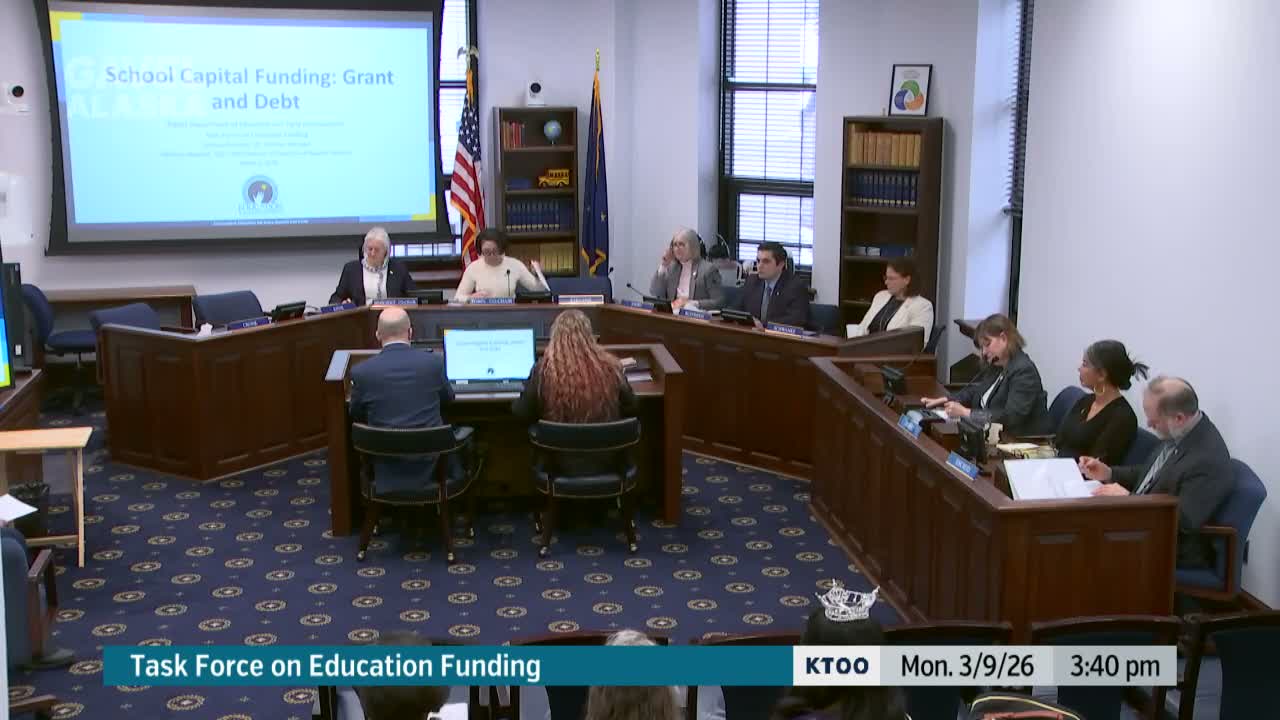
Juneau — At a March 9 meeting of the Joint Legislative Task Force on Education Funding, state officials told lawmakers that Alaska’s school construction and major maintenance needs far exceed current funding streams, leaving districts with persistent deferred maintenance and few clear options to address large projects.
Heather Heineken, director of finance and support services at the Department of Education and Early Development, told the task force that SB 237 requires an annual report on school construction and major maintenance and that, since reporting began, the state has funded approximately $1,780,000,000 in school construction and major maintenance projects. Heineken said DEED’s FY27 list includes a state share request of roughly $423,000,000 for construction and about $400,800,000 for major maintenance, and she emphasized that projects are evaluated using statutorily defined scoring criteria.
“Students can only learn effectively in environments that are safe, functional, and well maintained,” Heineken said, arguing that school facilities play a critical role in supporting learning.
Alexi Painter of the Legislative Finance Division contrasted two funding pathways: the school bond debt reimbursement program and the school construction/major maintenance grant program. Painter noted a moratorium on the debt program that lasted more than a decade and ended June 30, 2025, and said reimbursement rates have declined from earlier levels to current rates of roughly 40–50 percent for eligible projects. He warned that because state payments are subject to annual appropriation and have been short‑funded in several recent years, some municipalities remain reluctant to reenter the debt program.
“The timing and consistency of state payments has made municipalities wary of taking on new debt,” Painter said, noting the state has sometimes shorted statutory debt payments and later provided supplemental payments.
Painter also presented a broader funding picture: DEED and Legislative Finance estimate the insured value of school facilities at about $12.5 billion. Using a commonly recommended 3 percent capital‑renewal benchmark would imply roughly $376 million annually needed for capital renewal; Painter said FY26 funding for the state programs amounted to about $28.9 million, or roughly 7.7 percent of that 3 percent target.
Members focused on program mechanics that can disadvantage smaller or under‑resourced districts. Heineken and DEED facilities manager Michael Budicoffer explained that condition surveys—sometimes more than 400 pages and prepared by industry consultants—can materially strengthen an application but typically cost $200,000 to $300,000 to produce. Those surveys are reimbursable only when a project is later approved, creating financial risk for districts that front the cost.
“You can see how districts with limited staff and funds might choose not to apply,” Heineken said, noting DEED hears that the application process can be “complicated and expensive.” Budicoffer added that DEED conducts site visits on a roughly five‑year cycle but typically inspects only two or three facilities during each district visit and does not perform a full condition assessment on every school.
Lawmakers pressed for clarifications on the REA (Regional Education Attendance Area) fund, unobligated caps, and how state appropriations are calculated. Painter said the REA fund is tied to outstanding school debt and has decreased as debt has been paid down; he said the fund recently was “just under $20,000,000,” and noted a statutory unobligated cap of $70,000,000 that can limit the fund’s usefulness for very large construction projects unless funds are phased.
The task force did not take formal action. Co‑Chair Senator Luca Gil Tobin said members would follow up with DEED and Legislative Finance and scheduled another joint education meeting on March 11 to receive the State Board of Education’s annual report.
What happens next: Task force members said they will collect follow‑up information from DEED on fund balances, BRGR committee membership, and the statutory details of participating share and condition‑survey validity.
Heather Heineken, director of finance and support services at the Department of Education and Early Development, told the task force that SB 237 requires an annual report on school construction and major maintenance and that, since reporting began, the state has funded approximately $1,780,000,000 in school construction and major maintenance projects. Heineken said DEED’s FY27 list includes a state share request of roughly $423,000,000 for construction and about $400,800,000 for major maintenance, and she emphasized that projects are evaluated using statutorily defined scoring criteria.
“Students can only learn effectively in environments that are safe, functional, and well maintained,” Heineken said, arguing that school facilities play a critical role in supporting learning.
Alexi Painter of the Legislative Finance Division contrasted two funding pathways: the school bond debt reimbursement program and the school construction/major maintenance grant program. Painter noted a moratorium on the debt program that lasted more than a decade and ended June 30, 2025, and said reimbursement rates have declined from earlier levels to current rates of roughly 40–50 percent for eligible projects. He warned that because state payments are subject to annual appropriation and have been short‑funded in several recent years, some municipalities remain reluctant to reenter the debt program.
“The timing and consistency of state payments has made municipalities wary of taking on new debt,” Painter said, noting the state has sometimes shorted statutory debt payments and later provided supplemental payments.
Painter also presented a broader funding picture: DEED and Legislative Finance estimate the insured value of school facilities at about $12.5 billion. Using a commonly recommended 3 percent capital‑renewal benchmark would imply roughly $376 million annually needed for capital renewal; Painter said FY26 funding for the state programs amounted to about $28.9 million, or roughly 7.7 percent of that 3 percent target.
Members focused on program mechanics that can disadvantage smaller or under‑resourced districts. Heineken and DEED facilities manager Michael Budicoffer explained that condition surveys—sometimes more than 400 pages and prepared by industry consultants—can materially strengthen an application but typically cost $200,000 to $300,000 to produce. Those surveys are reimbursable only when a project is later approved, creating financial risk for districts that front the cost.
“You can see how districts with limited staff and funds might choose not to apply,” Heineken said, noting DEED hears that the application process can be “complicated and expensive.” Budicoffer added that DEED conducts site visits on a roughly five‑year cycle but typically inspects only two or three facilities during each district visit and does not perform a full condition assessment on every school.
Lawmakers pressed for clarifications on the REA (Regional Education Attendance Area) fund, unobligated caps, and how state appropriations are calculated. Painter said the REA fund is tied to outstanding school debt and has decreased as debt has been paid down; he said the fund recently was “just under $20,000,000,” and noted a statutory unobligated cap of $70,000,000 that can limit the fund’s usefulness for very large construction projects unless funds are phased.
The task force did not take formal action. Co‑Chair Senator Luca Gil Tobin said members would follow up with DEED and Legislative Finance and scheduled another joint education meeting on March 11 to receive the State Board of Education’s annual report.
What happens next: Task force members said they will collect follow‑up information from DEED on fund balances, BRGR committee membership, and the statutory details of participating share and condition‑survey validity.
Don't Miss a Word: See the Full Meeting!
Go beyond summaries. Unlock every video, transcript, and key insight with a Founder Membership.
✓
Get instant access to full meeting videos
✓
Search and clip any phrase from complete transcripts
✓
Receive AI-powered summaries & custom alerts
✓
Enjoy lifetime, unrestricted access to government data
30-day money-back guarantee
