Senate committee hears contested bill to limit heavy fuel oil discharges in Alaska waters; scientists and industry debate costs and regulatory overlap
March 09, 2026 | 2026 Legislature Alaska, Alaska
This article was created by AI summarizing key points discussed. AI makes mistakes, so for full details and context, please refer to the video of the full meeting. Please report any errors so we can fix them. Report an error »
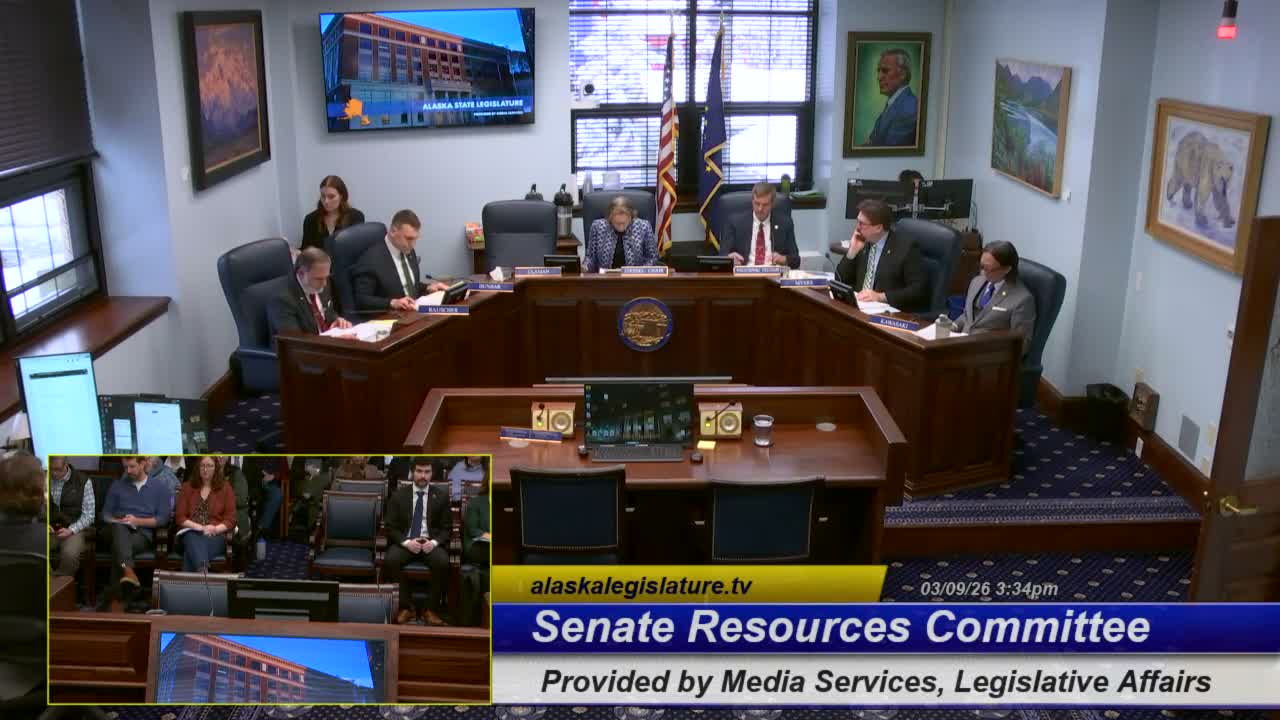
Senate Bill 253 drew extended testimony on March 9 as the Senate Resources Committee heard arguments over whether Alaska should restrict heavy fuel oil use and scrubber washwater discharges in certain state waters.
Sponsor Sen. Jesse Kiel said the bill targets the ‘‘most important, most heavily used waters’’ where discharges from exhaust gas cleaning systems (scrubbers) and burning heavy fuel oil could harm fisheries and coastal communities. Kiel explained the bill is not a blanket ban: it exempts vessels in innocent passage and ships that call only once in an Alaska port, and allows an exemption if a vessel captures scrubber washwater and offloads it shore‑side outside Alaska.
Kiel told the committee that heavy fuel oil contains polycyclic aromatic hydrocarbons (PAHs), soot (black carbon), and metals such as arsenic, cadmium, chromium and copper. He said scrubbers can move those contaminants from air to water, potentially harming early life stages of fish and shellfish.
Scientific testimony underscored that concern. Dr. Stanley Rice, Professor Emeritus, described long‑term studies and experiments linking very low parts‑per‑billion PAH exposures to reduced salmon embryo survival and lower adult returns, saying an exposure of about 5 ppb resulted in roughly a 20% reduction in adult returns in his laboratory work. Rice warned that chronic and repeated discharges overlapping important life stages could affect salmon, herring and shellfish populations.
Environmental advocates pressed the economic and compliance arguments. Maggie Rabe, executive director of the Southeast Alaska Conservation Council, said SEAC’s analysis of industry and EPA self‑reporting shows most HFO use in Alaska waters comes from the cruise industry and that 18 cruise ships self‑reported alleged violations 700 times during 2023–24. SEAC’s economists estimated the incremental cost of switching to cleaner marine fuel in Alaska waters at about $3.50 per passenger per day.
Industry witnesses pushed back. Donald Brown, Senior Vice President for Maritime Policy at Cruise Lines International Association (CLIA), said the industry supports emissions reductions but warned SB 253 risks duplicating or conflicting with international and federal requirements established under the International Maritime Organization (IMO), MARPOL Annex VI and the United States’ implementation of the North America Emissions Control Area. Brown argued that authorized technologies such as exhaust gas cleaning systems (EGCS) are recognized as equivalent solutions under international rules and that Alaska should use IMO risk‑assessment guidance before imposing additional restrictions.
Valerie Chatterley, an environmental consultant on the phone supporting industry witnesses, offered technical clarifications about ship fuel systems and scrubber configurations, noting many ships carry dual fuel tanks and some are LNG capable.
Committee members raised cost and coverage questions: how much more expensive cleaner fuels would be, which vessel classes the bill would affect (large cruise vessels, some container ships, tankers, and fewer tugs/barges), and why Alaska should act where international and federal rules already regulate sulfur in air. Sponsor Kiel responded that the North American ECA addresses air emissions but does not govern water discharges, and that the bill focuses on inside waters with limited mixing where scrubber washwater could pose particular risk.
No committee vote occurred on SB 253 at this hearing; the chair set the bill aside after testimony. Kiel offered to provide follow‑up information requested by members, including in‑state bunkering locations and more detailed fleet data.
What’s next: the committee will consider further information and may call additional witnesses or amendments in later meetings.
Sponsor Sen. Jesse Kiel said the bill targets the ‘‘most important, most heavily used waters’’ where discharges from exhaust gas cleaning systems (scrubbers) and burning heavy fuel oil could harm fisheries and coastal communities. Kiel explained the bill is not a blanket ban: it exempts vessels in innocent passage and ships that call only once in an Alaska port, and allows an exemption if a vessel captures scrubber washwater and offloads it shore‑side outside Alaska.
Kiel told the committee that heavy fuel oil contains polycyclic aromatic hydrocarbons (PAHs), soot (black carbon), and metals such as arsenic, cadmium, chromium and copper. He said scrubbers can move those contaminants from air to water, potentially harming early life stages of fish and shellfish.
Scientific testimony underscored that concern. Dr. Stanley Rice, Professor Emeritus, described long‑term studies and experiments linking very low parts‑per‑billion PAH exposures to reduced salmon embryo survival and lower adult returns, saying an exposure of about 5 ppb resulted in roughly a 20% reduction in adult returns in his laboratory work. Rice warned that chronic and repeated discharges overlapping important life stages could affect salmon, herring and shellfish populations.
Environmental advocates pressed the economic and compliance arguments. Maggie Rabe, executive director of the Southeast Alaska Conservation Council, said SEAC’s analysis of industry and EPA self‑reporting shows most HFO use in Alaska waters comes from the cruise industry and that 18 cruise ships self‑reported alleged violations 700 times during 2023–24. SEAC’s economists estimated the incremental cost of switching to cleaner marine fuel in Alaska waters at about $3.50 per passenger per day.
Industry witnesses pushed back. Donald Brown, Senior Vice President for Maritime Policy at Cruise Lines International Association (CLIA), said the industry supports emissions reductions but warned SB 253 risks duplicating or conflicting with international and federal requirements established under the International Maritime Organization (IMO), MARPOL Annex VI and the United States’ implementation of the North America Emissions Control Area. Brown argued that authorized technologies such as exhaust gas cleaning systems (EGCS) are recognized as equivalent solutions under international rules and that Alaska should use IMO risk‑assessment guidance before imposing additional restrictions.
Valerie Chatterley, an environmental consultant on the phone supporting industry witnesses, offered technical clarifications about ship fuel systems and scrubber configurations, noting many ships carry dual fuel tanks and some are LNG capable.
Committee members raised cost and coverage questions: how much more expensive cleaner fuels would be, which vessel classes the bill would affect (large cruise vessels, some container ships, tankers, and fewer tugs/barges), and why Alaska should act where international and federal rules already regulate sulfur in air. Sponsor Kiel responded that the North American ECA addresses air emissions but does not govern water discharges, and that the bill focuses on inside waters with limited mixing where scrubber washwater could pose particular risk.
No committee vote occurred on SB 253 at this hearing; the chair set the bill aside after testimony. Kiel offered to provide follow‑up information requested by members, including in‑state bunkering locations and more detailed fleet data.
What’s next: the committee will consider further information and may call additional witnesses or amendments in later meetings.
Don't Miss a Word: See the Full Meeting!
Go beyond summaries. Unlock every video, transcript, and key insight with a Founder Membership.
✓
Get instant access to full meeting videos
✓
Search and clip any phrase from complete transcripts
✓
Receive AI-powered summaries & custom alerts
✓
Enjoy lifetime, unrestricted access to government data
30-day money-back guarantee
